Understanding IACUC Protocol Submission for Animal Studies
At the heart of preclinical innovation, every research team conducting animal studies must submit a comprehensive IACUC protocol before initiating any experimental activity. Written by professionals with over 20 years of hands-on large animal model experience, this guide walks you through every critical element — from 3Rs justification to humane endpoints — that shapes both your approval timeline and the scientific credibility of your study.
✔ Ethical Approval Specialists
✔ Regulatory-Ready Protocols
Expert Insight
The single most common reason an IACUC protocol is returned for revision is not insufficient science — it is internal inconsistency. Reviewers routinely cross-check your animal numbers against your statistical power section, your pain category against your analgesia plan, and your procedures against your monitoring schedule. Investing two hours in a cross-check before submission routinely saves four to eight weeks of revision cycles.
What Is the IACUC and Why Is It Important?
The Institutional Animal Care and Use Committee (IACUC) — often referred to as an animal ethics committee — is the body responsible for granting ethical approval for animal research. It ensures that all work complies with legal and ethical standards, safeguarding animal welfare while enabling meaningful scientific advancement. Its role bridges regulatory compliance with day-to-day laboratory practice.
The institutional animal care committee reviews scientific justification, adherence to the 3Rs principles, animal welfare provisions, pain relief strategies, humane endpoints, staff competency, and housing conditions. Approval is mandatory before any research, teaching, or testing activity commences, and the completeness of the submission directly shapes both the timeline and the scientific credibility of the study.
???? Scientific Review
Evaluates study design, justification, and whether objectives cannot be achieved with alternatives.
???? Animal Welfare
Assesses housing, enrichment, monitoring frequency, pain management, and humane endpoints.
???? Regulatory Compliance
Ensures alignment with Israeli law, institutional policy, and international standards such as the 3Rs.
Step-by-Step Guide to IACUC Protocol Submission
Researchers typically submit their IACUC protocol through an institutional online system with defined monthly or bi-weekly deadlines. The submission first undergoes an administrative pre-review to check formatting, completeness, and adherence to basic institutional guidelines. Once cleared, it is assigned to one or more committee members for detailed scientific and ethical evaluation, leading to approval, conditional approval, or a request for revisions.
What Happens After You Click “Submit”?
After submission, an administrative officer verifies that every required section is present and that supporting documents — facility approvals, staff training records, funding alignment — are attached. Reviewers are then assigned based on expertise: typically a veterinarian, a scientist, and a non-scientific member, each providing structured feedback on distinct aspects of the protocol.
Step 1: Submit
Upload complete protocol with all required attachments through the institutional online portal before the deadline.
Step 2: Pre-Review
Administrative staff verify completeness, formatting, and attachment of supporting documents such as training records.
Step 3: Committee Review
Assigned reviewers evaluate scientific merit, animal welfare, 3Rs compliance, and provide structured feedback.
Step 4: Decision
Outcome: full approval, conditional approval with revisions required, or return for substantial revision.
Which Key Components Accelerate Fast IACUC Approval?
To expedite ethical approval for animal research, your protocol must clearly describe every procedure, provide strong scientific justification, present a well-reasoned animal number calculation, detail a robust pain management plan, specify humane endpoints, and outline a monitoring strategy. IACUC committees consistently prioritize clarity and internal consistency over stylistic polish.
Essential Fields for Your IACUC Ethics Submission
A complete submission should address each of the following fields. Each must be internally consistent with the others, since reviewers routinely cross-check procedures against animal numbers and pain categories.
- Research objective and specific aims
- Animal model justification with alternative models considered
- Detailed experimental procedures with dosages, frequencies, and durations
- Animal number justification supported by power analysis
- Pain and distress assessment linked to procedure severity
- Clearly defined, actionable humane endpoints
- Monitoring plans, staff competency records, and contingency procedures
Vague language, undefined dosages, unclear frequencies, missing exclusion criteria, and inconsistencies between the protocol and the underlying work plan. Resolve all cross-references before submission to avoid multi-cycle reviews.
Scenario: A Small Team Preparing Its First Cardiology Study
Coronary Stenting Study in Porcine Model
A small preclinical team planned a coronary stenting study in a porcine model. Their first draft described the surgical procedure in detail but omitted post-operative analgesia intervals and exclusion criteria for animals that fail to recover.
The committee returned the protocol with three requests:
- Define analgesic dosing windows precisely
- Clarify the humane endpoint threshold for post-surgical weight loss
- Reconcile the animal number (n=12) with the statistical power section (which assumed n=10)
A revised version addressing each point line-by-line was approved within one review cycle — illustrating how targeted revision beats broad rewriting.
Justifying Animal Use Through the 3Rs Framework
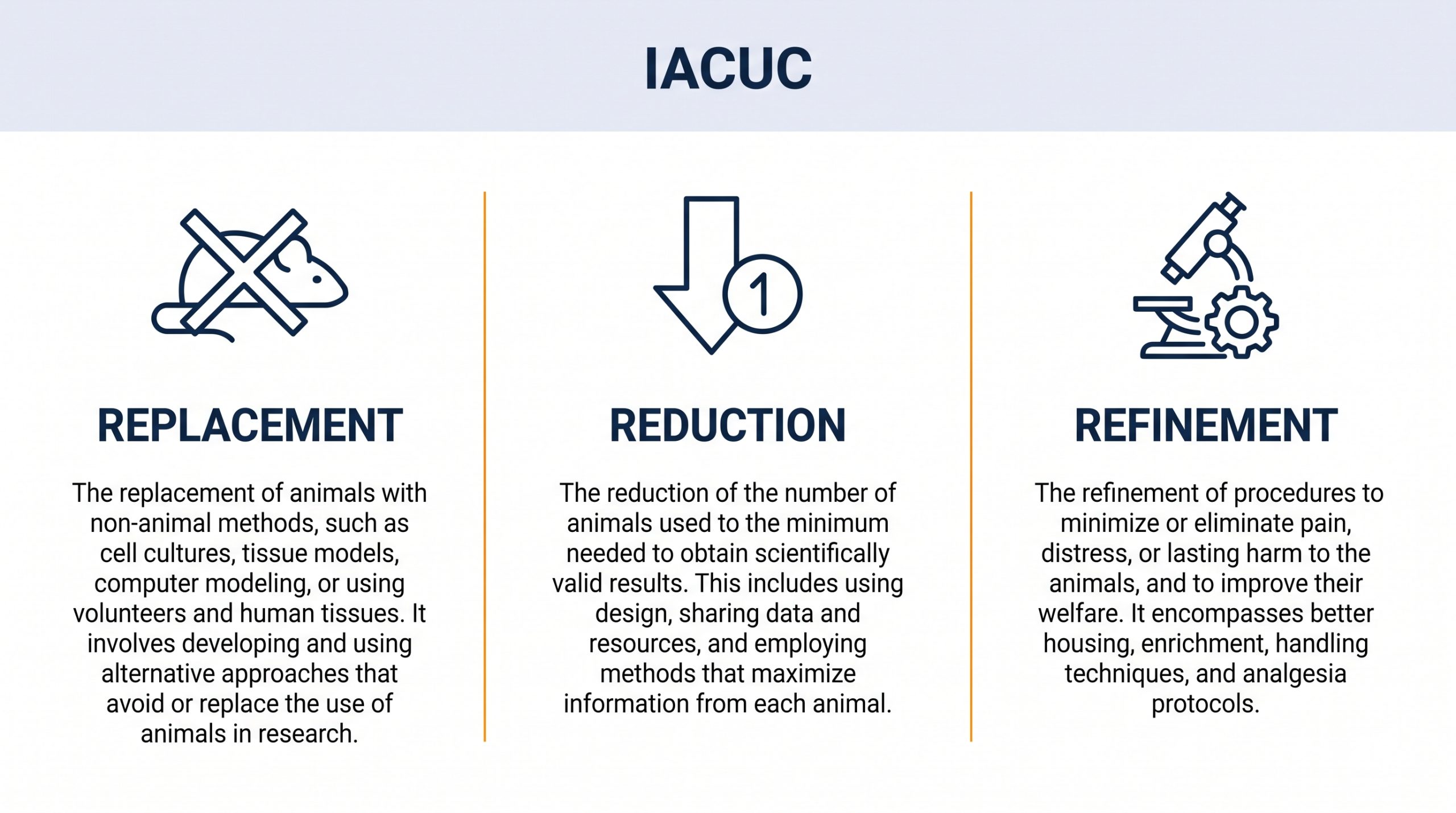
Your IACUC protocol must demonstrate adherence to the 3Rs: Replacement, Reduction, and Refinement. These are a cornerstone of the animal ethics committee review and are increasingly enforced by regulatory guidance in Israel and internationally.
Replacement
Discuss alternative models (in vitro assays, computational models, lower phylogenetic species) considered and why they were insufficient for translational validity.
Reduction
Outline the experimental design and statistical considerations minimizing animal numbers without compromising scientific validity.
Refinement
Detail analgesia protocols, environmental enrichment, habituation training, and less invasive imaging or sampling techniques such as high-definition ultrasound.
Effective Wording for 3Rs Justification
Effective 3Rs language demonstrates thorough consideration of alternatives with references, provides numerical justification for group sizes, and specifies procedural refinements such as use of high-definition ultrasound instead of terminal sampling. Avoid boilerplate language — reviewers recognize copy-paste text immediately.
“The 3Rs are not a checkbox exercise — they are a demonstration of scientific maturity. Reviewers can immediately distinguish between a team that genuinely considered alternatives and one that inserted a templated paragraph.”
— Adir Koreh, CEO, Biotech Farm Ltd.
How to Justify Animal Numbers, Sample Size, and Power
Animal numbers in your IACUC ethics submission must be justified through statistical power calculations or a clearly reasoned experimental rationale, avoiding unnecessary groups and redundant replication. Common errors include arbitrary numbers (“we always use 10”) and inconsistencies between the protocol and the funding proposal or work plan.
Where pilot data is unavailable, propose reasonable ranges based on published literature, use conservative assumptions, and outline a plan for interim analysis and protocol amendment if early results warrant recalibration.
- State the primary endpoint clearly
- Specify expected effect size with literature citation
- Define variance (SD or CV) from a comparable published study
- Set alpha (0.05) and desired power (0.80 minimum)
- Ensure group sizes in protocol match the power calculation exactly
Managing Pain and Distress Through Anesthesia and Analgesia
Your IACUC protocol must meticulously describe anticipated pain and distress, specifying drugs, dosages, administration times, responsible personnel, monitoring methods, and escalation procedures for treatment or humane removal from study. Reviewers look for a consistent narrative linking procedure, expected pain category, treatment plan, monitoring frequency, and defined endpoints.
Regulatory guidance in Israel emphasizes careful anesthesia and analgesia planning to minimize suffering at every stage of the research process.
Justifying the Omission of Pain Relief for Scientific Reasons
If scientific justification for withholding analgesia is necessary — for example, when analgesics would confound the study endpoint — provide detailed rationale, cite supporting literature, and outline alternative mitigation methods such as shorter procedure durations, non-invasive monitoring, and earlier humane endpoints. Such requests undergo rigorous scrutiny by the animal ethics committee.
Generic name, dose per kg, route of administration
Pre-, intra-, and post-operative intervals specified
Named scoring system (e.g., grimace scale), monitoring frequency
Threshold score triggering additional treatment or euthanasia
Defining and Implementing Humane Endpoints
Humane endpoints are predefined criteria for terminating a procedure, removing an animal from study, or performing humane euthanasia. Examples include weight loss beyond a defined threshold, persistent pain signs unresponsive to treatment, specific clinical or behavioral indicators, or tumor size exceeding a maximum limit. Clear endpoints are essential for animal welfare and shorten the review by preempting reviewer questions.
Recommended Threshold Structure for Humane Endpoints
| Clinical Sign | Threshold | Immediate Action | Approving Authority | Documentation |
|---|---|---|---|---|
| Body weight loss | ≥20% from baseline | Euthanasia | Attending veterinarian | Daily weight chart |
| Persistent pain despite analgesia | Score ≥3/4 for 24h | Additional analgesia or euthanasia | Veterinarian + PI | Pain scoring sheet |
| Tumor burden | >1.5 cm diameter (mice) / defined limit | Euthanasia | PI + veterinarian | Caliper measurement log |
| Post-surgical complication | Non-recovery within 24–48h | Veterinary intervention or euthanasia | Attending veterinarian | Recovery monitoring form |
IACUC Approval Timeline: What to Expect
The time to receive ethical approval for animal research varies by institution and review type. A clear, complete IACUC protocol submission can be approved within a few weeks, while ambiguous submissions may take months due to multiple revision cycles. Timelines depend on submission deadlines, committee workload, whether full committee review or designated member review applies, and the researcher’s responsiveness.
Planning backwards from the intended start date — including buffer for at least one revision round — is a practical rule of thumb for large animal studies requiring 8–12 weeks lead time.
Complete, internally consistent protocol with no queries from reviewers.
One revision cycle required to address targeted reviewer questions.
Multiple revision cycles due to vague language, missing sections, or internal inconsistencies.
Comparing Amendment, Renewal, and New Submission
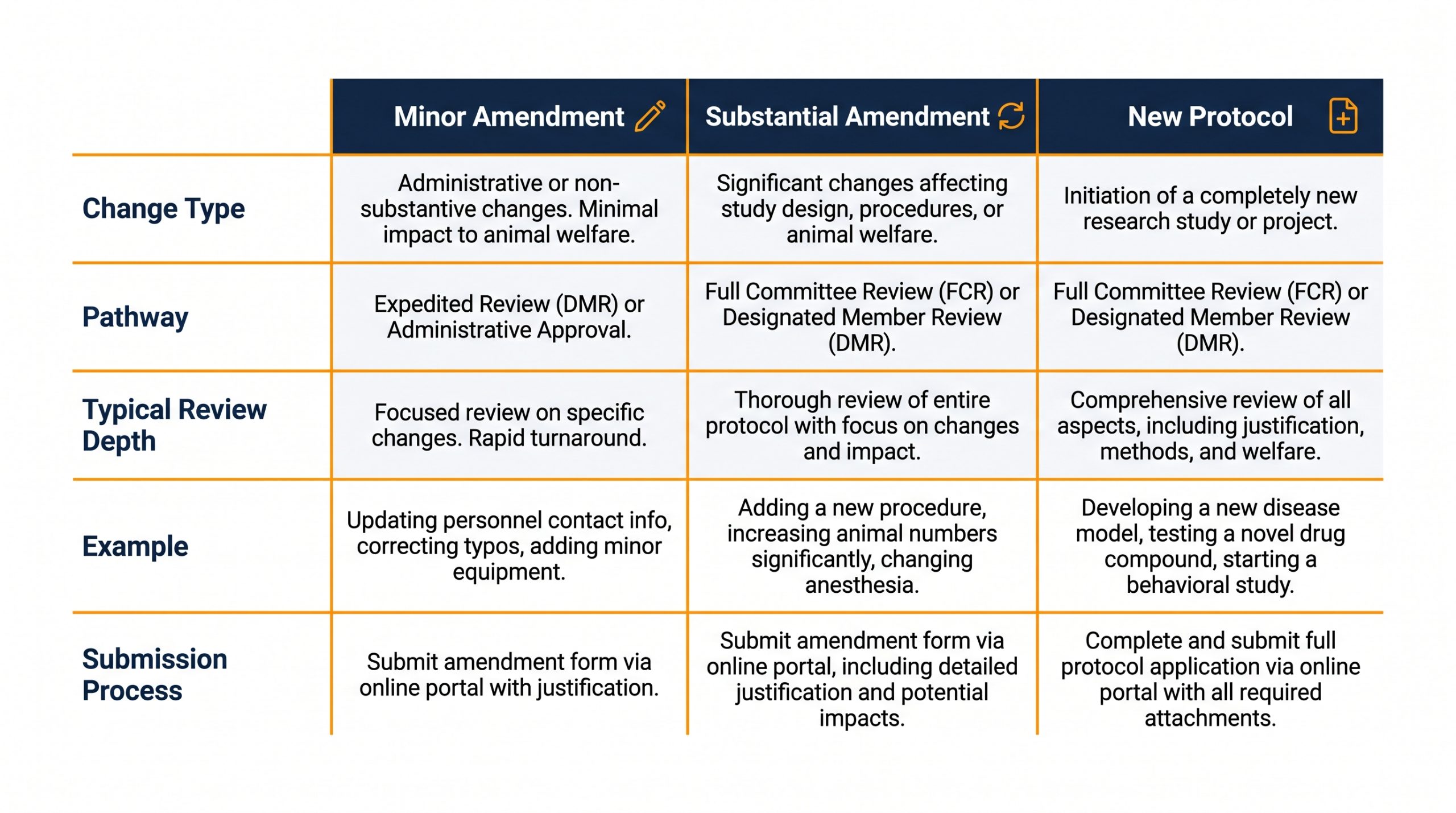
Not every change requires a new protocol. An Amendment modifies an already approved IACUC protocol submission; a Renewal is a periodic re-evaluation of an ongoing project; and a new protocol is required for genuinely new research or substantial modifications. The Israeli official submission form explicitly requires investigators to commit to reporting any changes as amendments to the animal ethics committee.
| Change Type | Pathway | Typical Review Depth | Example |
|---|---|---|---|
| Adding trained personnel | Minor Amendment | Administrative | New surgical assistant with documented training |
| Change of facility room | Minor Amendment | Administrative | Move within same approved facility |
| New invasive procedure | Substantial Amendment | Full committee | Adding pericardial approach |
| Higher pain category | Substantial Amendment | Full committee | Shift from Category C to D/E |
| New species or aim | New Protocol | Full committee | Adding sheep model to a pig study |
How a Full-Service Preclinical Facility Simplifies the Process
Working with a fully equipped preclinical partner reduces the administrative burden that often derails IACUC protocol submission. A facility with state-of-the-art surgical suites — C-Arm fluoroscopy, high-definition ultrasound, echocardiography probes, and 4K laparoscopic towers — can supply the detailed equipment descriptions reviewers expect, drawn from validated internal standard operating procedures.
Biotech Farm’s approach emphasizes matching services to study needs, providing scientific escort throughout protocol drafting, and documenting procedures in a manner that anticipates reviewer questions. Transparency in collaboration and well-documented procedures translate into fewer revision cycles. To understand more about the regulatory framework governing institutional animal care, remember that IACUC approval is essential before beginning any animal research.
Business Needs Mapped to Facility Capabilities
| Business Need | How a Supportive Facility Helps in Practice |
|---|---|
| Drafting a defensible protocol | Scientific escort experienced in large animal models contributes precise procedural language |
| Justifying animal numbers | Access to historical variability data from similar large animal studies |
| Demonstrating refinement | Documented use of imaging (OCT, echocardiography) instead of terminal sampling |
| Staff competency documentation | Senior surgeons and trained crew with existing training records spanning a decade |
| Facility description appendix | Pre-written descriptions of surgical rooms, animal housing, and welfare practices |
| Handling amendments efficiently | Structured change logs aligned with regulatory expectations |
“When a research team comes to us with a protocol draft, we treat the IACUC submission as a shared responsibility. Our 20+ years of documented procedures, trained personnel, and validated SOPs become part of their submission — and that translates directly into faster approvals.”
— Adir Koreh, CEO, Biotech Farm Ltd. & Biotech Anatomy Ltd.
Common Reasons Protocols Get Rejected — And How to Avoid Them
The most frequent causes for a protocol to be sent back are lack of detail, insufficient justification, internal inconsistencies, and the absence of a comprehensive monitoring plan, pain relief strategy, or defined humane endpoints. Official Israeli guidance emphasizes that any deviation from established standards must be accompanied by clear scientific justification.
Inconsistent Numbers
Animal numbers in the experimental groups do not match the statistical power section or the funding proposal.
Undefined Procedures
Procedures described without specific dosages, frequencies, durations, or responsible personnel names.
Missing Endpoints
No predefined, actionable humane endpoints or termination criteria for complications.
Boilerplate 3Rs
Copy-paste 3Rs language that fails to demonstrate genuine consideration of alternatives for the specific study design.
Pre-Submission Checklist
Before clicking submit, verify each item below is addressed and internally consistent:
- ✔ Every procedure has dosages, frequencies, and durations
- ✔ Scientific justification is specific and cites literature
- ✔ Animal numbers match the power calculation exactly
- ✔ Pain management plan matches procedure severity and pain category
- ✔ Humane endpoints are specific, measurable, and actionable
- ✔ Monitoring schedule is sufficient for the pain category
- ✔ Personnel qualifications and training records are stated and attached
- ✔ Internal contradictions resolved; protocol matches grant work plan
- ✔ All supplementary documents and appendices are attached
- ✔ Contingency plan for complications exists and is described
For a direct reference on the required paperwork, review a sample IACUC Protocol Form to ensure completeness. Detailed guidance on achieving IACUC Compliance outlines the key steps to full approval. Before initiating any research, formal Protocol Approval from the IACUC is always required.
Frequently Asked Questions
Ready to Move Your Preclinical Study Forward?
Which section of your IACUC protocol is currently slowing down your approval — the animal number justification, the pain management plan, or the facility description? A supportive preclinical partner can help you close the gaps before submission and reduce revision cycles.