
Preclinical Regulatory Strategy Consulting: Building a Defensible Path to First-in-Human
At the intersection of scientific discovery and regulatory reality, preclinical regulatory strategy consulting shapes how a molecule, biologic, gene therapy, or medical device transitions from the bench toward human trials. Drawing on decades of hands-on experience in leading and managing translational research, this discipline transforms scattered nonclinical data into a coherent, submission-ready package — running the right studies, in the right sequence, with endpoints that answer the questions regulators will inevitably ask.
Expert Regulatory Insight
A well-structured preclinical regulatory strategy does not just satisfy agency checklists — it actively de-risks development, protects timelines, and preserves capital. The most defensible IND packages are those where every study choice is traceable to a specific regulatory question. Done well, this discipline turns nonclinical data into a compelling regulatory narrative that carries authority from the bench to the boardroom.
What is Preclinical Regulatory Strategy Consulting?
Preclinical regulatory strategy consulting is an advisory service that builds a regulatory roadmap spanning the entire nonclinical phase — from discovery-stage decisions to IND-enabling package delivery. Its core purpose is readiness: readiness to interact with agencies, readiness to submit, and readiness to defend every study choice with a scientifically grounded rationale.
The service integrates three planning layers — scientific, regulatory, and operational — so that laboratory outputs translate into a compliant, compelling submission. Typical clients include biotech startups preparing their first IND, pharmaceutical sponsors expanding into new indications, academic spinouts, gene therapy developers, and medical device manufacturers seeking convergence between preclinical evidence and regulatory expectations across multiple jurisdictions.
Preclinical vs. Nonclinical: A Distinction That Matters in Documentation
Although “preclinical” and “nonclinical” are used interchangeably in casual conversation, regulatory documentation is unambiguous: nonclinical is the formal term. It encompasses all data not generated in human subjects — toxicology, pharmacokinetics, safety pharmacology, biodistribution, and pharmacodynamics. Submissions, review divisions, and CTD sections (Module 4) consistently use “nonclinical.”
???? Documentation Tip: Aligning internal terminology from the earliest planning stages prevents inconsistencies in study reports, briefing documents, and summaries. A mismatch between what a sponsor calls a study and how a reviewer classifies it can slow down review cycles and create confusion during meeting exchanges.
Why a Robust Preclinical Regulatory Strategy is Essential
Early strategic decisions — species selection, dose range, GLP versus non-GLP designation, duration, and endpoints — cascade into every subsequent submission. A poorly justified species choice or an underpowered toxicology design can force expensive repeat studies or, worse, create a data “hole” that surfaces during agency review.
De-Risk Development
Anticipates decision points and benchmarks against ICH and FDA expectations before costly mistakes occur.
Protect Timelines
Avoids redundant experiments and ensures GLP capacity is reserved for pivotal studies.
Preserve Capital
Ensures each study contributes meaningfully to the regulatory narrative — no costly detours.
When Should Sponsors Engage Regulatory Strategy Consulting?
Timing is everything. The most valuable engagement points cluster around inflection moments:
- Once a lead candidate is nominated and a clear mechanism of action is established
- At the initiation of IND-enabling study planning, before any formal FDA interaction
- When changing indication, introducing a new formulation, or scaling up manufacturing
- When entering a global program requiring EMA alignment alongside FDA strategy
⚠️ Critical Timing Warning: Waiting until studies are underway — or worse, completed — narrows the options for course correction significantly. Early engagement enables sponsors to justify what to include and, equally important, what to defensibly leave out of the package.
What Nonclinical Regulatory Planning Actually Entails
Nonclinical regulatory planning translates regulatory goals into a concrete sequence of studies, documents, and scientific justifications. It defines success criteria for each study, identifies risks, and establishes contingency logic if data trend unfavorably.
Typical deliverables include:
Nonclinical Regulatory Strategy Document
Gap Analysis vs. Agency Expectations
Curated Meeting Questions with Rationale
IND-Enabling Study Plan with GLP Sequencing
CTD Module 4-Aligned Nonclinical Summary Templates
For a deeper dive into GLP frameworks that underpin these deliverables, see the GLP compliance CRO requirements guide.
Mapping Business Needs to Regulatory Support
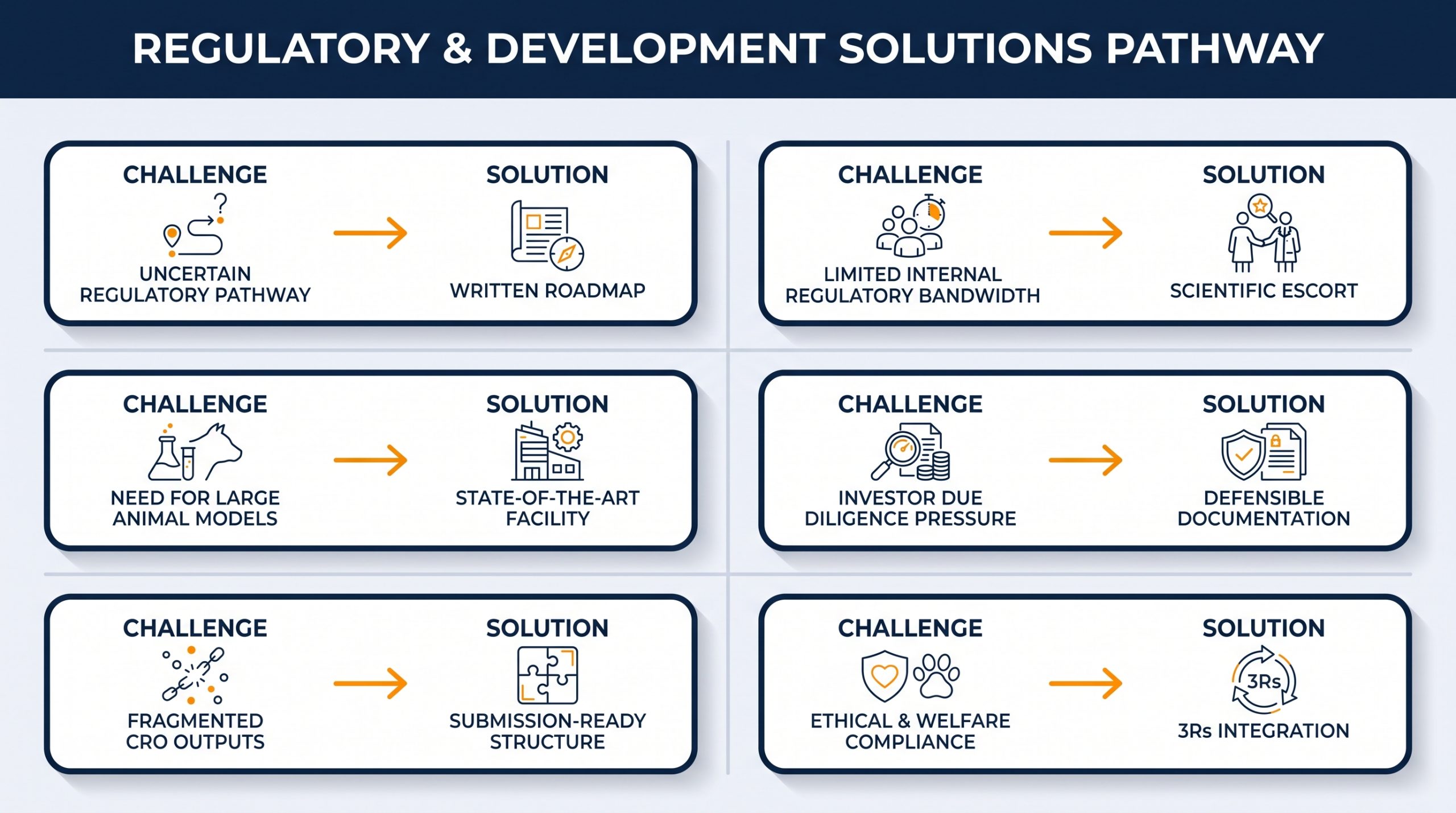
Sponsors often struggle to translate operational pain points into concrete advisory scopes. The table below maps common needs to how a well-structured preclinical program addresses them in practice.
| Business Need | How Strategic Preclinical Support Helps |
|---|---|
| Uncertain regulatory pathway | Delivers a written roadmap aligning ICH, FDA, and EMA expectations to the specific modality |
| Limited internal regulatory bandwidth | Provides scientific escort from study design through report finalization |
| Need for large animal models | Access to a state-of-the-art facility supporting cardiology, ophthalmology, orthopedics, and more |
| Investor due diligence pressure | Generates defensible documentation suitable for board and diligence review |
| Fragmented CRO outputs | Consolidates protocols and reports into submission-ready structure |
| Ethical and welfare compliance | Integrates the 3Rs — Replacement, Reduction, Refinement — into study design |
Working Effectively with a Regulatory Strategy CRO
The consultant defines the strategy, priorities, and regulatory questions each study must answer. The CRO executes those studies under GLP or fit-for-purpose conditions and delivers reports. The critical connection between these roles is regulatory utility: a beautifully executed study that fails to address a reviewer’s core question is a costly detour.
Common pitfalls include protocols that omit key endpoints, misalignment between nonclinical timing and early clinical plans, and reports that require substantial rewriting before insertion into a submission. Selecting a partner with integrated scientific-regulatory literacy — and referencing resources such as FDA preclinical study guidance — mitigates these risks.
Signs of Good Collaboration
- Protocols reviewed by both scientific and regulatory eyes before finalization
- Interim data trigger structured decision points with documented rationale
- Final reports arrive with defensible discussion sections ready for submission
- CRO can articulate why each endpoint exists in regulatory terms, not only scientific ones
Designing an Efficient IND-Enabling Package
An IND-enabling package is a curated collection of studies establishing the scientific and safety basis for first-in-human trials. Its guiding principle is proportionality — the minimum required studies to support the proposed clinical protocol, justified by clear scientific rationale.
Core Package Components
- GLP toxicology in relevant species
- Safety pharmacology (CV, CNS, respiratory)
- Genotoxicity assessment
- DART studies (when applicable)
Efficiency Principles
- Leverage GASK where appropriate
- ICH M3(R2) as timing anchor
- Address specific regulatory concerns
- Documented justification for inclusions and omissions
Timing and sequencing are anchored in the ICH M3(R2) guideline. For tailored study design support, explore Preclinical Study Design Consulting.
Is a Pre-IND Meeting Required?
A Pre-IND meeting is a formal interaction with regulatory authorities before submitting an IND. It provides sponsors with feedback on nonclinical adequacy, proposed clinical design, and CMC readiness. Although generally not mandatory, it is broadly regarded as valuable — the FDA’s Pre-IND FAQ explicitly frames it in those terms.
For novel modalities, biologics, gene therapies, or products with challenging safety signals, skipping the Pre-IND is rarely advisable. The meeting converts assumptions into documented alignment.
— Biotech Farm Regulatory Advisory Team
Preparing the Pre-IND Meeting Package
A strong Pre-IND meeting package includes a concise product overview, summaries of preliminary pharmacology and toxicology, manufacturing snapshot, proposed clinical development plan, and — most importantly — a focused list of specific questions with rationale. Questions should be tightly scoped: broad questions produce broad, non-actionable answers.
Guidance from the OTP Pre-IND Meetings page illustrates precisely what “too broad” looks like and how to reformulate effectively.
Question Quality: A Comparison That Regulators Notice
| ❌ Too Broad | ✅ Focused and Actionable |
|---|---|
| Does the FDA agree with our nonclinical program? | Does the Agency concur that a 28-day GLP toxicology study in two species is sufficient to support a single-ascending-dose Phase 1 trial? |
| Is our starting dose reasonable? | Does the Agency agree that a starting dose derived from the NOAEL in the more sensitive species with a 10-fold safety factor is appropriate? |
| Are our CMC data adequate? | Does the Agency agree that the proposed specifications and stability data support Phase 1 clinical supply for a 6-month program? |
Common Reasons for Clinical Holds Linked to Nonclinical Data

Clinical holds tied to nonclinical data typically arise from a familiar set of preventable gaps. A structured strategy identifies these red flags months before submission, and a well-prepared Pre-IND meeting surfaces reviewer concerns while there is still time to address them.
Insufficient duration or dose coverage relative to proposed clinical exposure
Unresolved safety signals in animal studies
GLP non-compliance in pivotal studies
Weak bridging between animal findings and predicted human risk
Inadequate justification for species selection
How Preclinical Strategy Supports Investment and Business Objectives
Regulatory clarity is a business asset. Investors evaluate biotech opportunities not only by scientific plausibility but by the credibility of the path forward. A documented regulatory strategy, complemented by positive FDA interactions, reduces perceived risk and often correlates with stronger valuations at financing milestones.
The Strategy Document as a Business Tool
The regulatory strategy document becomes a multi-purpose communication asset — applicable in board presentations, investor pitches, partnership negotiations, and licensing discussions. It signals that the sponsor understands what regulators will require and has a defensible plan to deliver it.
Timeline and Cost Considerations: Comprehensive Pre-IND preparation typically spans several months to a year, driven by molecule complexity, availability of existing nonclinical data, and the scope of consultancy and CRO services required. The more instructive metric is value: preventing a clinical hold, a redesigned pivotal study, or a delayed IND submission almost always dwarfs the investment in solid preparation.
Benefits of External Preclinical Regulatory Affairs Expertise
External expertise contributes three assets that internal teams often lack in combination:
Specialized Knowledge
Evolving FDA, EMA, and ICH expectations — kept current through continuous regulatory monitoring
Objective Perspective
Challenges internal assumptions and identifies blind spots before they surface in regulatory review
Process Efficiency
Avoids predictable pitfalls through a first-time-right orientation that accelerates timelines and reduces rework
Modern Approaches: NAMs, Weight-of-Evidence, and the Evolving Landscape
The nonclinical landscape is not static. New Approach Methodologies (NAMs) and weight-of-evidence frameworks are increasingly discussed as complements — and in some cases alternatives — to traditional animal studies. A useful overview of how sponsors can integrate these tools into IND-supporting programs is available in this discussion on streamlining nonclinical development with FDA NAMs.
Strategic advisors help sponsors evaluate where such approaches strengthen a package and where traditional models remain the expected standard. The integration of NAMs requires careful regulatory justification — not all novel tools are accepted at the same level of evidence by all agencies and review divisions.
???? 3Rs Integration: Biotech Farm’s approach embeds the 3Rs principle — Replacement, Reduction, and Refinement — across all study planning. This is not only an ethical imperative but an increasingly important regulatory signal of responsible, modern nonclinical research practice.
What Makes Biotech Farm an Effective Partner for Preclinical Regulatory Strategy
Biotech Farm combines a state-of-the-art large animal research facility with more than three decades of experience in leading and managing translational preclinical programs. The team supports platforms spanning cardiology, ophthalmology, orthopedics, metabolic disease, respiratory disease, and wound healing, with humanoid organ models available across pig, sheep, goat, and rabbit systems.
Therapeutic Platforms
Cardiology · Ophthalmology · Orthopedics · Metabolic Disease · Respiratory · Wound Healing
Animal Model Systems
Pig · Sheep · Goat · Rabbit — humanoid organ models available across species
Integrated Approach
Scientific escort with regulatory awareness — protocols designed with submission utility in mind
Transparency in collaboration and well-documented procedures round out an environment built for sponsors who need both technical depth and regulatory foresight — from first protocol draft to IND submission.
— Biotech Farm Ltd., Translational Research Philosophy
Frequently Asked Questions
Ready to Define Your Preclinical Regulatory Path?
Is your program equipped with a written regulatory roadmap, defensible study justifications, and a Pre-IND package that anticipates reviewer concerns before they surface? If any of these are incomplete, the earlier they are addressed, the more options remain on the table.