Expert Preclinical Research | Medical Device Testing
Neurovascular Device Preclinical Testing: A Practical Roadmap from Bench to First-in-Human
Bringing a neurovascular device to market is one of the most demanding paths in medical technology. The vessels are small, tortuous, and unforgiving; the target tissue — the brain — leaves little room for error. For medical device companies, entrepreneurs, R&D engineers, and regulatory affairs professionals preparing for First-in-Human (FIH) studies or regulatory submissions, neurovascular device preclinical testing is the stage where ideas are stress-tested against biological reality.
GLP-Capable Facility
Surgery · Imaging · Pathology
Expert Insight
This article maps the full territory of neurovascular device preclinical testing: bench testing, animal models, endpoints, GLP requirements, timelines, costs, and the documentation needed for regulatory approval. The aim is practical — to help teams reduce risk, prove feasibility, and build a robust evidence package that holds up under regulatory scrutiny from FDA, CE, and Israeli MOH.
What Is Neurovascular Device Preclinical Testing and Why Is It Critical for Human Trials?
Neurovascular device preclinical testing is the comprehensive set of non-clinical evaluations conducted to demonstrate the safety and functional performance of a device — stent, flow diverter, thrombectomy catheter, coil, or implant — before it touches a patient. It typically combines laboratory bench tests, computational simulations, physical/flow models, and in vivo animal studies, along with pathology and imaging analysis.
Why it matters: regulators expect a coherent “package of evidence” showing the device works as intended and that residual risks are characterized and acceptable. The FDA’s guidance for neurothrombectomy devices explicitly outlines what preclinical work should support a regulatory submission. Beyond compliance, this stage is about risk reduction — catching design flaws early, when fixes are cheap and reversible, rather than during clinical trials when they are not.
What Types of Tests Are Included in a Neurovascular Device Preclinical Program?
A robust program is usually layered across four tiers, each answering a different question.
Bench Performance Testing
Mechanical strength, fatigue, particle release, deployment accuracy, radial force, kink resistance, and delivery system compatibility.
Physical & Flow Models
Anatomical realism for trackability and deployment assessment in vessels that mimic human neurovasculature.
Computational Simulations
CFD and FEA extend testing to scenarios that are difficult or impossible to reproduce physically.
In Vivo Animal Studies
Biological response: thrombogenicity, vessel wall damage, tissue healing, and procedural feasibility under conditions approximating real clinical use.
A Common Scenario: Where Teams Underestimate the Preclinical Workload
⚠ Common Pitfall
A frequent pattern with early-stage device companies: the team has a compelling prototype, strong bench data, and an investor deadline. They assume one animal study will bridge them to FIH. In practice, regulators often ask for additional acute and chronic time points, sometimes a second model, and traceable GLP-grade documentation. The result is a six-to-twelve-month delay that could have been avoided with phased planning. Treating preclinical as a single milestone — rather than an iterative program with go/no-go gates — is one of the most expensive mistakes in the field.
Distinguishing Bench Testing, Flow Models, and Animal Studies for Device Evaluation
Each platform answers questions the others cannot. Bench and flow models offer controlled, reproducible environments — ideal for characterizing performance, iterating designs, and screening variants. Flow loop systems allow early thrombogenicity evaluation under physiologically relevant shear conditions.
Animal studies, in contrast, capture genuine biological interaction: endothelial response, healing, inflammation, and unexpected complications. A peer-reviewed review of preclinical platforms for mechanical thrombectomy directly compares phantoms, in-vivo animals, and cadaveric models, noting that each has blind spots. The practical conclusion: bench and flow models de-risk the design; animal studies de-risk the biology. Skipping either tier weakens the evidence package.
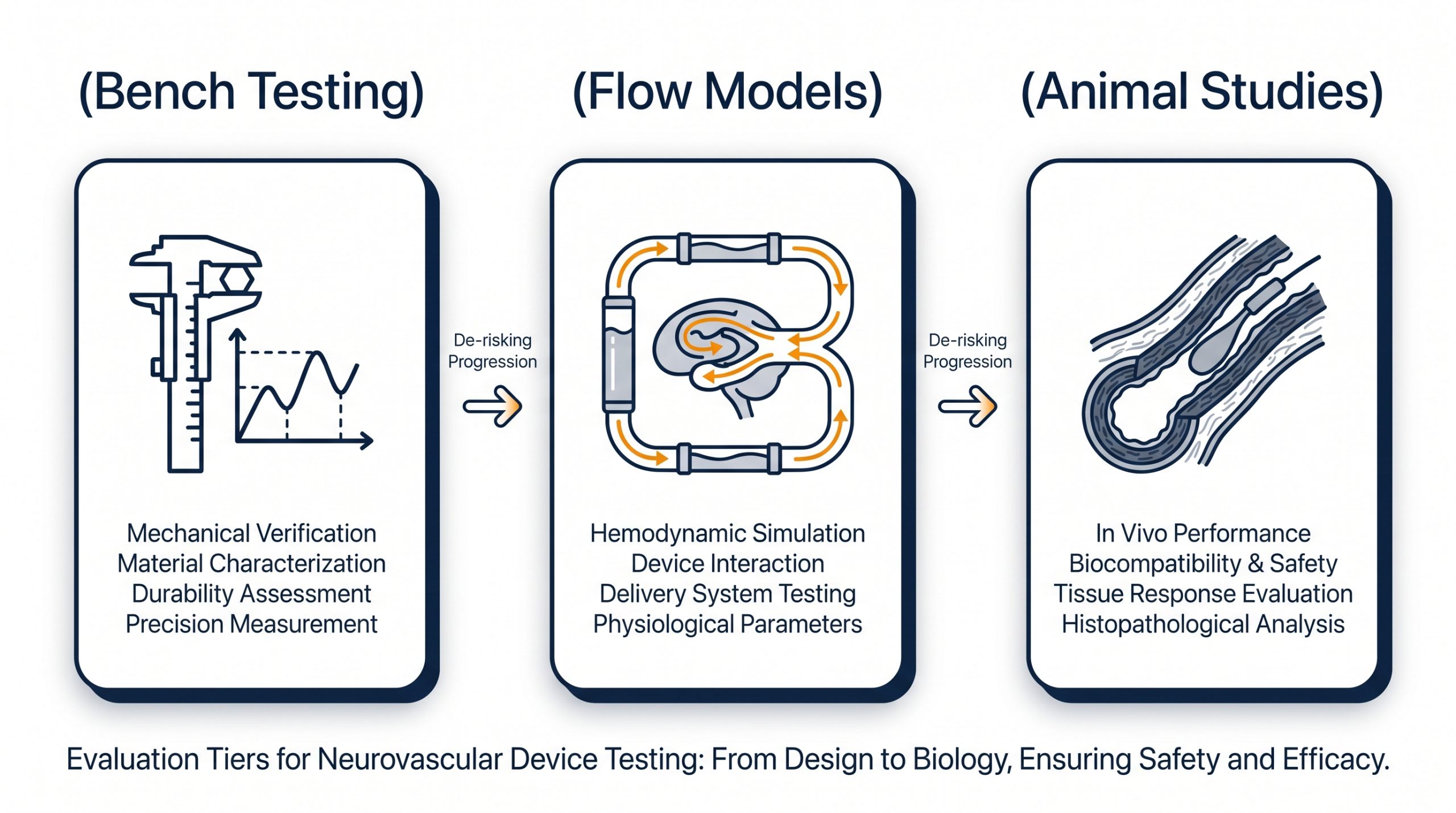
“Bench and flow models de-risk the design. Animal studies de-risk the biology. A robust preclinical program requires both — neither can substitute for the other.”
— Adir Koreh, CEO, Biotech Farm Ltd.
Which Animal Model Is Best Suited for Neurovascular Device Testing?
Model selection depends on anatomy, vessel diameter, device type, and endpoints (acute vs. chronic). Rabbits are widely used for aneurysm models — particularly elastase-induced aneurysms — for flow diverter evaluation and asymmetric vascular stent assessment. Swine and ovine models are common for thrombectomy, stenting, and embolization work where vessel diameter and procedural similarity to humans matter. The FDA’s general considerations for animal studies remains the anchor reference for justifying model choice.
| Model | Best For | Advantages | Limitations |
|---|---|---|---|
| Rabbit | Aneurysm models (elastase-induced), flow diverters, coils | Well-established, lower cost, accessible vessels | Smaller vessel diameter than human neurovasculature |
| Swine | Thrombectomy, stenting, embolization | Vessel diameter closer to human, procedural similarity | Higher cost, more complex logistics |
| Ovine | Vascular implants, chronic healing studies | Good vascular healing analog, available chronic models | Less procedural realism for neurovascular-specific work |
Defining a “Translational Model” Beyond Technical Workability
A model that “works” — meaning the device can be deployed and the animal survives — is not automatically translational. A translational model reproduces the clinically relevant anatomy, flow conditions, and biological response patterns that will determine human outcomes. When selecting a model, ask: does it mimic the disease state, does it allow the same procedural tools and imaging modalities used clinically, and does the healing biology resemble human response? Without these, even well-executed studies generate data that may not predict clinical performance.
How to Select Appropriate Endpoints for a Neurovascular Device Preclinical Study
Endpoints should map directly to clinical risks. Endpoints that look impressive but don’t tie to a clinical risk add cost without strengthening the submission.
???? Safety Endpoints
- Vessel injury and dissection
- Perforation and vasospasm
- Distal emboli and mortality
⚙ Performance Endpoints
- Successful deployment and retrieval
- Device stability and placement accuracy
- Procedural time and efficiency
???? Biological Endpoints
- Thrombogenicity and endothelialization
- Neointimal response at defined time points
- Histopathology (30, 90, 180 days), OCT, MRI
What Is Examined in Brain Device Testing for Neurostimulation or Neural Implants?
For neural implants and stimulators, the question shifts from mechanical performance to long-term tissue interface. Biotech Farm offers comprehensive preclinical research and development services spanning the disciplines needed here.
Key Assessment Areas — Neural Implants
- Electrode stability and impedance drift over time
- Heating and current characterization
- Glial response and foreign body reaction
- Imaging artifact assessment
- Behavioral, electrophysiological, and histological evaluation (chronic)
Model selection depends on implantation location (cortex, peripheral nerve, deep brain), duration (acute, sub-chronic, chronic), and intended clinical use. Programs typically combine chronic implantation studies in large animal models with detailed multidisciplinary evaluation. The complexity demands a facility with surgical, imaging, and pathology capabilities under one roof.
What Is GLP in Medical Device Preclinical Studies and When Is It Mandatory?
Good Laboratory Practice (GLP) is a quality system for non-clinical safety studies, defined in the US by 21 CFR Part 58 and internationally by the OECD Principles. It governs protocol approval, raw data integrity, QA oversight, study director responsibilities, and archiving.
Non-GLP studies are appropriate for Proof of Concept, design iteration, and early optimization — they are faster and less expensive. GLP becomes appropriate (and often required) when the data will support a regulatory submission such as an IDE or PMA. A practical rule: pivotal safety studies feeding the submission should be GLP; exploratory work need not be.

GLP vs. Non-GLP at a Glance
| Aspect | Non-GLP | GLP |
|---|---|---|
| Purpose | Proof of concept, design iteration, screening | Pivotal safety data for regulatory submission |
| Documentation | Lab notebooks, summary reports | Approved protocol, raw data, QA audits, final report |
| Quality Oversight | Internal | Independent QA unit |
| Cost & Duration | Lower, faster | Higher, longer setup |
| Typical Stage | Early R&D, pilot | Pre-IDE / pre-CE pivotal |
How Long Does Neurovascular Device Preclinical Testing Typically Take — and What Does It Cost?
Realistic timelines range from a few weeks for focused bench work to 12–18 months for a full chronic in vivo program with multiple time points and GLP documentation. Factors that extend duration include prototype manufacturing iterations, protocol development, ethics committee approvals, chronic follow-up windows, pathology turnaround, and statistical analysis.
Teams that plan iteratively — with clear go/no-go gates after each phase — typically reach FIH faster than those who attempt one large monolithic study. Cost is driven mainly by model type (rabbit vs. swine vs. ovine), number of animals and time points, surgical complexity, imaging modalities used, and quality requirements (GLP vs. Non-GLP).
✓ Cost Optimization Strategy
A phased program — POC, pilot, pivotal — lets teams allocate resources where they generate the most value and avoid over-investing before a design is stable. Working with a facility that integrates surgery, imaging, and pathology in-house often reduces both cost and timeline compared to coordinating multiple vendors. A 10–20% reduction in overall project cost is commonly achieved through integrated facility partnerships.
What Documents and Deliverables Are Required for Regulatory Submission?
Regulators expect traceable, defensible documentation. The IMDRF N9 framework provides useful structure for organizing non-clinical evaluation content. The core deliverables tie raw data to performance and safety claims through a clear chain of evidence.
Recommended Deliverables Checklist
- Approved Study Protocol — clear hypotheses and endpoints
- Documented Amendments & Deviations with justifications
- Raw Data (paper and electronic) with audit trails
- QA Statements describing inspections and audits
- Pathology Reports with images and grading scales
- Statistical Analysis Plan and Results
- Final Study Report explicitly linking findings to safety and performance claims
How to Mitigate Risk and Avoid Failures in Animal Studies (and Reduce Time to Market)
Most animal study failures trace back to weak experimental design or premature pivotal work. The IDEAL-D consensus framework emphasizes structured de-risking before First-in-Human, with phased preclinical work that matches the device’s risk profile and failure modes.

Practical risk mitigation includes: investing in a small pilot before a pivotal study, validating surgical technique and imaging endpoints early, pre-specifying analysis methods, and running an implant safety study in animals with adequate sample size and follow-up before committing to GLP. Iterative development with explicit go/no-go criteria — rather than “let’s see what happens” — is the single most powerful tool for reducing time to market.
“Iterative development with explicit go/no-go criteria — rather than ‘let’s see what happens’ — is the single most powerful tool for reducing time to market and protecting your regulatory investment.”
— Biotech Farm Preclinical Team, based on 20+ years large animal model experience
Biotech Farm’s Approach to Neurovascular Device Preclinical Testing
Biotech Farm operates as a large animal preclinical facility offering integrated surgery, imaging, and pathology capabilities relevant to neurovascular and implantable device work. The facility supports a range of animal models in preclinical research, including rabbit, swine, and ovine models commonly used for vascular and implant studies. Surgical rooms equipped with C-arm fluoroscopy, high-definition ultrasound, and laparoscopic systems support clinically realistic procedural setups.
Programs are designed around the specific device, endpoints, and regulatory pathway — rather than fitting projects into a fixed template. The team works with sponsors to structure phased programs (POC → pilot → pivotal) and supports both Non-GLP exploratory work and studies aligned with GLP documentation standards.
Mapping Business Needs to Practical Preclinical Capabilities
| Business Need | What an Integrated Preclinical Facility Provides |
|---|---|
| Reduce vendor coordination overhead | Surgery, imaging, pathology, and project management under one roof |
| Move from POC to pivotal quickly | Phased program design with go/no-go gates |
| Meet regulatory documentation standards | GLP-capable infrastructure and traceable reporting |
| Test complex procedural workflows | Clinical-grade imaging (fluoroscopy, ultrasound, OCT) and surgical suites |
| Match human anatomy for procedural realism | Access to relevant large and small animal models |
| Iterate design based on biological feedback | Scientific support throughout the program, not just data delivery |
Which Regulatory Bodies and Ethical Committees Oversee Neurovascular Device Preclinical Testing in Israel?
In Israel, preclinical animal studies operate within a defined legal and ethical framework. The Animal Welfare Law (Animal Experiments), 1994, establishes the framework including the role of the National Council for Animal Experimentation in granting permits and supervising institutions. Compliance with both animal welfare oversight and device regulatory expectations is essential for studies intended to support submissions in Israel or as part of an international package.
???? Animal Ethics Oversight
National Council for Animal Experimentation — permit granting and institutional supervision under the Animal Welfare Law (Animal Experiments), 1994.
⚕ Medical Device Regulation
Israeli Ministry of Health — circulars and procedures for medical accessories and devices.
???? Clinical Trial Oversight
Supreme Helsinki Committee framework for human trials, building on preclinical evidence packages.
First-in-Human (FIH) Readiness: What Do You Need Before Clinical Trials?
Moving from preclinical to FIH requires a defensible data package and the right approvals. The package should demonstrate biological safety, mechanical and functional performance, biocompatibility (typically aligned with ISO 10993), and adequate chronic follow-up data for implants.
✓ FIH Readiness Checklist
- Bench performance and durability data
- Biocompatibility per ISO 10993
- Sterilization and packaging validation
- Acute and chronic in vivo safety and performance data
- Complete documentation package linking results to safety and performance claims
- Helsinki Committee application (Israel) and/or IDE/CE submission (international)
In Israel, clinical trial applications go through Helsinki Committees, with oversight described in Ministry of Health procedure for medical trials in humans. Building the preclinical program with the FIH submission already in mind avoids costly rework.
Frequently Asked Questions About Neurovascular Device Preclinical Testing
Ready to Design Your Neurovascular Device Preclinical Program?
Are you preparing for First-in-Human studies and looking for a preclinical partner who can integrate surgery, imaging, pathology, and regulatory-grade documentation into a single, phased program? Discuss your device, endpoints, and timeline with an experienced team.