Expert Preclinical Research & Development
Wearable Medical Device Preclinical Testing: A Comprehensive Guide
Bringing a wearable medical device from concept to clinic requires rigorous preclinical evaluation. This guide walks through the scientific, regulatory, and ethical pillars of wearable medical device preclinical testing, with a focus on biosensor performance, animal study design, and Israeli regulatory expectations — helping R&D teams plan studies that generate defensible data and shorten the path to submission.
Animal Study Design
Israeli Regulatory
3Rs Framework
Expert Insight
“A well-structured preclinical package addresses sensor accuracy, mechanical reliability, skin interaction, and data integrity under realistic conditions — forming the technical backbone of the regulatory dossier. Misalignment between claims and preclinical evidence remains the most preventable cause of regulatory deficiency letters.”
— Adir Koreh, CEO, Biotech Farm Ltd. | 20+ Years Large Animal Model Expertise
What is Preclinical Testing for Wearable Medical Devices?
Preclinical testing for a wearable medical device preclinical program is the structured evaluation phase performed before human trials or regulatory submission. It establishes safety, performance, and biological compatibility through benchtop simulations, in vitro work, and, when justified, in vivo animal studies that verify how the device behaves on a living, moving body.
The objective is twofold: minimize risk to future human subjects, and create reproducible evidence supporting the intended claims. A well-structured preclinical package addresses sensor accuracy, mechanical reliability, skin interaction, and data integrity under realistic conditions, forming the technical backbone of the regulatory dossier.
When Are Animal Studies Required for Wearable Devices?
Animal studies are warranted only when bench, in vitro, and simulation methods cannot deliver the safety and performance evidence required. They become relevant for evaluating long-term skin interaction, signal fidelity during natural movement, and physiological response of a device that contacts living tissue continuously.
Israeli Regulatory Framework
Israeli law on animal experimentation, overseen by the National Council for Animal Experiments, explicitly requires that researchers demonstrate no suitable alternative exists before approval is granted. The framework balances scientific advancement with the duty to prevent unnecessary suffering, applying the 3Rs (Replacement, Reduction, Refinement) at every stage of study planning.
Verification vs. Analytical Validation vs. Clinical Validation
The V3 framework, articulated in npj Digital Medicine, separates three distinct evaluations that often get conflated in early development.
Verification
“Did we build the product right?” — Testing sensors and electronics against engineering specifications under controlled bench conditions.
Analytical Validation
Confirms the device accurately measures the physiological or behavioral parameter it claims to measure across the conditions of use.
Clinical Validation
Assesses whether the output is meaningful for the target user population in real-world settings — conducted after first-in-human use.
Preclinical animal studies typically cover verification endpoints and a substantial portion of analytical validation prior to first-in-human use.
Defining Intended Use and Claims Before You Design the Study
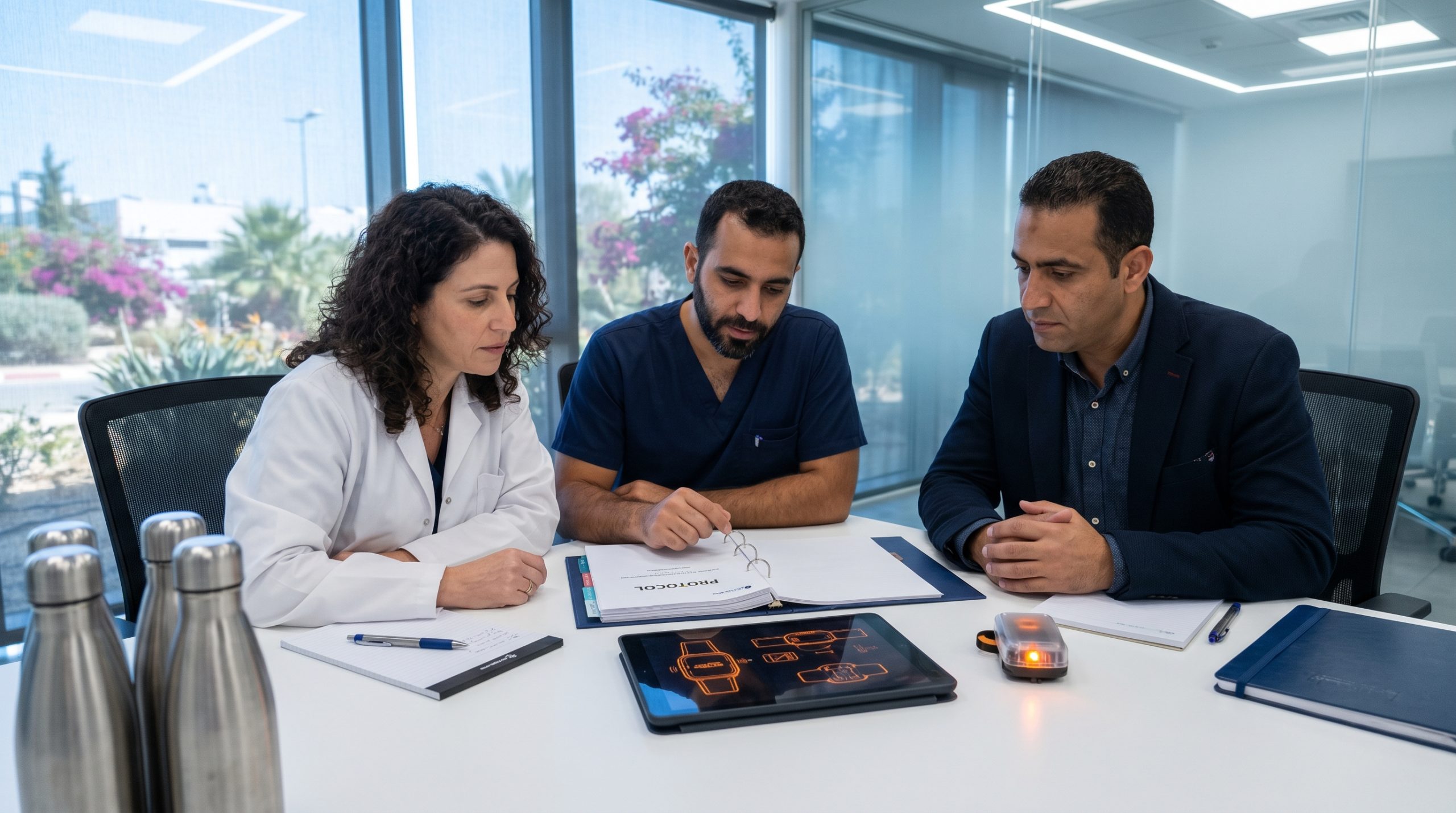
Every preclinical decision flows from the intended use statement. Specify the target population, environment of use, measured parameters, and the clinical purpose — monitoring, screening, triage, or diagnosis. The claims, in turn, dictate study rigor: a device claiming “trending of heart rate during sleep” requires different evidence than one claiming “absolute SpO2 measurement for hypoxia detection.”
Tighter claims demand tighter accuracy bounds, larger sample sizes, and broader condition coverage. Misalignment between claims and preclinical evidence is one of the most common reasons regulatory reviewers issue deficiency letters, so early alignment between R&D, clinical, and regulatory teams pays off.
⚠ Common Pitfall
Teams that begin animal studies before locking their intended use statement consistently produce data that fails to support their eventual labeling claims — a costly and time-consuming error that is entirely preventable with early-stage protocol discipline.
Preclinical Testing Methods Available for Wearables
Preclinical evaluation typically progresses through sequential, complementary stages. Combining these methods strategically reduces development time, lowers cost, and respects animal-welfare principles. For a deeper dive into the overall process, see Preclinical Testing Medical Devices Safety Evaluation.
Bench Test Examples for Wearables
Typical bench evaluations include mechanical stress and drop testing, fluid ingress per the relevant IP rating, sensor drift and response-time characterization, battery life and charge-cycle endurance, and electromagnetic compatibility. EMC and electrical safety often reference IEC 60601 and its Israeli adoption (T.I. 60601).
- Mechanical stress, drop, and vibration testing
- Fluid ingress per IP rating (IEC 60529)
- Sensor drift, response time, and signal stability
- Battery life and charge-cycle endurance
- Electromagnetic compatibility (EMC) per IEC 60601 / T.I. 60601
In Vivo Endpoints for Wearables
In vivo endpoints focus on translatable performance: signal quality under voluntary movement, agreement with a gold-standard reference, skin and tissue response after prolonged contact, attachment stability, and data integrity during realistic activity. Endpoints should be pre-specified and statistically powered, not retrofitted after data review.
Selecting an Appropriate Animal Model for Wearable Sensor Testing
A meaningful monitoring device animal study begins with model selection driven by the measurement target, not convenience. This careful selection is integral to Preclinical Research And Development Services, where matching model to question avoids wasted animals and inconclusive data.
???? Anatomical Relevance
Skin thickness, vascular density, and body curvature where the device attaches. Pigs are widely used for cardiovascular and dermal applications due to close similarity with human skin and cardiac anatomy.
❤️ Physiological Relevance
Heart rate range, blood pressure, thermoregulation. Sheep and rabbits serve specific niches, while rodents are used for rapid feasibility assessments with appropriate translatability caveats.
???? Behavioral Factors
Activity patterns, tendency to dislodge the device, and feasibility of acquiring a reliable reference measurement in that species during normal movement.
“Model selection must be driven by the measurement target, not convenience or cost. A mismatched model produces data that looks rigorous but fails to translate — wasting both resources and, critically, animals.” — Adir Koreh, CEO, Biotech Farm Ltd.
What Is Monitored in a Wearable Monitoring Device Animal Study?
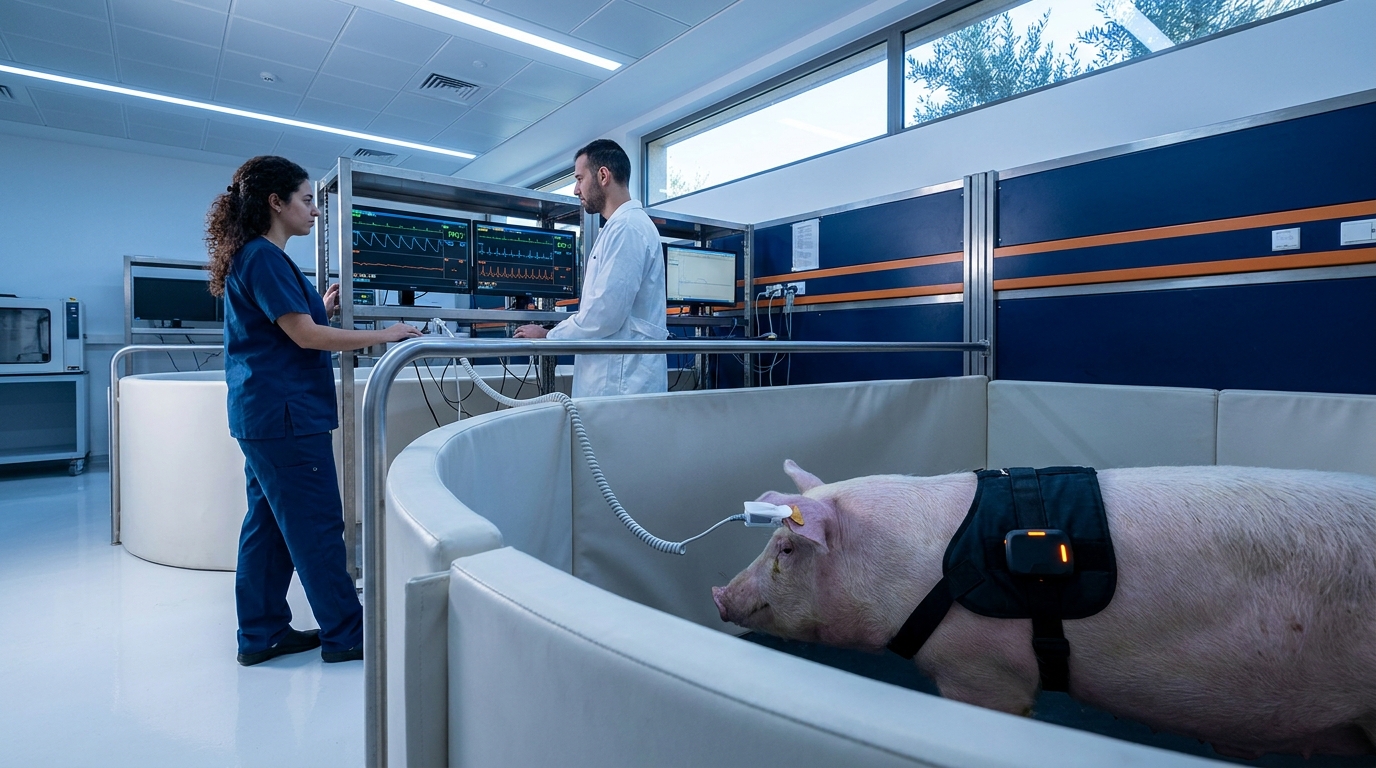
The core outputs of an animal study mirror what regulators and clinicians will eventually scrutinize: accuracy and precision against a gold-standard reference, signal stability across activities and postures, sensitivity to environmental influences such as temperature and humidity, and data yield over hours or days of continuous use.
Study design should replicate the intended human use case as closely as the model allows — including duration of wear, attachment location, and the spectrum of physiological states the device must handle. Findings on wearable wireless biosensor technology illustrate how continuous monitoring in animals informs both veterinary and human applications.
✓ Best Practice
Always include a spectrum of physiological states in animal study design: rest, light activity, vigorous exercise, and recovery. Single-state studies systematically under-report artifact and signal dropout rates that appear in real-world use.
How Signal Quality and Data Yield Are Measured
Signal quality is typically reported through Signal-to-Noise Ratio (SNR), the percentage of artifact-free epochs, and the ability to distinguish physiological from non-physiological signals. Data yield captures uptime, packet loss, and the share of total recording time producing valid, analyzable data.
Signal Quality Metrics
- Signal-to-Noise Ratio (SNR)
- Percentage of artifact-free epochs
- Physiological vs. non-physiological signal discrimination
Data Yield Metrics
- System uptime percentage
- Packet loss rate
- Valid analyzable data as % of total recording time
The two metrics must be reported together: a wearable with high accuracy but 30% data yield offers limited clinical value, while moderate accuracy with consistent 95% yield may be more clinically actionable. Both metrics should be measured under stationary and dynamic conditions, since real-world use rarely resembles a calibration bench.
Validating PPG, ECG, and SpO2 Wearables in Preclinical Models
Validation of optical and electrical biosensors requires parallel measurement against a clinical or laboratory reference, with precise time synchronization between the wearable and the reference signal. Error analysis typically uses Bland-Altman plots, root-mean-square error, and segmented analysis by physiological state — rest, exercise, recovery, and stress.
Performance under movement artifact, perfusion variability, and changing skin contact deserves particular attention, since these are the conditions where field failures cluster. A detailed example of a wearable continuous health monitoring system is described by Frontiers in Robotics and AI, showing how preclinical evaluation can address signal robustness in freely moving subjects.
Technical Note
Time synchronization between wearable and reference system is a frequently overlooked technical requirement. Even a 100ms offset can introduce apparent errors in high-rate parameters like ECG. Establish synchronization protocol before animal enrollment begins, not after data collection reveals anomalies.
Comparison Table: Preclinical Testing Stages for Wearables
| Stage | Primary Question | Typical Methods | Key Outputs |
|---|---|---|---|
| Bench | Does the hardware meet specifications? | Mechanical, ingress, EMC, battery | Engineering compliance evidence |
| In Vitro | Is the sensor stable in biological media? | Cytotoxicity, sensor response in matrices | Biocompatibility, analytical baseline |
| In Vivo | Does it perform on a living, moving body? | Animal model with reference standard | Accuracy, signal quality, data yield |
| Reporting | Is the evidence traceable to claims? | Statistical analysis, structured report | Regulatory-ready dossier section |
What Makes Biosensor Preclinical Testing Different
Biosensor preclinical testing goes beyond physical measurement to evaluate the biological interface. The sensing element must demonstrate sensitivity, selectivity, and linearity in biological matrices, not just in saline. Biocompatibility matters at every contact surface, and biofouling — protein and cell adhesion that degrades signal — must be characterized over the intended wear time.
Interference from coexisting biomolecules, sweat composition, or motion-induced contact changes can shift baselines unpredictably. Where the biosensor includes a partially or fully implanted element, these studies often align with broader Implant Safety Study Animals protocols to ensure both system safety and sustained performance.
????
Biofouling Assessment
Protein and cell adhesion characterization over full intended wear time — critical for long-duration wearables.
????
Sweat Interference
Electrolyte, pH, and biomolecule variation in sweat can alter optical and electrochemical sensor baselines during exercise.
????
Contact Stability
Motion-induced changes in skin-sensor interface geometry produce artifacts that must be distinguished from real physiological variation.
Biocompatibility Standards Crucial for Skin-Contact Wearables
Skin-contact wearables follow the ISO 10993 series, which assigns test batteries based on contact category and duration. Essential evaluations include cytotoxicity, sensitization, irritation, and where wear time is long, systemic toxicity.
| Test Category | ISO 10993 Reference | When Required |
|---|---|---|
| Cytotoxicity | ISO 10993-5 | All skin-contact devices |
| Sensitization | ISO 10993-10 | All skin-contact devices |
| Irritation | ISO 10993-23 | Extended wear wearables |
| Systemic Toxicity | ISO 10993-11 | Long-duration contact (>30 days) |
International guidance from the OECD on integrated approaches to skin corrosion and irritation encourages combining in chemico, in vitro, and historical data before in vivo work — a practical way to honor the 3Rs while building a defensible biocompatibility file.
Common Mistakes That Undermine Preclinical Wearable Studies
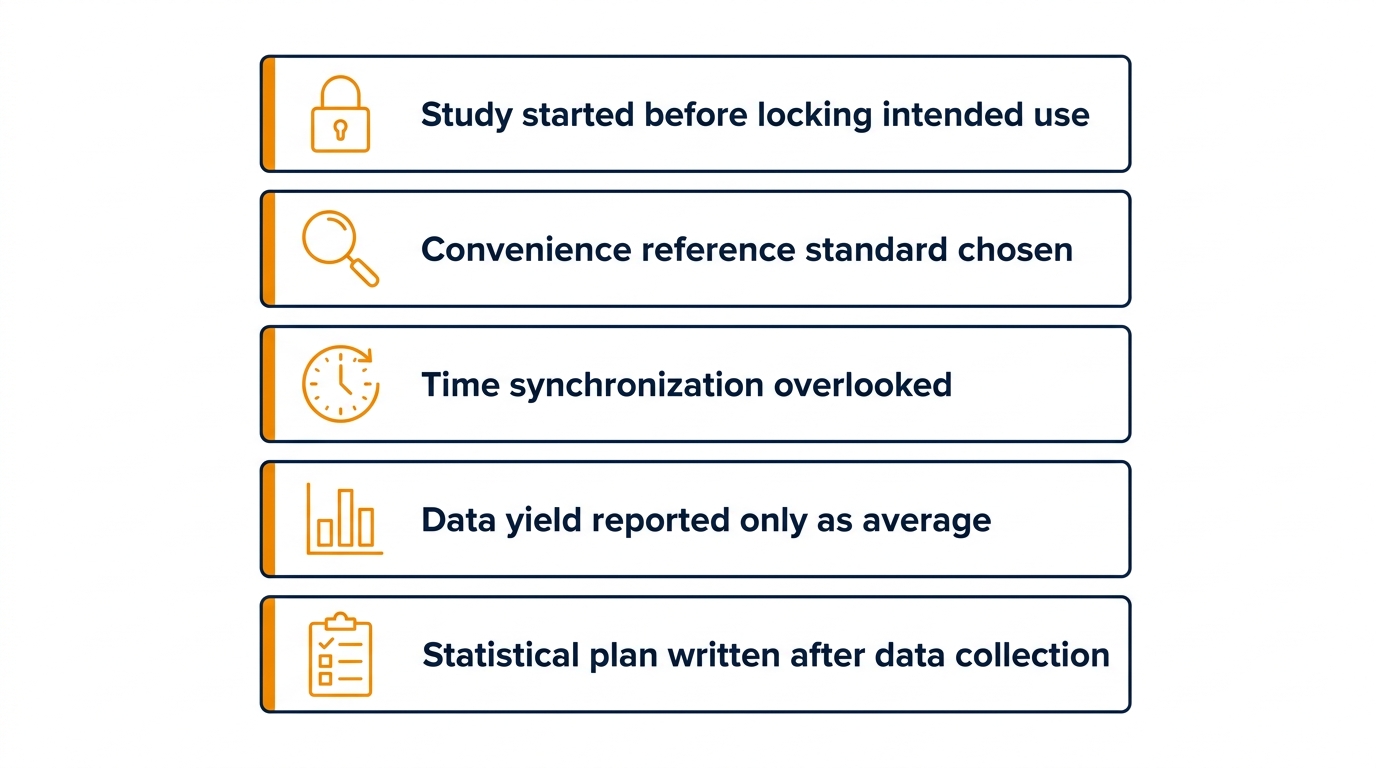
Several recurring mistakes derail otherwise promising programs. Each of these is avoidable with a written protocol reviewed by regulatory and biostatistics stakeholders before the first animal is enrolled.
❌ Unlocked Intended Use at Study Start
Teams start animal studies before locking the intended use and claims, leading to data that does not support the eventual labeling. Fix: complete claims matrix before protocol finalization.
❌ Convenience-Based Reference Standard
Reference standards chosen for convenience rather than rigor weaken accuracy comparisons. Fix: select reference based on clinical gold-standard in the relevant physiological parameter.
❌ Missing Time Synchronization Protocol
Latency artifacts between wearable and reference masquerade as inaccuracy. Fix: establish hardware or software synchronization with documented latency before enrollment.
❌ Average-Only Data Yield Reporting
Reporting yield as an average hides long dropout episodes. Fix: report yield distribution, including minimum continuous valid segments and episode-level dropout analysis.
❌ Post-Hoc Statistical Planning
Statistical plans written after data collection invite bias. Fix: pre-register analysis plan with power calculations, primary endpoints, and data exclusion criteria before study initiation.
Israeli Regulatory Requirements for Wearable Preclinical Studies
In Israel, the AMAR unit (Medical Devices Division) of the Ministry of Health oversees registration and post-market regulation of medical devices, including wearables. Preclinical data is a mandatory component of the AMAR submission, and dossiers commonly reference international standards adopted by the Standards Institution of Israel.
????️
AMAR Submission
Preclinical data is mandatory. Dossiers reference IEC 60601 family for electrical safety and essential performance via Israeli adoption T.I. 60601.
⚖️
Animal Experimentation Law
Law on Animal Cruelty (Animal Experiments), 1994 requires institutional permits, ethical review, and demonstrated absence of suitable alternatives.
????
Early Alignment Strategy
Aligning preclinical plan with AMAR expectations and animal experimentation framework early prevents costly rework before submission.
Business Need to Capability Mapping
| Business Need | How a Specialized Preclinical Partner Helps |
|---|---|
| Translating early prototypes into testable study designs | Scientific escort from concept through endpoint definition, with protocol drafting aligned to claims |
| Choosing the right large-animal model | Access to multiple species (pig, sheep, rabbit) with anatomical and physiological matching to the device |
| Generating regulatory-ready evidence in Israel | Familiarity with AMAR expectations, local standards, and ethics committee processes |
| Running long-duration wear studies | Animal housing designed for low-stress continuous monitoring and reliable reference acquisition |
| Integrating bench, in vitro, and in vivo work | Coordinated workflow that reduces duplication and supports 3Rs principles |
Key Considerations for Data Analysis and Reporting
Robust analysis accounts for between-subject and within-subject variability, the influence of physiological state, and the differing reliability of reference measurements across conditions. Reports should transparently document study design, model justification, any adverse events, performance metrics with confidence intervals, and the full statistical methodology.
Reporting Checklist
- ✓Approved study protocol with pre-registered analysis plan
- ✓Ethics approvals and institutional permits
- ✓Raw and processed data with traceability chain
- ✓Calibration records for all reference equipment
- ✓Adverse event log with narrative and resolution
- ✓Final report linking findings to intended use and claims
Traceability from raw signal through processed data to the claim being supported is essential. Pre-registration of the analysis plan and clear handling of excluded data segments strengthen credibility with reviewers and downstream clinical partners alike.
How Biotech Farm Supports Your Wearable Preclinical Program
Biotech Farm provides an integrated environment for wearable medical device preclinical testing, combining a well-equipped large-animal facility with scientific escort across the project lifecycle. Teams benefit from custom study design, access to multiple animal models, established workflows for biosensor performance evaluation, and documentation practices oriented toward regulatory submission.
The approach is collaborative — protocols are tailored to the device’s intended use rather than fitted to a generic template — and operates under transparent ethical and welfare standards, with an emphasis on minimizing animal numbers without compromising statistical power.
What Biotech Farm Brings to Your Program
- 20+ years of large-animal model expertise under Adir Koreh’s leadership
- A team of experienced veterinarians working together for over a decade
- Multiple species access: pig, sheep, rabbit, and others matched to device anatomy
- Custom-designed protocols aligned to AMAR submission requirements
- Ethics-first approach grounded in 3Rs and Israeli animal welfare law
- Serving both Israeli and international industry and academic clients
Frequently Asked Questions
Ready to Plan Your Wearable Preclinical Study?
What evidence does your device need to convincingly support its claims, and how will you generate it under Israeli regulatory and ethical expectations? If you are mapping the path from prototype to submission and want a scientifically supportive partner to design the right preclinical program, contact Biotech Farm to discuss your project.