The Critical Factors for Choosing an Animal Model in Preclinical Research
At the heart of medical innovation, the selection of an appropriate animal model is one of the most consequential decisions in any preclinical program. The right choice shapes data quality, regulatory acceptance, and the ultimate translatability of findings into human clinical trials. With more than 30 years of experience managing large-animal research, the team at Biotech Farm approaches model selection as a scientific exercise — matching biology, endpoints, and regulatory expectations to the specific research question, rather than defaulting to convenience.
Expert Insight from Biotech Farm
Choosing the wrong animal model is one of the leading causes of preclinical-to-clinical translation failures. At Biotech Farm, we treat model selection as a rigorous scientific discipline — one that demands deep anatomical knowledge, cross-species biology expertise, and a clear line of sight from preclinical readouts to clinical intent. Every protocol we support begins not with species availability, but with the research question itself.
What is the Primary Purpose of Animal Models in Preclinical Studies?
Animal models bridge the gap between in-vitro experiments and human clinical trials. They allow researchers to study disease progression, drug efficacy, pharmacokinetics, and safety studies in an intact living system where organ-level interactions, immune responses, and metabolism can be observed. No cell culture or organ-on-chip can yet replicate the full complexity of a living mammal.
Within preclinical research, animal models serve two intertwined goals: demonstrating that a therapy works (efficacy) and confirming that it is safe enough to administer to humans. Biotech Farm contributes scientific escort across both — helping sponsors define endpoints, choose species, and design protocols that meet GLP-aligned expectations from the outset.
Why Careful Animal Model Selection Criteria Are Crucial for Preclinical Success
The model dictates everything downstream: translatability, reproducibility, and regulatory credibility. An unsuitable model can produce misleading results, wasted resources, and significant delays in drug development. Conversely, a well-justified model accelerates decision-making and strengthens the IND/CTA package.
Detailed knowledge of physiology, anatomy, and pathology across species — like the comparative expertise reflected in understanding the nuances of animal models — enhances the selection process by aligning model choice directly with the research question. Strong animal model selection criteria are not a checklist filled in retrospectively; they are a planning discipline that determines preclinical success long before the first animal enters the protocol.
How Do You Choose an Animal Model for a Preclinical Study?
Selecting an animal model for a preclinical study means matching it to four anchors: the research question, the primary outcome, the target biology, and the regulatory requirements. Availability, cost, and historical familiarity may be practical considerations, but they cannot replace scientific justification.
The choice directly impacts data relevance, human predictability, and regulatory success. There is no single “best species” for all situations; a model that is ideal for cardiovascular device testing may be wholly inappropriate for ophthalmology or metabolic disease. The discipline of how to choose an animal model for preclinical work is, at its core, the discipline of aligning biology with intent.
Research Question
Focused, answerable, pre-defining what will be measured and which decision it changes.
Primary Outcome
Measurable, sensitive, and clinically relevant — chosen before species, not after.
Target Biology
The chosen species must express the molecular target similarly to humans for predictive data.
Regulatory Requirements
ICH, FDA, EMA, and OECD frameworks define expectations that must be met from day one.
What Are the Most Important Criteria for Selecting an Animal Model?
Key animal model selection criteria include biological relevance to humans at the level of target and pathway, translational validity, measurable endpoints, and experimental rigor (randomization, blinding, and statistical power). Evaluation frameworks emphasize a “line of sight” from preclinical readouts to clinical intent — every measurement should map to something that will matter in the clinic.
Equally important is suitability for the underlying pathobiology. A model that produces a superficially similar phenotype but through a different mechanism may mislead the program. Continuity from preclinical to clinical endpoints — using imaging, biomarkers, or functional tests that can be replicated in humans — is what makes the data defensible.
Defining the Research Question That Drives Correct Model Selection
A good research question is focused, answerable, and pre-defines what will be measured. The question and the primary outcome together dictate the model — not the other way around. Trying to “answer too many questions in one study” dilutes planning and almost always leads to suboptimal animal model choices.
Before selecting a species, the team should articulate: What is the hypothesis? What single outcome would change the development decision? What magnitude of effect is clinically meaningful? Only then can the model be chosen to actually deliver that answer with confidence.
???? Three Questions to Ask Before Any Species Decision
- What is the hypothesis and what single outcome changes the development decision?
- What magnitude of effect is clinically meaningful — and can this model detect it?
- Have all alternative approaches been evaluated and formally ruled out?
Choosing a Primary Outcome and Its Relationship to Species and Strain
Select a measurable, sensitive, and clinically relevant primary outcome first; then choose a species and strain that allow reliable, repeatable measurement of that outcome. The outcome shapes the measurement method — imaging, histology, mechanical testing, biomarkers — and directly influences sample size.
For example, if the primary outcome is coronary patency post-stenting, species selection preclinical reasoning leans toward swine for vessel size and physiology. If the outcome is bone integration of an orthopedic implant, sheep may be preferable. The measurement defines the model.
Evaluating the Validity of an Animal Model: Face, Construct, and Predictive
A strong model shows similarity in symptoms (face validity), similarity in mechanism (construct validity), and — most importantly — the ability to predict treatment response in humans (predictive validity). In practice, predictive validity often matters more than perfect replication of a mutation or phenotype.
A model can look very human-like and still fail to predict clinical outcomes, while a mechanistically imperfect model may nonetheless forecast responder populations accurately. Programs should weigh these three dimensions of translational validity explicitly and document the rationale.
Similarity in observable symptoms and phenotypic presentation to the human condition being modeled.
Similarity in the underlying biological mechanism — ensuring disease origin parallels human pathobiology.
The ability to forecast treatment response in humans — the most critical dimension for drug development programs.
“A model that predicts human response — even imperfectly mimicking symptoms — is more useful than one that looks human-like but fails to forecast clinical outcomes.”
— Biotech Farm Scientific Team
Are Animal Models Always Necessary? When Alternatives Apply
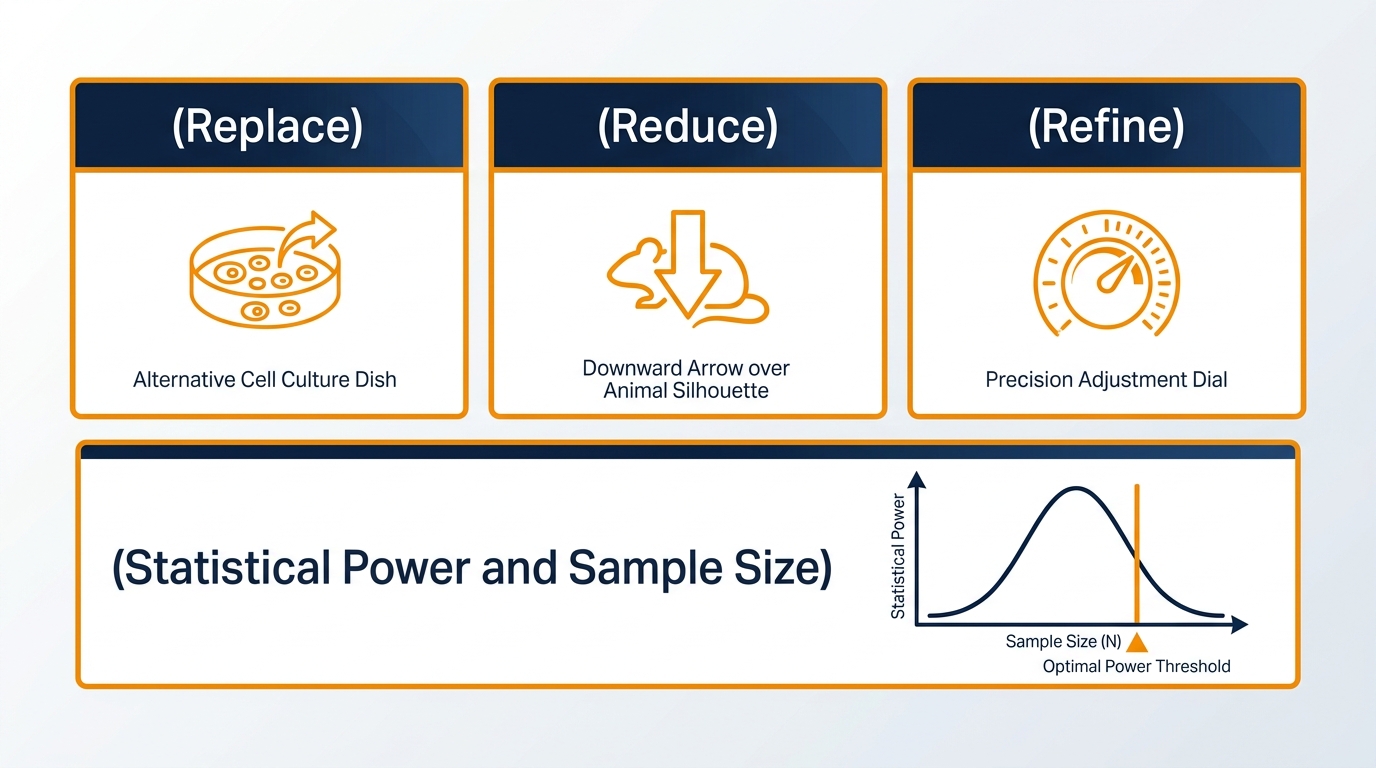
Animal models are not always mandatory. Under the 3Rs principle — Replace, Reduce, Refine — alternatives to animal models such as advanced cell culture, organoids, organ-on-chip, and in-silico modeling are considered first. Only when no suitable alternative can address the research question is an animal model pursued. A thorough literature review can also prevent duplicate experiments and reduce animal use.
National frameworks reinforce this principle. The Israeli regulatory framework for animal research, for example, explicitly requires minimizing suffering and preventing unnecessary experiments before any approval is granted.
✅ The 3Rs in Practice at Biotech Farm
- Replace: Alternatives (organoids, organ-on-chip, in-silico) are assessed before any animal model is proposed.
- Reduce: Proper power calculations ensure minimum effective cohort sizes — no excess animals.
- Refine: Refined husbandry, analgesic protocols, and minimally invasive surgical techniques reduce distress throughout.
Efficacy Model Versus Safety/Toxicology Model: How the Goal Changes Selection
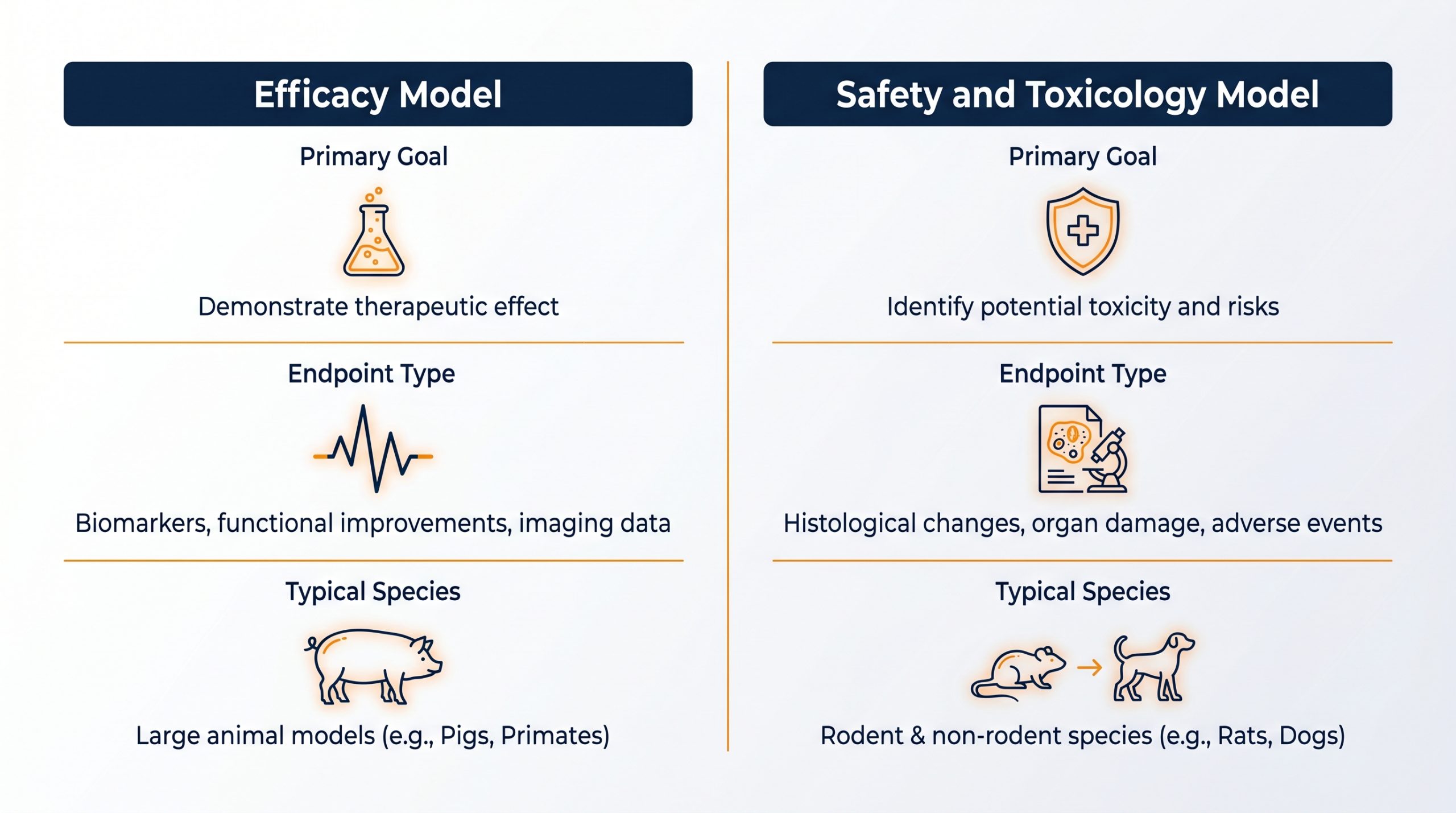
An efficacy model is chosen for its ability to reflect a disease mechanism and produce a measurable therapeutic response. A safety or toxicology model is chosen for physiological and metabolic relevance — its ability to reveal off-target effects, organ toxicity, and dose-limiting risks. The requirements often diverge, and a single species rarely satisfies both optimally.
This is why species selection preclinical reasoning must be planned as a package. Efficacy data in one model and safety studies in another are routinely combined to support a single IND, provided the rationale is transparent and scientifically grounded.
When Two Species Are Required and What It Means for Selection
Many regulatory pathways expect safety assessments in at least two species — typically a rodent and a non-rodent species. Early planning must therefore consider a scientifically justified pair, not a single choice made in isolation. Regulatory requirements expect a scientific rationale grounded in target expression, metabolism, and exposure relevance — not “because it’s cheap or available.”
OECD guidelines for repeated-dose toxicology in non-rodents (such as Test No. 409) detail species and strain considerations that should inform planning from day one.
Selecting a Species Based on Target Biology and Cross-Reactivity
The chosen species must express the molecular target similarly to humans, with relevant binding and functional activity — otherwise, the data may simply not be predictive. This is particularly critical in biologics and immunotherapy, where cross-reactivity between species is often the deciding factor.
Selecting a model without considering target biology risks generating non-translatable data that cannot support clinical decisions. Before committing to a model, teams should perform in-vitro binding and functional assays on tissues from candidate species, review homology and pathway literature, and consider a short pilot study to confirm pharmacodynamic readouts.
How PK/PD Profiles Influence Animal Model Selection
If pharmacokinetics and metabolism differ significantly from humans, the model may deliver irrelevant exposure profiles — leading to efficacy or toxicity predictions that simply do not reflect human reality. PK/PD alignment is therefore a core element of animal model selection criteria, not a downstream consideration.
Species selection directly impacts the predictive ability for human dosage and exposure. Metabolic pathways, plasma protein binding, clearance routes, and receptor distribution all vary between species and must be evaluated against the candidate molecule’s known profile.
Choosing Strain, Stock, and Genetic Background Within a Species
Within a species, strain choice can dramatically alter results. Select a strain based on phenotype sensitivity, stability and variability, and a genetic background that matches the mechanism under investigation. In mouse and rat studies in particular, strain selection is a critical determinant of phenotype reproducibility and generalizability.
The same therapy tested in two strains of mice can yield opposite conclusions. Documenting strain rationale up front — and reporting it transparently — is essential for reproducibility and external validity.
⚠️ Common Strain Selection Pitfalls
- Defaulting to the most commercially available strain without checking phenotype match.
- Failing to document genetic background in the study report — a reproducibility red flag.
- Switching strain mid-program without formal protocol amendment and re-justification.
Do Age and Sex Affect Model Selection?
Yes. Age and sex as a biological variable influence physiology, immunity, metabolism, and disease progression. They are integral parts of the model selection decision, not technical afterthoughts. Pre-defining age and sex distributions reduces variability and increases reproducibility.
NIH policy since 2014 requires balanced consideration of male and female animals in preclinical studies unless sex-specific biology dictates otherwise. Historical over-reliance on male-only cohorts has been shown to limit translational validity, and modern protocols treat sex inclusion as a default expectation.
Sample Size, Statistical Power, and the 3Rs
The model must allow a measurable effect with reasonable variability to achieve statistical power. A “noisy” model demands more animals to reach significance — or fails to reach it at all. Proper sample size calculation is therefore both an ethical obligation under the 3Rs and a scientific prerequisite for reproducibility.
The ARRIVE 2.0 guidelines provide a standard checklist covering experimental design, outcome measures, sample size, randomization, and blinding — and should be consulted before, not after, the study begins.
Comparing Selection Drivers: Efficacy Versus Safety Models
Understanding the distinct priorities of efficacy and safety model selection helps sponsors plan both components of their preclinical package from the outset — rather than discovering mismatches after the first study is complete.
| Selection Driver | Efficacy Model Priority | Safety/Toxicology Model Priority |
|---|---|---|
| Primary Goal | Demonstrate mechanism-based therapeutic response | Detect organ toxicity and dose-limiting effects |
| Target Expression | Homologous target with functional pathway | Relevant metabolism and systemic exposure |
| Endpoint Type | Disease-specific (imaging, biomarker, function) | Histopathology, clinical chemistry, hematology |
| Typical Species | Disease-relevant (pig, sheep, rabbit, rodent) | Rodent plus non-rodent pairing |
| Regulatory Anchor | Scientific rationale, mechanism evidence | ICH M3(R2), OECD TG 407/408/409 |
Regulatory Requirements and Ethics in Animal Model Choice
Multiple bodies shape species selection preclinical: IACUC committees oversee ethical conduct at the institutional level; the FDA, EMA, and ICH guidelines (notably ICH M3(R2)) define expectations for nonclinical safety packages supporting clinical trials and marketing authorization. EMA guidelines and OECD test guidelines provide further specifics on study design.
Across all frameworks, the 3Rs — Replace, Reduce, Refine — apply continuously. Documenting the rationale for model choice, including why alternatives were not adopted, is no longer optional; it is a core component of regulatory submissions and ethical review.
How Biotech Farm Aligns with Regulatory Expectations
As a state-of-the-art large-animal facility with established procedures, well-documented protocols, and a senior surgical team, Biotech Farm supports sponsors in producing the kind of traceable, transparent data that regulators expect. Scientific escort throughout the program — from protocol design to endpoint reporting — reduces avoidable rework during regulatory review.
Biotech Farm Large-Animal Infrastructure
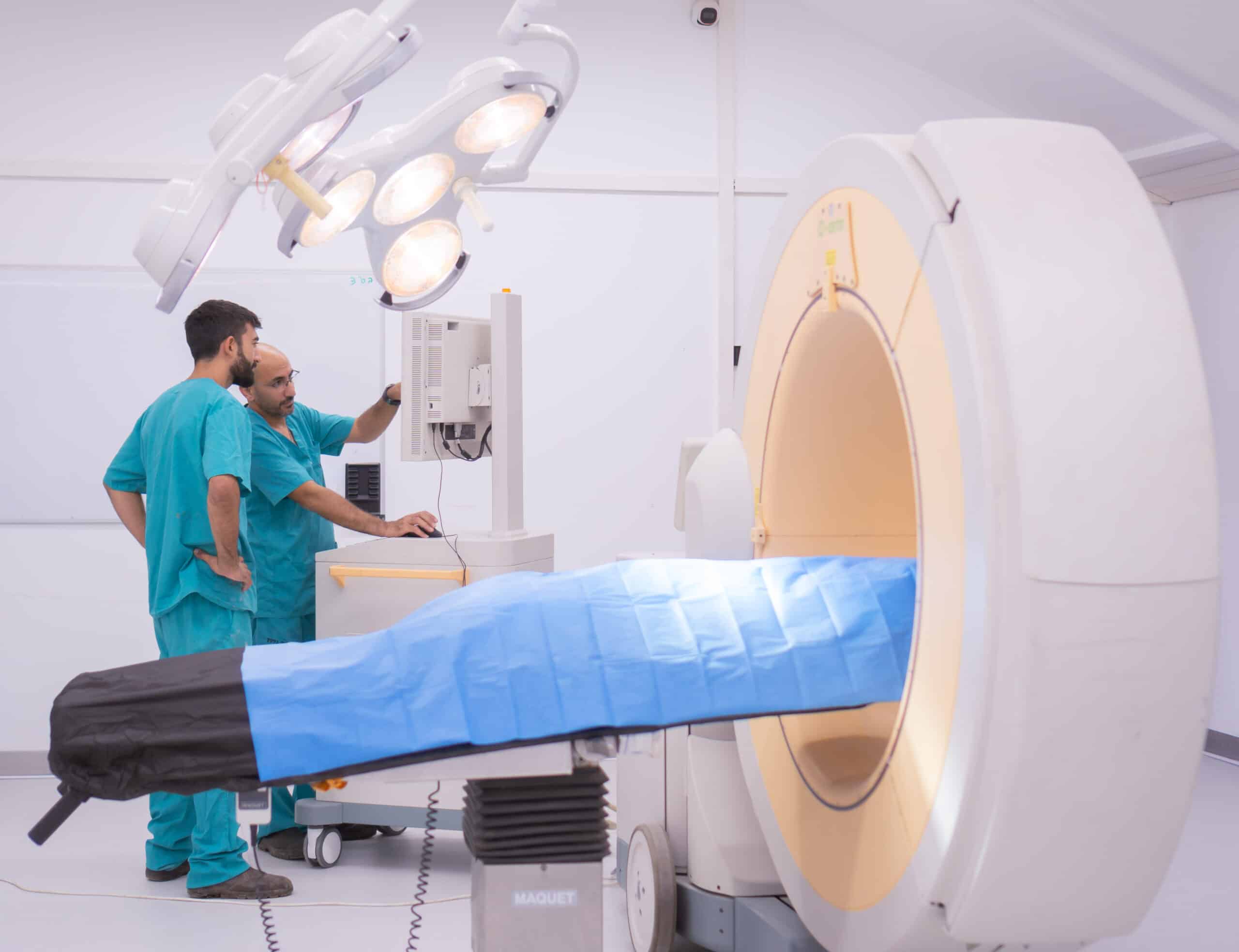
Our facility operates equipped surgery rooms with C-Arm fluoroscopy, ultrasound imaging, and laparoscopic towers, enabling complex surgical models across cardiology, ophthalmology, and orthopedics — all under GLP-aligned documentation and animal welfare standards.
- Intraoperative C-Arm fluoroscopy for real-time procedural guidance
- Standardized SOPs and well-documented procedures for regulatory traceability
- Senior veterinary team with more than a decade of collaborative experience
- Scientific escort from protocol design through final endpoint reporting
Common Pitfalls and How to Avoid Them
Recurring issues in preclinical animal research include poor experimental design, absent randomization or blinding, underpowered studies, and inconsistent reporting. These common pitfalls generate irreproducible results that hinder translation. Even years after ARRIVE was first published, reviews continue to document substantial gaps in rigor and reproducibility.
Actionable safeguards include: pre-registering the protocol, applying randomization and blinding wherever feasible, calculating sample size before the study, and reporting per ARRIVE 2.0. Resources such as the NC3Rs key elements of a well-designed experiment consolidate these practices into a usable framework.
Checklist for Optimal Animal Model Selection
Applied early, this checklist tightens planning for the right animal model and supports defensible preclinical animal research outcomes.
| Decision Point | Question to Resolve |
|---|---|
| Research Question | Is it focused, answerable, and tied to a single primary outcome? |
| Biological Relevance | Is the human target or pathway represented in the candidate species? |
| Translational Validity | Have face, construct, and predictive validity been assessed? |
| PK/PD Similarity | Are metabolism and exposure comparable to projected human profiles? |
| Species/Strain/Background | Is the genetic background documented and justified? |
| Age and Sex | Are both sexes and relevant ages included where applicable? |
| Ethics (3Rs) | Have alternatives been reviewed and rejected with rationale? |
| Regulatory Fit | Does the design meet two-species and ICH/OECD expectations? |
| Experimental Rigor | Are randomization, blinding, and power calculations planned? |
| Contingency | Is there a plan for unexpected model behavior or attrition? |
Mapping Research Needs to Facility Capabilities
Choosing the right model is only half the equation. The facility must have the infrastructure, expertise, and documentation systems to execute the study with the rigor the model demands. The table below maps common research needs to Biotech Farm’s integrated large-animal capabilities.
| Business or Scientific Need | How Biotech Farm Supports It |
|---|---|
| Cross-disciplinary studies (cardiology, ophthalmology, orthopedics) | Multiple platforms and imaging modalities under one roof |
| GLP-aligned documentation | Standardized SOPs, well-documented procedures, transparent collaboration |
| Complex surgical models | Equipped surgery rooms with C-Arm, ultrasound, laparoscopic towers |
| Scientific design support | Scientific escort and protocol review by experienced senior staff |
| Animal welfare compliance | Refined husbandry, ethical performance, 3Rs integration |
Frequently Asked Questions
Ready to Align Your Model with Your Scientific and Regulatory Goals?
If you are planning a preclinical program and weighing which model will best translate to human outcomes, ask yourself: what is the single most important question your study must answer — and is your current model truly built to answer it? For tailored scientific escort and large-animal capabilities aligned with your endpoints, connect with the Biotech Farm team to discuss your project.

This article is intended for informational purposes for professionals in the biotechnology and pharmaceutical sectors. References to external guidelines (ICH M3(R2), OECD TG 409, ARRIVE 2.0) reflect publicly available regulatory and scientific standards. Biotech Farm Ltd. operates in accordance with applicable Israeli and international animal research regulations.