
Preclinical Safety Expertise · 30+ Years Combined Experience
Understanding Single Dose Toxicity Studies: A Biotech Farm Overview
A single dose toxicity study is a foundational element of preclinical safety assessment, designed to characterize the acute adverse effects of a test article following one administration. The objective is not merely to detect lethality, but to map the qualitative and quantitative profile of toxicity that may emerge after exposure, including identification of target organs and dose-response relationships. At Biotech Farm, these assessments are integrated into a broader scientific strategy that translates molecular candidates into evidence-based development decisions.
The data generated supports informed dose selection for subsequent studies, defines tolerability thresholds, and provides early warning signals before resources are committed to longer-term programs. Many protocols include a 14-day post-dose observation window to capture the full progression of acute effects, in alignment with internationally accepted guidance from the FDA and OECD.
Expert Insight
Single dose toxicity studies are not a regulatory checkbox — they are a strategic tool. When designed with precision, a single acute safety study can de-risk an entire development program, saving sponsors months of costly investment in molecules with insurmountable safety liabilities. The key is aligning the study design with the actual decision the sponsor needs to make, not a generic template.
Single Dose vs. Acute Toxicity: Where the Terminology Diverges
Although the phrases are often used interchangeably, “acute toxicity testing” is the broader category, encompassing any short-term exposure scenario, while a single dose toxicity study refers specifically to a design in which one administration — or dosing within a 24-hour window — is followed by a defined observation period. This distinction matters in regulatory dossiers, where the precise study design influences how data are interpreted and accepted.
Acute toxicity may, in some frameworks, include multiple administrations within 24 hours, whereas single-dose designs are constrained to one defined exposure event. Recognizing this nuance helps sponsors align study choice with the specific question they need answered, whether for hazard classification, IND-enabling support, or internal candidate triage.
Why Sponsors Choose Single Dose Safety Assessments Early in Development
Early-stage developers often face a critical decision point: continue investing in a candidate, or pivot. A single dose safety assessment delivers rapid, decision-enabling data that helps de-risk the next phase. By identifying tolerability boundaries quickly, sponsors avoid committing significant capital to a molecule that may carry insurmountable safety liabilities.
Biotech Farm positions these studies within a comprehensive program of preclinical safety studies, ensuring that single-dose findings flow naturally into repeat-dose, pharmacology, and specialized toxicology work. The facility’s experienced team, with more than 30 years in research management, provides scientific escort throughout the process, helping clients interpret signals and adjust strategy without losing momentum.
Why 14 Days? The Logic Behind the Standard Observation Window
The 14-day post-administration observation period is a widely accepted convention in single-dose acute toxicity testing. The rationale is scientific rather than arbitrary: delayed toxicity, recovery dynamics, and progression of clinical signs may manifest days after exposure. A truncated window risks missing critical safety information, while an unnecessarily extended window consumes resources without proportional informational gain.
Regulatory bodies, including the FDA and OECD, reference this duration in their guidance documents. For most small-molecule candidates with conventional pharmacokinetic profiles, 14 days captures the full envelope of acute response.
What Happens During the 14-Day Observation Period?
During this window, animals undergo structured clinical monitoring: daily observations for behavioral changes, body weight measurements, food and water consumption tracking when protocol requires, and detailed documentation of any abnormal findings. The cadence is intensive in the first 24 hours, then transitions to daily checks. This systematic data collection produces the safety record that underpins later decisions.
When Might the Observation Period Differ?
The 14-day default is not universal. Test articles with extended half-lives, unusual pharmacology, or specialized routes of administration may warrant longer monitoring. Conversely, certain biologics or program-specific endpoints may justify a shorter window. The protocol design should reflect the molecule’s biology, not a template.
Endpoints That Define a Meaningful Single Dose Toxicity Study

A robust study captures far more than mortality. Comprehensive endpoints include clinical observations, body weight trajectories, food consumption, gross necropsy findings, and — when justified — clinical pathology and histopathology. The goal is to construct a complete picture of how the test article behaves in vivo, including which organs are most vulnerable and at what dose levels effects emerge.
Clinical Signs and Functional Observations
Trained personnel document tremors, convulsions, changes in gait, respiratory pattern shifts, salivation, piloerection, and posture abnormalities. These functional observations, recorded systematically, often provide the earliest indication of central nervous system, cardiovascular, or autonomic effects.
Clinical Pathology and Organ Assessment
When the program requires it, hematology, clinical chemistry, gross pathology, and histopathology are integrated into the study. These additions transform a basic tolerability screen into a target-organ identification exercise, which is essential when planning repeat-dose studies or supporting regulatory dialogue.
Clinical Signs Monitoring
Systematic daily observations capture tremors, gait changes, respiratory shifts, and autonomic signs — the earliest indicators of CNS or cardiovascular effects.
Body Weight & Consumption
Body weight trajectories and food/water consumption data provide quantitative indices of systemic health throughout the observation window.
Gross Necropsy & Histopathology
Post-mortem organ assessment and microscopic tissue evaluation identify target organs and characterize the nature and reversibility of toxicological findings.
How Dose Escalation Shapes Acute Toxicology Preclinical Programs
Dose escalation is a stepwise method in which sequential cohorts receive progressively higher doses until tolerability limits are reached or predefined endpoints are met. The approach is central to identifying the maximum tolerated dose (MTD) and informing starting doses for subsequent studies. OECD methodologies such as the Fixed Dose Procedure and Up-and-Down Procedure formalize this logic, balancing scientific rigor with the ethical mandate to minimize animal use.
A well-designed dose escalation study avoids both undershooting (producing no informative signal) and overshooting (causing unnecessary distress). Biotech Farm’s approach combines existing physicochemical data, pharmacology rationale, and pilot observations to calibrate dose levels intelligently from the outset.
MTD vs. NOAEL: What a Single Dose Study Can and Cannot Tell You
Maximum Tolerated Dose (MTD) is the highest dose that produces toxicity without causing unacceptable harm or mortality. No Observed Adverse Effect Level (NOAEL) is the highest dose at which no statistically or biologically significant adverse effects are detected. While a single-dose study can support tolerability characterization and inform early dose selection, a definitive NOAEL is typically established through repeat-dose studies, where cumulative and chronic effects can be evaluated.
⚠ Common Misinterpretation
Sponsors who confuse MTD with NOAEL risk over-interpreting single-dose data. The study tells you what happens after one exposure; it does not predict the consequences of weeks or months of dosing. These are distinct scientific constructs with different regulatory meanings.
| Endpoint | What It Measures | Typical Study Type | Decision Use |
|---|---|---|---|
| MTD | Highest tolerated dose without unacceptable harm | Single-dose / dose escalation | Sets ceiling for further studies |
| NOAEL | Highest dose with no adverse effect | Repeat-dose toxicity | Supports human starting dose |
| LD50 (legacy) | Lethal dose for 50% of animals | Older acute methods | Largely replaced by modern OECD methods |
| Target organ identification | Tissues showing toxicity | Single or repeat-dose with pathology | Guides safety biomarkers |
Species and Routes of Administration: Tailoring the Design
The choice of species and route of administration is not generic. It is dictated by the test article’s intended clinical use, its pharmacokinetic profile, and the scientific question at hand. Common routes include oral, dermal, inhalation, intravenous, subcutaneous, and intramuscular. Species selection ranges from rodents for early screening to non-rodent large animal models when human-relevant anatomy or physiology is required.
Biotech Farm specializes in large animal models — pig, rabbit, sheep, and goat — where humanoid organ size and physiology provide translational relevance, particularly for medical device and combination product development. This capability complements rodent-based programs and offers sponsors flexibility in matching model to question.
✓ Biotech Farm Large Animal Advantage
- Pig models with humanoid cardiovascular and GI anatomy
- Rabbit and sheep for orthopedic and implant applications
- Goat models for specialized translational programs
- On-site veterinary team with 10+ years collaborative experience
“The choice of animal model is one of the most consequential decisions in preclinical program design. Getting it right from the start prevents costly course corrections downstream and produces data that genuinely informs human safety.”
— Biotech Farm Scientific Team
Navigating OECD Guidelines: 420, 423, and 425
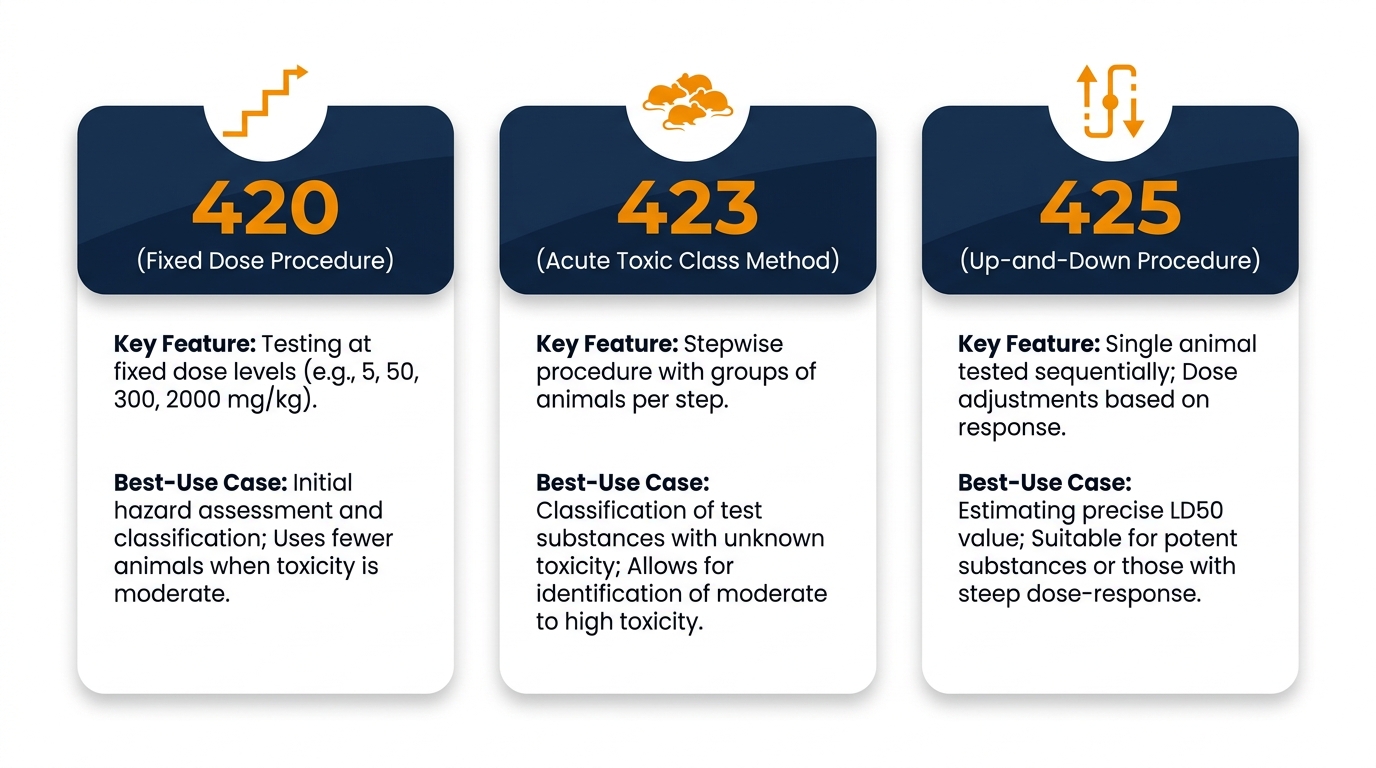
Three OECD test guidelines define modern acute oral toxicity testing. Each represents a refinement over older LD50 methods, with explicit emphasis on reducing animal use while maintaining scientific validity.
| Guideline | Method | Key Feature | Best Suited For |
|---|---|---|---|
| OECD 420 | Fixed Dose Procedure | Predefined dose levels (5, 50, 300, 2000 mg/kg) with sighting study | Hazard classification with clear evidence of toxicity |
| OECD 423 | Acute Toxic Class Method | Stepwise dosing in small groups | GHS hazard classification |
| OECD 425 | Up-and-Down Procedure | Sequential single-animal dosing | Point estimate of LD50 with minimum animals |
For deeper context, the OECD Guidance Document on Acute Oral Toxicity Testing helps sponsors choose between these methods based on data needs.
GLP Compliance: When It Matters and When It Does Not
Good Laboratory Practice (GLP) is a quality system defined by the OECD for the planning, conducting, documenting, reporting, and archiving of non-clinical safety studies. It is not always mandatory for every acute toxicity study, but it is essential for studies submitted to support regulatory filings such as IND or CTA applications.
The strategic question is not “GLP or not” but “GLP when.” Early screening, candidate triage, and proof-of-concept studies often function effectively under non-GLP conditions, provided documentation and methodology remain rigorous.
When GLP is Typically Expected
Pivotal studies that directly support regulatory submissions require GLP. The data integrity, traceability, and quality assurance overlay that GLP imposes are non-negotiable when the study underwrites human exposure decisions or product approval.
When Non-GLP is Sufficient
Non-GLP is appropriate for internal decision-making and early candidate selection. Even outside GLP, validated methods, complete documentation, proper animal welfare protocols, and traceable raw data remain essential. Biotech Farm applies the same scientific rigor to non-GLP work.
What Sponsors Should Receive: Deliverables That Drive Decisions
The deliverables from a single dose toxicity study should not be a data dump — they should be a decision-ready package. At minimum, sponsors should expect a structured study report, raw data with traceability, summary tables of clinical observations and pathology findings, and — when relevant — recommendations for dose selection in subsequent studies.
Typical Report Sections and What Reviewers Look For
A standard toxicology report contains an executive summary, study objectives, materials and methods, results, discussion, and conclusions. Reviewers — whether internal stakeholders or regulators — focus on protocol adherence, completeness of observations, statistical handling, and the clarity of conclusions in relation to the original objectives.
Data Integrity and Traceability
Even outside GLP, data integrity is non-negotiable. Each observation should be attributable, legible, contemporaneous, original, and accurate — the ALCOA principles. This discipline protects the program if data are later reviewed by regulators or external partners.
Standard Deliverable Checklist
- Signed final study report with executive summary
- Raw data with complete audit trail
- Summary tables of clinical observations, body weights, and pathology
- Dose selection recommendations for subsequent studies
- Archiving documentation aligned with regulatory expectations
Business Need to Service Mapping
Understanding how specific sponsor needs map to Biotech Farm’s capabilities enables faster, more targeted collaboration. The table below outlines the most common business requirements and the corresponding service approach.
| Business Need | How Biotech Farm Supports It |
|---|---|
| Rapid go/no-go decision | Streamlined study design with defined timelines and clear endpoints |
| Large animal model access | On-site facility with pig, rabbit, sheep, and goat capabilities |
| Scientific guidance | Senior team with 30+ years of research management experience |
| Flexible compliance level | Both GLP-aligned and non-GLP study designs available |
| Local Israeli sponsor support | On-the-ground project management and direct communication |
| Integration with broader safety program | Seamless transition from single-dose to repeat-dose work |
Biotech Farm Methodology: Data-Driven Dose Selection
Dose selection is a scientific exercise, not a guess. The process draws on existing in vitro data, physicochemical properties, pharmacology rationale, and — when needed — a sighting study to anchor the starting dose. OECD 420 formalizes a sighting study approach to identify a tolerated starting point before the main study commences.
The ethical mandate runs in parallel: doses should be informative without causing excessive distress. Biotech Farm’s approach blends data-driven dose calibration with rigorous animal welfare protocols, reflecting the facility’s commitment to the 3Rs — Replacement, Reduction, and Refinement.
Common Pitfalls That Delay Acute Toxicity Testing Timelines
Several recurring issues extend timelines: incomplete characterization of the test article before study start, inadequate stability or formulation data, ambiguous protocols, late changes to dose levels, and insufficient communication between sponsor and CRO. Each delay has a cost beyond calendar time — it shifts downstream development milestones and can affect funding cycles.
Proactive planning, including a pre-study scientific dialogue and clearly defined responsibilities, prevents most of these pitfalls. Biotech Farm’s collaborative model emphasizes upfront alignment, ensuring that the protocol reflects the actual biology of the test article and the actual decision the sponsor needs to make.
⚠ Pitfall #1
Incomplete test article characterization before study initiation delays formulation preparation and can invalidate dose accuracy.
⚠ Pitfall #2
Ambiguous or incomplete protocols require mid-study amendments, triggering regulatory scrutiny and extending timelines by weeks.
⚠ Pitfall #3
Insufficient CRO-sponsor communication results in misaligned expectations on scope, timeline, and deliverable format.
Advancing from Single Dose to Repeat-Dose Toxicity Studies
A single dose toxicity study is rarely the endpoint — it is the foundation. Data from acute studies inform the design of repeat-dose programs: dose range, monitoring intensity, and species selection. The ICH M3(R2) guidance frames the timing and types of nonclinical safety studies expected at each clinical phase, and the European Medicines Agency provides parallel direction on repeated-dose toxicity.
Sponsors who treat the single-dose study as a strategic stepping stone — rather than a regulatory checkbox — extract maximum value from the investment. The data generated should directly inform the next study, the IND-enabling package, and ultimately the human starting dose.
“A single dose study is most valuable when it is designed backward from the decision it needs to enable — not forward from a regulatory template. Know your question first; then design the study.”
— Adir Koreh, CEO, Biotech Farm Ltd.
Frequently Asked Questions
Ready to Plan Your Single Dose Toxicity Study?
Are you weighing how a single dose toxicity study fits into your development roadmap, or trying to decide between non-GLP screening and a regulatory-grade design? Biotech Farm’s team combines a state-of-the-art large animal facility, decades of research leadership, and a collaborative scientific approach that adapts to your program’s specific questions.
This article is intended for informational purposes for pharmaceutical and biotech development professionals. Study design requirements vary by regulatory jurisdiction, test article, and program stage. Consult with qualified regulatory and scientific advisors before initiating any preclinical program.