Written by a team with more than 20 years of hands-on practice in large animal model setup — led by Adir Koreh, CEO of Biotech Farm LTD, working alongside the most experienced team of veterinarians in the region, together for more than a decade.
Pig Anesthesia Protocols Research: Protocols, Monitoring, and Surgical Preparation in Research Pigs
Anesthesia in research pigs sits at the intersection of veterinary medicine, animal welfare, and experimental science. Unlike routine clinical anesthesia, where the primary goal is simply a safe and uneventful procedure, research anesthesia must also protect the integrity of the data being collected. Every physiologic variable influenced by an anesthetic drug, from blood pressure to blood gases, can become a source of experimental noise. Facilities that specialize in large animal preclinical work, such as Biotech Farm, build their anesthesia programs around this dual responsibility: keeping the animal stable and comfortable while keeping the study results clean and reproducible.
Exclusive Insight: In research anesthesia, the anesthetist optimizes for a dataset, not just a patient. Every protocol decision — drug selection, monitoring cadence, warming strategy — either protects or contaminates your endpoints. A well-run anesthesia program is, in effect, part of your study’s quality control system.
Why Does Pig Anesthesia Protocols Research Differ from Routine Clinical Anesthesia?
In a clinical setting, the anesthetist optimizes for one patient. In a research setting, the anesthetist optimizes for a dataset. Protocols must be standardized across animals so that physiologic variability reflects the experimental intervention rather than inconsistencies in anesthesia management. Research procedures are frequently prolonged and noxious, and the protocol must be adaptable to specific experimental endpoints such as hemodynamic measurements or serial blood gas sampling. Ethical committees may also restrict the use of certain drugs or reversal agents if they could confound the study question. A comprehensive narrative review of pig sedation and anesthesia for medical research highlights how species particularities and study design shape every anesthetic decision.
What Exactly Is Balanced Anesthesia in Research Pigs?
Balanced anesthesia combines three components: hypnosis, analgesia, and muscle relaxation or immobilization. The logic is pharmacologic economy. Rather than pushing a single agent to a dose that produces all three effects, the anesthetist administers lower doses of multiple drugs, each targeting one component. This reduces dose-dependent side effects, most importantly cardiovascular depression, which is a persistent problem with both inhalant agents and most injectable anesthetics in pigs.
In practice, balanced anesthesia in swine is delivered through several configurations. Total intravenous anesthesia (TIVA) relies entirely on infusion of injectable drugs. Partial intravenous anesthesia (PIVA) combines a reduced inhalant concentration with an intravenous infusion. Both approaches allow finer control of anesthetic depth and a faster, smoother recovery, which matters greatly when the animal must return to a study schedule or undergo repeated procedures.
How Do You Choose a Protocol Based on Procedure Type and Duration?
The first decision in any porcine sedation protocol is defining the intensity of stimulation and the expected duration. Short, minimally invasive procedures such as imaging sessions or peripheral catheterization may require only deep sedation with monitoring. Open surgical procedures — thoracotomy, laparotomy, vascular device implantation — demand full general anesthesia with intubation, controlled ventilation, advanced monitoring, and active warming throughout. Matching the anesthetic intensity to the procedure avoids both under-treatment, which is an animal welfare failure, and over-treatment, which adds unnecessary physiologic derangement.
Sedation is adequate for non-painful interventions of short duration where spontaneous breathing and stable positioning can be maintained. General anesthesia becomes mandatory for any painful, invasive, or prolonged procedure, and for any intervention requiring complete immobilization and unconsciousness. The dividing line is the nociceptive load: if the procedure would be painful in a human patient, a research pig deserves the same standard of unconsciousness and analgesia.
In research anesthesia, the anesthetic plane must be assessed through standardized scoring systems — converting subjective impressions into reproducible data points that can be compared across animals and study days. — Biotech Farm Anesthesia Team Practice
What Does Step-by-Step Pig Surgical Preparation Look Like?
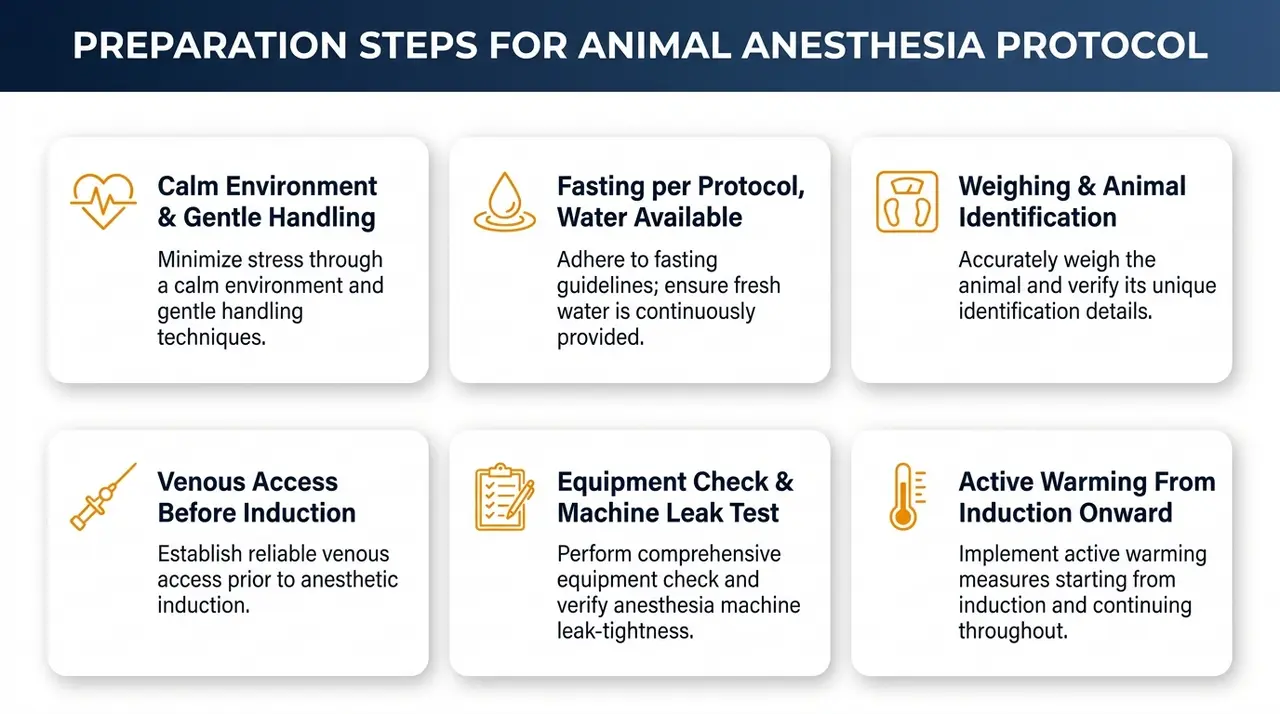
Good pig surgical preparation begins long before the first incision. The sequence is roughly: prepare the work environment, minimize stress, apply an appropriate fasting interval, weigh and identify the animal, establish venous access, induce anesthesia, intubate, disinfect the surgical site, and establish a sterile field. Each step reduces a specific category of risk. Proper preparation lowers the incidence of laryngospasm, hypoxemia, and hypothermia, and a calm animal arriving at induction typically requires a lower dose of induction agent, which translates into a more stable first thirty minutes of anesthesia.
| Preparation Step | Primary Risk It Controls |
|---|---|
| Calm environment and gentle handling | Catecholamine surge, erratic induction |
| Fasting per protocol (food withheld, water usually not) | Regurgitation and aspiration |
| Weighing and identification | Dosing errors, animal mix-ups |
| Venous access before induction | Delayed emergency drug delivery |
| Equipment check and machine leak test | Ventilator failure mid-procedure |
| Active warming from induction onward | Perioperative hypothermia |
Which Equipment Must Be Ready Before Induction?
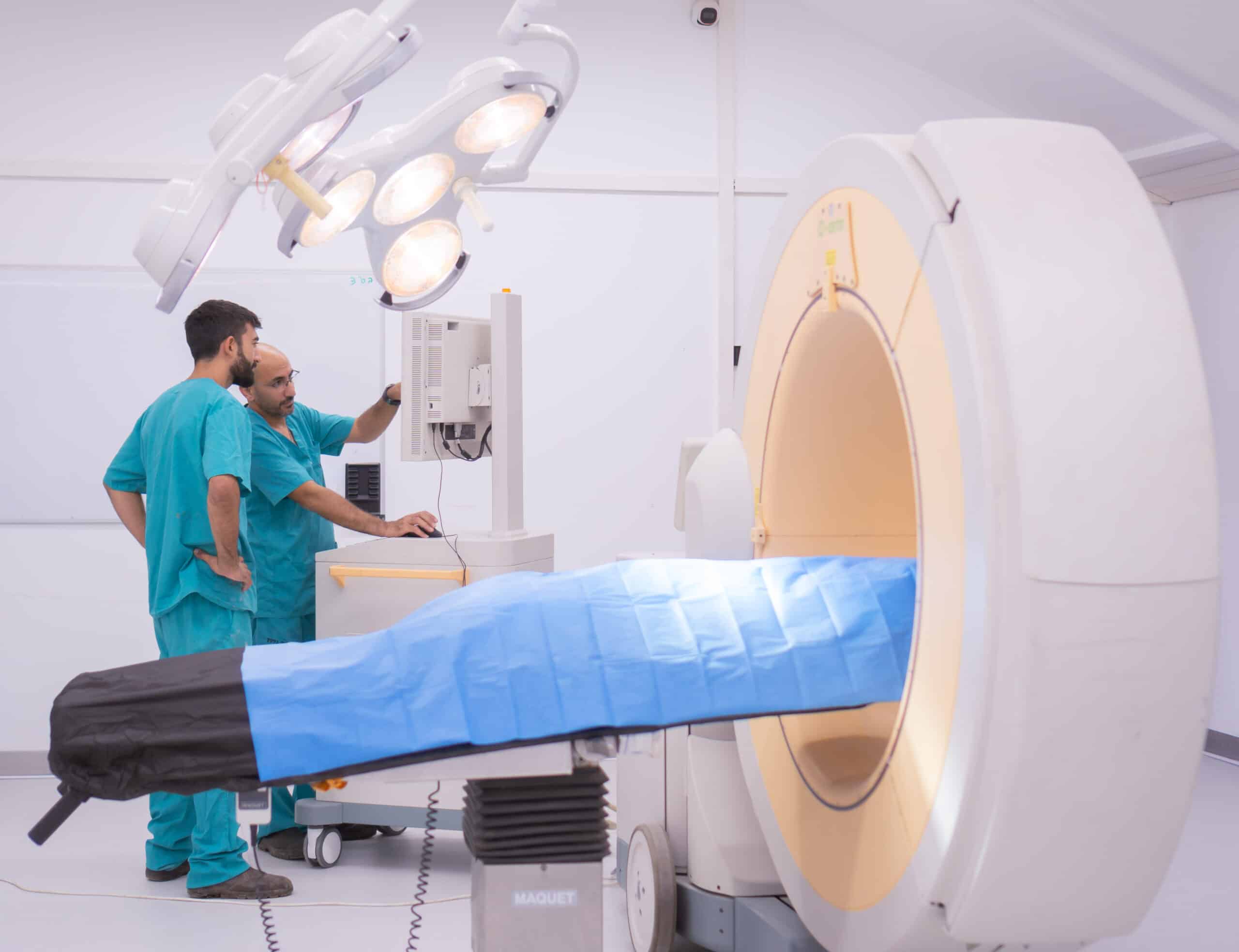
The checklist is long because every missing item becomes a crisis if it is needed mid-procedure. Essentials include a calibrated anesthesia machine with vaporizer, an oxygen source, a breathing circuit, endotracheal tubes in several sizes, a laryngoscope with appropriate blades, intravenous catheters and fluids, warming devices, and a full monitoring stack: ECG, pulse oximeter, capnograph, blood pressure capability, and a temperature probe. Emergency drugs for resuscitation and malignant hyperthermia response should be drawn up or immediately accessible. Facilities like Biotech Farm maintain this equipment in dedicated, well-equipped surgical suites precisely because a missing capnograph or a cold recovery area can compromise both welfare and data quality in a single afternoon.
What Belongs in the Mandatory Anesthesia Record?
The anesthesia record is a scientific document as much as a clinical one. It should capture every anesthetic drug with dose, route, and time; physiologic parameters recorded at fixed intervals; fluid therapy; surgical events and timing; and recovery observations. This documentation serves two masters. Clinically, it enables pattern recognition across procedures. Scientifically, it is the evidence base for reproducibility and regulatory compliance, allowing a reviewer to reconstruct exactly what the animal experienced and when. Standards from human anesthetic practice, such as the recommendations for monitoring during anesthesia and recovery, have influenced how laboratory animal records are structured, including five-minute recording cycles for key parameters.
How Long Should Pigs Fast Before Anesthesia?
The general rule is food withheld for at least eight hours before induction, with water typically not withheld. Fasting reduces the risk of regurgitation and aspiration, which in pigs can cause severe pulmonary complications. Withholding water is generally discouraged because it promotes dehydration and hypotension, both of which complicate induction and worsen outcome. Whatever the general rule, the institutional veterinary and ethics protocol always governs; some studies require modified fasting to protect metabolic measurements.
How Do You Reduce Pre-Sedation Stress in Pigs?

Stress is not merely an emotional problem, it is a physiologic confound. A frightened pig arrives at induction with elevated catecholamines that disrupt heart rate and blood pressure, making drug titration erratic and complicating any between-group comparison. The practical countermeasures are simple and effective: minimize noise and unfamiliar people, work with experienced handlers the animals recognize, and administer pre-medication when the pig is calm in a familiar environment. Pigs are surprisingly social animals, and consistent, gentle handling produces animals that are markedly easier to anesthetize safely. This is one reason why well-run facilities invest so heavily in animal care staff: the quality of daily husbandry directly determines the quality of the anesthesia.
What Does a Common Porcine Sedation Protocol Before Intubation Look Like?
Pre-medication in pigs typically combines a sedative with a dissociative agent, sometimes with an anticholinergic or benzodiazepine added. Common combinations include tiletamine/zolazepam with an alpha-2 agonist, or ketamine-based combinations with adjuncts for muscle relaxation and analgesia. The goals are chemical restraint deep enough to permit venous access, suppression of stress responses, and a smooth transition to induction and intubation. The specific cocktail depends on the study: a cardiovascular protocol may avoid drugs with strong chronotropic effects, while a neurophysiology study may exclude agents that alter intracranial dynamics. Detailed institutional guidance, such as the University of Michigan guidelines on anesthesia and analgesia in swine, illustrates how these combinations are structured in practice.
IM or IV: Choosing the Pre-Medication Route
Intramuscular injection is the workhorse for initial sedation in uncooperative animals, since it does not require established venous access. Once the animal is sedated and an intravenous line is placed, subsequent drug administration shifts to the IV route, which offers faster onset, finer titration, and continuous infusion options.
When Should Antagonists Be Considered?
Reversal agents can shorten recovery, but they introduce abrupt physiologic shifts, rebound arousal, and sometimes pain when analgesic components are reversed along with sedative ones. Any use of antagonists should be justified in the written protocol and applied consistently across all animals in a study group, never selectively.
How Do You Intubate a Pig Safely, and What About Laryngospasm?
Pig intubation is anatomically challenging: the larynx is angled, the epiglottis is prominent, and the airway is unforgiving of rough handling. The technique requires careful alignment of the head and neck, laryngoscopic exposure of the epiglottis, and gentle advancement of the tube, ideally guided by a stylet and assisted by topical lidocaine applied to the larynx to reduce laryngospasm. Laryngospasm is a genuine hazard in swine and can produce rapid hypoxia if not anticipated. Slowing down, using local anesthetic on the glottis, and having appropriately sized tubes ready are the practical defenses.
Warning: Confirmation of tracheal placement should never be assumed. Capnography is the definitive confirmation — a sustained end-tidal CO2 waveform over several breaths excludes esophageal intubation with near certainty. Common mistakes include poor head positioning, wrong tube size, laryngeal trauma from repeated attempts, and unrecognized esophageal intubation.
What Is TIVA, and When Is It Preferred Over Inhalants?
Total intravenous anesthesia delivers the entire anesthetic through infusion, commonly propofol or ketamine-based combinations. TIVA is preferred when the study demands stable blood gases and ventilation without the confounding effects of inhalational agents, which are known to influence vascular tone, cerebral blood flow, and organ protection pathways. For pharmacokinetic studies or investigations where an inhaled agent would interfere with the measured endpoint, TIVA is often the only defensible option. The trade-off is logistical: infusions require pumps, dedicated venous access, and vigilant depth assessment because there is no vaporizer dial to turn down.
Why Is PIVA So Common in Research Pigs?
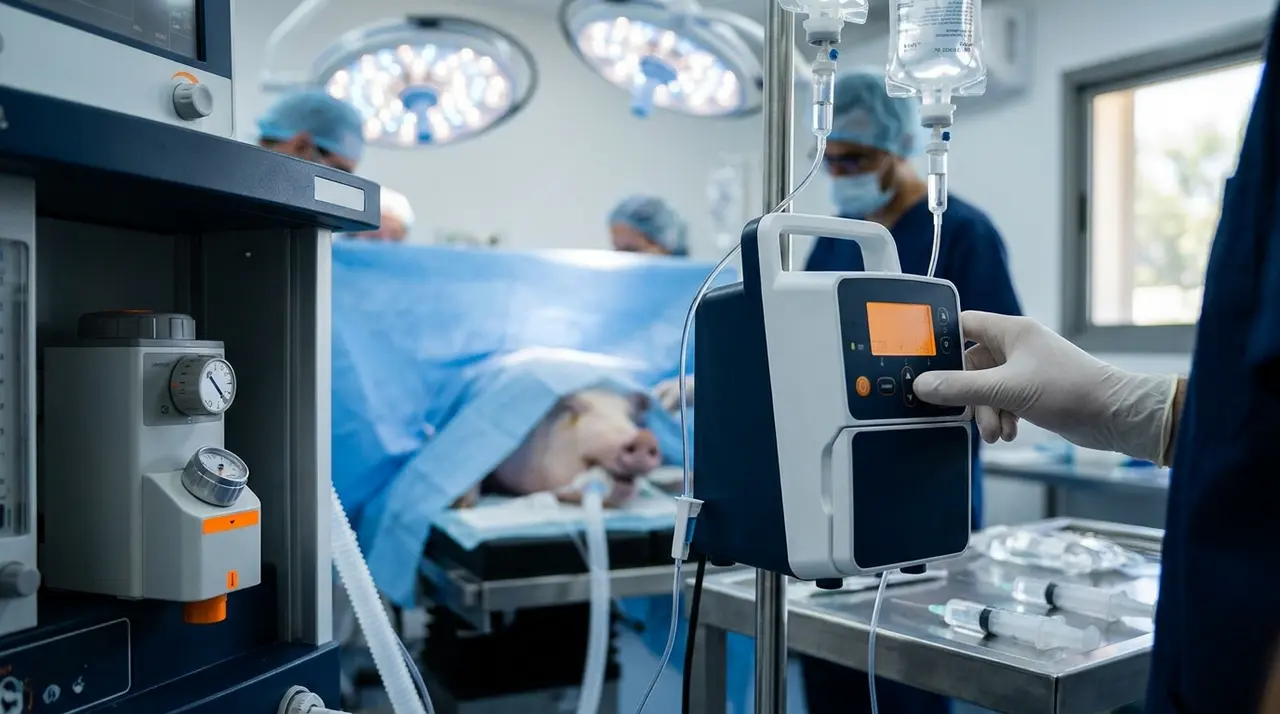
Partial intravenous anesthesia combines a reduced concentration of inhalant with a continuous infusion of an analgesic or sedative agent. The appeal is balance: the inhalant provides easy, moment-to-moment titration, while the infusion supplies anti-nociceptive depth that allows the vaporizer setting to drop. Lower inhalant concentrations mean less cardiovascular depression, better hemodynamic stability, and often a quicker, better-quality recovery. For long porcine surgeries, PIVA has become a default approach because it distributes the pharmacologic burden across drug classes instead of exhausting the tolerance of any single one.
Which Parameters Define Adequate Swine Anesthesia Monitoring?
The minimum monitoring set includes heart rate or ECG, respiratory rate, body temperature, assessment of reflexes and jaw tone, and mucous membrane color. The ideal set adds invasive or non-invasive blood pressure, pulse oximetry, capnography, and blood gas sampling where the study requires it. No single parameter is sufficient on its own; a pig can show a normal heart rate while being profoundly hypotensive, or a normal SpO2 while developing serious hypercapnia. Continuous, multi-parameter observation is what catches deterioration early, and integrating that data stream into a coherent record is what makes the monitoring scientifically useful.
| Parameter | Minimum Standard | Research Addition |
|---|---|---|
| Cardiovascular | Heart rate, mucous membranes | ECG, arterial blood pressure |
| Respiratory | Respiratory rate, chest excursion | SpO2, EtCO2, blood gases |
| Depth | Reflexes, jaw tone | Standardized scoring, response to stimuli |
| Thermal | Intermittent temperature | Continuous core temperature probe |
How Often Should Parameters Be Recorded?
Vital signs should be documented at regular intervals, typically every five to fifteen minutes depending on procedural stability, with immediate recording whenever the animal’s condition changes. Every entry should capture the monitored parameters, any drugs given, fluid therapy, and interventions performed. This cadence is not bureaucratic overhead; it is the resolution at which physiologic trends become visible, and trends are what distinguish a stable anesthetic from a slowly deteriorating one.
Methodology Insight: Monitoring targets should be pre-specified before the procedure begins — framed as physiologic ranges that both protect welfare and preserve the study question. When targets are defined in advance, the anesthetist is not improvising, and the data collected during anesthesia is not inadvertently steering the experiment.
How Do You Assess Depth When Neuromuscular Blockers Are on Board?
Neuromuscular blockade removes the most familiar depth indicators: movement, reflexes, and jaw tone all disappear regardless of anesthetic depth. Assessment must shift to autonomic parameters — heart rate and blood pressure responses to stimuli, EtCO2 trends — and where available, processed depth indicators. Paralysis can mask pain, so analgesia must be generous and pre-emptive, and the plan for depth assessment under blockade must be written into the protocol before the first animal is anesthetized. An animal that is paralyzed but under-anesthetized is the single most serious welfare failure possible in a surgical research setting.
What Is a Normal EtCO2, and What Do Changes Mean?
End-tidal CO2 approximates arterial CO2, with a typical target range of 35 to 45 mmHg under controlled ventilation. A rising EtCO2 suggests hypoventilation, an airway leak, rebreathing, or, in the worst case, developing malignant hyperthermia. A falling EtCO2 suggests hyperventilation, over-breathing of the circuit, or a drop in cardiac output. The response algorithm is systematic: check the breathing circuit for leaks, assess respiratory rate and tidal volume, verify equipment function, and adjust ventilation parameters accordingly. The underlying physiology of capnography is well described in reviews of monitoring equipment basics, and it is a skill every member of an anesthesia team should be able to perform without hesitation.
How Do You Prevent Hypothermia in Anesthetized Pigs?
Anesthesia disables thermoregulation, and pigs are particularly vulnerable because of their relatively hairless skin and large surface area. Hypothermia is not benign: it prolongs recovery, impairs coagulation, alters drug metabolism, and adds physiologic variability that can quietly distort study data. Prevention starts at induction, not at the first temperature drop. Active warming surfaces, insulating coverings for exposed regions, warmed intravenous fluids, and warmed inspired gases, combined with continuous temperature monitoring, keep the animal in range throughout long procedures.
Why Are Some Pigs Susceptible to Malignant Hyperthermia?
Certain pig populations carry a genetic predisposition to malignant hyperthermia, a hypermetabolic crisis triggered by volatile anesthetics and succinylcholine. The presentation is dramatic: rapidly rising core temperature, muscle rigidity, metabolic acidosis, and a climbing EtCO2 that does not respond to ventilation adjustment. The response must be immediate: discontinue trigger agents, hyperventilate with pure oxygen, initiate active cooling, and administer dantrolene. Because minutes matter, core temperature monitoring is strongly recommended for all long procedures, and emergency protocols should be rehearsed, not merely written. Reviews such as the NCBI StatPearls chapter on malignant hyperthermia provide the clinical detail teams need before they encounter their first crisis.
How Do You Build an Analgesia Protocol That Reduces Research Noise?
Pain itself is a confound. An under-treated animal mounts stress responses that alter endocrine, immune, and cardiovascular measurements, so sloppy analgesia is not more scientific, it is less. A sound protocol defines the expected pain level for the procedure, uses multimodal analgesia combining opioids, alpha-2 agonists, and local or regional techniques, administers it consistently and pre-emptively, and documents pain assessment during recovery. Consistency across animals is what makes the analgesia transparent to the dataset rather than another hidden variable. For deeper species-specific guidance, the overview of anesthetic procedures and techniques in pigs is a useful reference.
What Complications Should Every Team Anticipate?
Hypotension
May respond to reduced anesthetic depth, fluid bolus, or vasopressor support. Caught early through continuous blood pressure monitoring.
Hypoventilation
Addressed through ventilation adjustment or reversal of excessive anesthetic depth, guided by capnography.
Hypothermia & Laryngospasm
Prevented with active rewarming from induction onward, and with topical lidocaine plus gentle airway technique.
How Do You Ensure a Smooth and Safe Recovery?
Recovery is a high-risk window that deserves the same attention as induction. The essentials are a warm, quiet, supervised recovery area; continued monitoring of vital signs until the animal is fully conscious; protection of the airway, with extubation only when swallowing and airway reflexes have returned; and effective post-operative analgesia. Early detection of complications during recovery — hypothermia, pain, or respiratory distress — prevents small problems from becoming terminal ones, and a calm, comfortable recovery protects both the animal’s welfare and the timeline of the study.
What Facilities and Ethical Approvals Does Pig Anesthesia Research Require?
On the infrastructure side, research pig anesthesia requires a dedicated anesthesia machine, monitoring equipment, intubation supplies, emergency drugs, warming devices, and separate, appropriate areas for induction and recovery. On the ethical side, every protocol must be approved by an Institutional Animal Care and Use Committee or the equivalent national body, adhering to the 3Rs principles of replacement, reduction, and refinement. Personnel must be qualified for the species and procedures they perform, and the justification for animal use, the minimization of pain and distress, and the adequacy of the anesthetic plan are all subject to committee scrutiny before the study begins. Facilities such as Biotech Farm operate within these regulatory landscapes routinely, aligning study design with ethical requirements so that sponsors do not discover compliance problems mid-project.
The Result: Standardized protocols, experienced personnel, well-maintained equipment, and a genuine culture of animal welfare together make data reproducible. Strict adherence to anesthetic protocols reduces between-animal variability attributable to anesthesia rather than the experimental intervention — which strengthens statistical power and reduces the number of animals needed, a welfare gain as well as a scientific one.
What Trends Are Shaping the Future of This Field?
Three directions stand out. First, multimodal analgesia is expanding, with growing use of regional techniques such as epidural and local infiltration blocks that reduce systemic drug burden. Second, monitoring is becoming less invasive and more continuous, with integrated platforms that stream physiologic data in real time and flag deviations automatically. Third, anesthesia is becoming more personalized: dose regimens adjusted to the individual animal’s response rather than applied by weight alone. Each trend serves the same dual goal of better welfare and cleaner data, and teams wanting a broader clinical grounding can consult the open chapter on swine analgesia, sedation and anesthesia for large animal practice.
Frequently Asked Questions About Pig Anesthesia Protocols Research
Where Should You Go From Here?
Which anesthetic decisions in your current study protocol carry the greatest risk of confounding your endpoints, and when did you last have them reviewed by a team that anesthetizes large animals every day? If you are planning a preclinical study in pigs and want a facility with the surgical infrastructure, monitoring capabilities, and experienced staff to carry it out to a high standard, Biotech Farm offers exactly that environment.