Pig Housing Welfare in Preclinical Facilities: The Complete Operational Guide
With over 20 years of hands-on experience in large animal model setup, our team at Biotech Farm has managed swine housing across hundreds of preclinical studies — and we can state one fact with certainty: housing welfare is not a compliance checkbox. It is a primary determinant of your study’s scientific validity. Every protocol we run is built on the principle that ethical animal care and reliable data are the same investment.
Expert Insight
Stress does not merely discomfort the animal — it actively alters physiology in ways that are indistinguishable from treatment effects. Cortisol elevation, inflammatory shifts, and fragmented sleep all introduce noise into your data. In our experience, the single most cost-effective intervention for data quality is not better instrumentation — it is environmental stability paired with a rigorous enrichment protocol.
What Is a Pig Housing Welfare Preclinical Facility?
A pig housing welfare preclinical facility is a specialized research environment in which swine are kept under rigorously controlled conditions that serve two goals at once: ethical animal care and scientific reliability. Such a facility combines housing design, environmental control, biosecurity, enrichment, and documentation into a single operational system. Every element, from pen dimensions to daily observation routines, is defined in advance and recorded over time.
Most facilities operate under written Standards of Care, often called SOPs, that specify daily routines, environmental monitoring thresholds, and incident reporting. The underlying welfare principles embedded in these protocols are consistent across the field: good housing, good health, appropriate behavior, and proper nutrition. When all four are satisfied simultaneously, the animals experience less stress and the data generated from studies become more dependable, which is the entire point of preclinical work.
Why Does Housing Welfare Determine Research Quality?
Stress, pain, and unstable environmental conditions do not merely discomfort the animal. They actively alter physiology and behavior in ways that introduce noise into experimental results. Cortisol levels rise, inflammatory markers shift, appetite changes, sleep patterns fragment, and aggression increases. A researcher measuring a cardiac device or a metabolic compound cannot distinguish drug effects from stress effects if the housing environment is unstable.
Good welfare practice also reduces attrition. Fewer injuries, fewer bite wounds, and fewer health impairments mean fewer animals drop out mid-study, which protects both the study timeline and the statistical power of the experiment. Academic preclinical centers, such as the Ben-Gurion University Preclinical Research Services Center, explicitly link pain reduction, environmental enrichment, and defined experiment termination limits to research integrity, and this linkage is now standard thinking across the industry.
Which Regulatory Frameworks Guide Swine Housing in Research?
Swine housing in research facilities is governed by layers of requirements. At the base sit national animal welfare laws, which establish the legal authority for regulating housing conditions, transport, and prevention of cruelty. In Israel, the Animal Welfare Law (1994) provides this foundation, covering conditions of holding, transport, and abuse prevention for all regulated facilities.
Above the law sit institutional procedures. Ethics committees or IACUC-equivalent bodies review every protocol, and internal SOPs translate broad legal language into concrete daily practice: what temperature range is acceptable, how often enrichment must be refreshed, what triggers an incident report. General regulations typically address cleanliness, maintenance, waste disposal, utilities, and disease risk, while institutional documents add the monitoring specifics that regulators deliberately leave to each facility.
What Does an Operational Swine Housing Checklist Look Like?
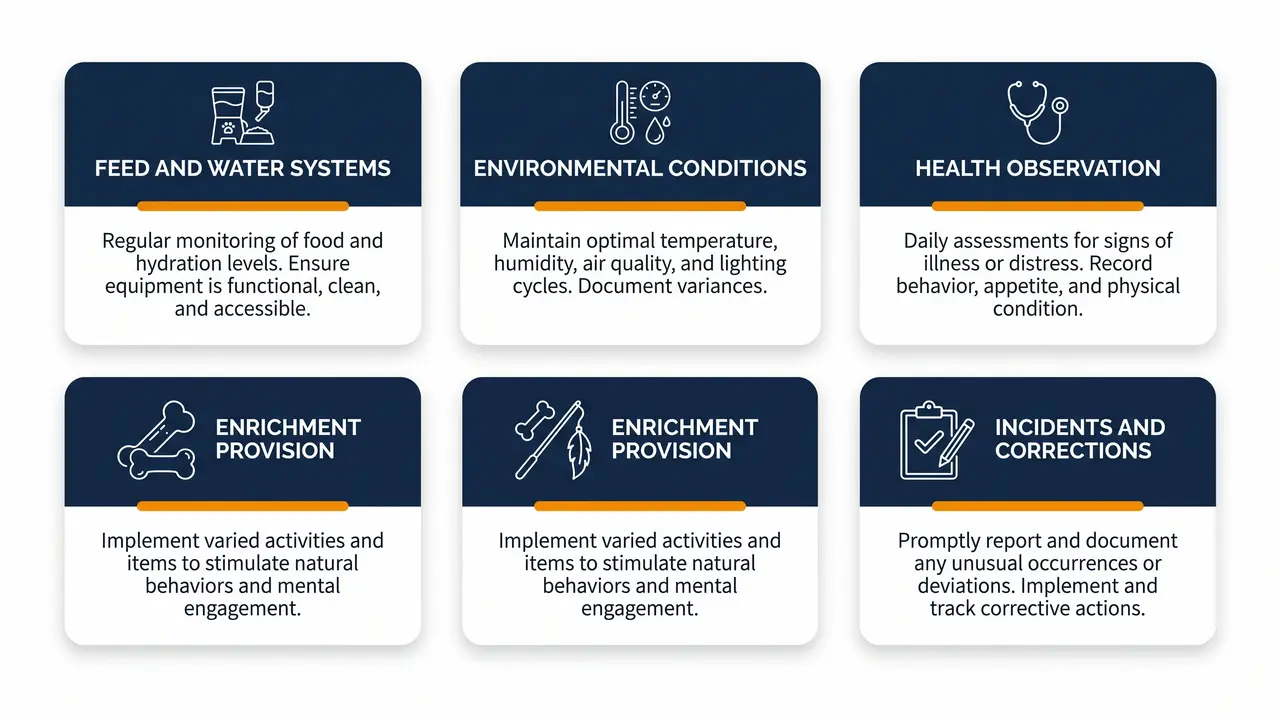
Practical swine housing standards translate into daily and weekly checklists. Daily checks verify feeder and drinker function, inspect floor and enclosure integrity, and look for signs of distress, lameness, or injury. Weekly checks tend to be broader: deep cleaning verification, enrichment rotation, and review of environmental logs for drift. Any deviation from expected values is documented together with the corrective action taken.
Documentation typically involves four log families: room logs, treatment logs, incident logs, and corrective action records. A governmental procedure on pig keeping, published by the Israeli Ministry of Agriculture, details welfare requirements including bedding and housing conditions, and it maps closely onto the checklist structure used in research settings. The table below shows a typical mapping between checklist domains and their evidence trail.
| Checklist Domain | Frequency | Typical Evidence Recorded |
|---|---|---|
| Feed and water systems | Daily | Feeder function, drinker flow, consumption notes |
| Environmental conditions | Daily min/max | Temperature, humidity, ventilation status |
| Health observation | Daily, twice where required | Appetite, activity, injuries, lameness |
| Enrichment provision | Daily provision, weekly rotation | Materials offered, condition, replacement date |
| Incidents and corrections | As they occur | Description, action, follow-up, sign-off |
How Much Space Do Research Pigs Actually Need?
Space requirements depend on weight, age, physiological status, flooring type, and the research objective. The core principle is that every pig must be able to stand comfortably, lie down fully stretched, and move without constant competition for lying area. Overcrowding raises aggression, injury rates, and stress markers, all of which contaminate study data.
Preclinical research adds a wrinkle: equipment and monitoring constraints sometimes necessitate specific pen designs that differ from farm standards. The practical approach is to establish internal density ranges by weight category and then link those ranges to measurable indicators such as injury frequency, aggression counts, and lying time. Facilities like Biotech Farm’s Advanced Facility illustrate how large animal housing can be planned around both welfare parameters and the technical demands of device and pharmaceutical studies.
Group Housing or Individual Housing: Which Should Be the Default?
The welfare default is social housing whenever feasible. Pigs are highly social animals, and group housing supports natural interaction, play, and hierarchy formation. But group housing is not automatic welfare: it requires careful management of aggression, stable group composition, and sufficient resources so that competition does not escalate into injury.
When is individual housing justified?
Individual housing is justified after procedures, during recovery, when infection risk requires isolation, when injuries need protection, or when a study demands individual measurements such as metabolic monitoring. In all of these cases the facility must compensate with enhanced enrichment, more human interaction, and rigorous monitoring, because isolation without compensation is itself a welfare cost.
What Temperature and Humidity Targets Apply in Pig Rooms?
Temperature and humidity targets should be set by age and weight class, since a piglet and an adult sow have very different thermal needs. What matters more than the exact number is stability: many SOPs require daily minimum and maximum recordings, with defined alert thresholds and pre-planned corrective actions when values drift outside range.
Continuous monitoring reduces heat and cold stress events, both of which negatively affect welfare and experimental data alike. A heat-stressed pig shows altered circulation, respiration, and behavior, and those changes can persist well beyond the stress event itself. Recording the values, rather than simply trusting the HVAC system, creates the traceability that inspectors and ethics committees expect.
A Scenario: Ventilation Failure at 02:00
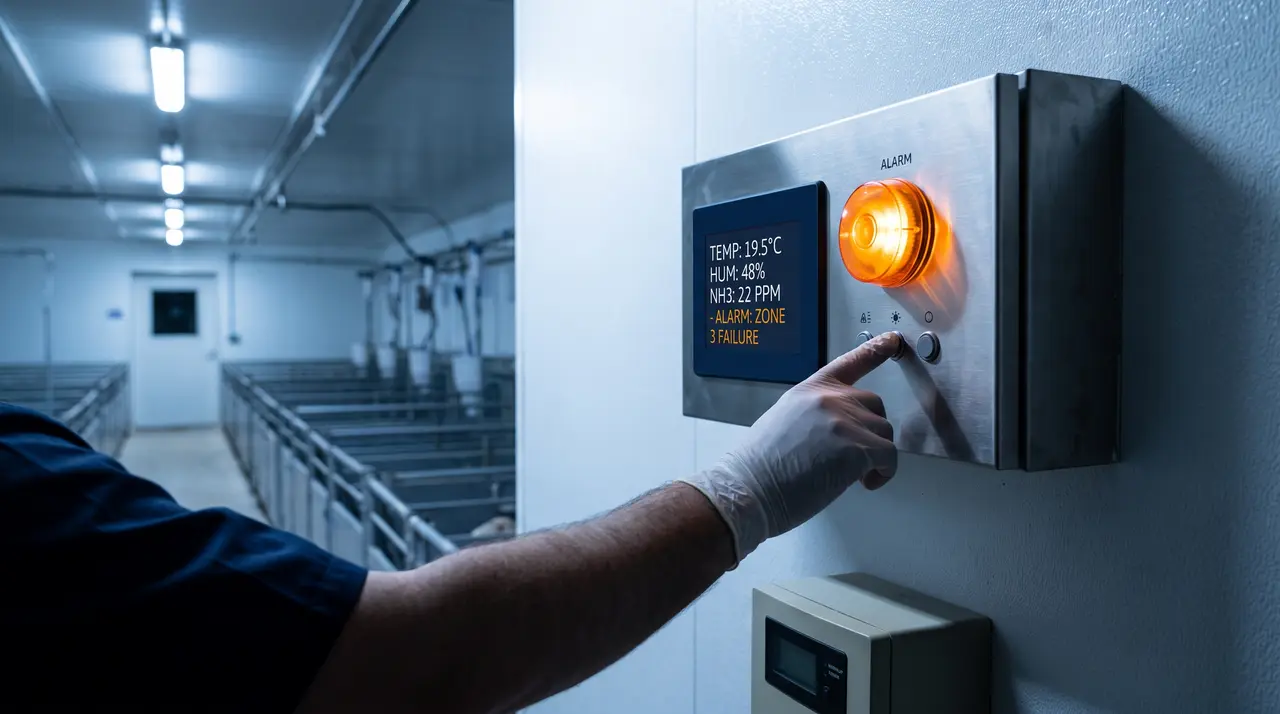
Consider a facility where the ventilation system fails overnight. Within hours, ammonia accumulates, humidity rises, and the thermal load climbs. By morning, without alarms and a response plan, the entire herd is stressed and a study scheduled for that week is compromised. This scenario explains why ventilation planning is treated as a safety system, not a comfort feature.
Effective ventilation maintains air quality by removing gases, dust, and excess humidity while stabilizing temperature. Planning includes defined air quality targets, scheduled filter maintenance, power backup, and a written emergency procedure for system failure. Environmental regulation of animal facilities, as covered in governmental guidance on livestock facility management, reinforces the same infrastructure and waste management principles that research facilities adopt.
⚠ Critical Warning
A ventilation failure handled poorly at 02:00 is only recoverable if the night shift knows the alarm thresholds, backup procedures, and escalation contacts without looking them up under pressure. Emergency plans that exist only on paper — never drilled — will fail exactly when they are needed most.
Which Flooring and Bedding Choices Make Sense?
Flooring and bedding decisions balance four factors: ease of cleaning, biosecurity, injury prevention, and compatibility with enrichment. Bedding such as straw improves comfort and resting quality and doubles as enrichment material, but it complicates sanitation and can increase contaminant risk if it becomes wet or moldy. The UK’s official code of practice for pig welfare classifies enrichment materials by whether they are edible, chewable, investigable, and manipulable, with straw and hay rated optimal because they satisfy all four characteristics.
Slatted or partially slatted floors are common in research settings because they simplify hygiene, but they limit bedding options and therefore require adapted enrichment solutions, such as suspended materials, dispensers, or object-based enrichment designed not to fall through the slats. There is no universally correct choice; there is only a documented rationale tied to the study’s infection control requirements.
What Makes an Enrichment Protocol “Effective” Rather Than Decorative?
A porcine enrichment protocol is a written guideline defining which enrichment types are provided, how often they rotate, how they are cleaned and safety-checked, and how success is measured. The distinction between enrichment and decoration is behavioral: effective enrichment allows exploration, chewing, rooting, and manipulation, and it demonstrably reduces boredom-driven behaviors.
Common examples include chewable and investigable materials, appropriate ropes, rotating objects, and controlled food-based enrichment. UK welfare guidance notes that objects like balls and chains lose novelty quickly and are unacceptable alone unless complemented by materials meeting the full enrichment criteria. Academic work on welfare as a dynamic process, such as this Ben-Gurion University publication, supports the principle that enriched environments produce measurable welfare effects that can be tracked over time.
Methodology: Rotation and Replacement — The Part Everyone Forgets
Planned rotation is what keeps enrichment working. Pigs habituate quickly, and an object that occupied them for a week may be ignored in the second week. A protocol that specifies rotation intervals, replacement criteria for worn materials, and a log of what was provided when will outperform an ad hoc approach indefinitely. Habituation is not a failure of the material; it is a predictable process the protocol must anticipate.
How Are Tail Biting and Aggression Actually Reduced?
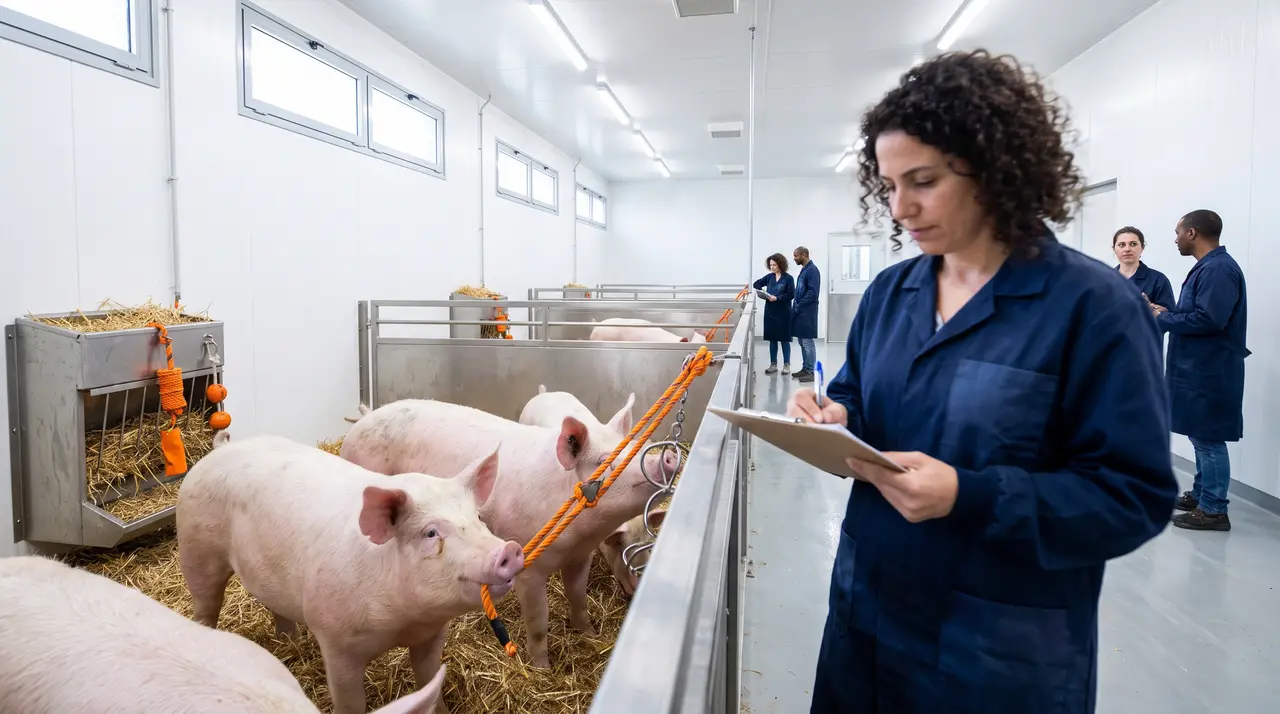
Tail and ear biting are rarely random. They typically signal lacking stimulation, resource competition, or an imbalanced environment such as poor air quality or overcrowding. Reducing them requires combining enrichment, adequate density, stable group management, and continuous access to food and water, with early observation to catch triggers before injuries escalate.
A rapid response protocol matters just as much as prevention. It should include temporary isolation of the victim, injury treatment, enrichment change, and a structured reassessment of environmental conditions. Facilities that provide scientific oversight as a service, such as Biotech Farm’s Scientific Escort services, help research teams address behavioral and welfare problems with a methodical rather than reactive approach.
Case Study: Biosecurity as Welfare
A disease outbreak in a research herd causes suffering, destroys study cohorts, and forces repeat experiments — directly contradicting the reduction principle of the 3Rs. Facilities that implemented controlled access with shower-in protocols, quarantine for new arrivals, documented pest control, and strict clean/dirty zone separation report dramatically fewer cohort losses. Biosecurity is a welfare issue disguised as a logistics issue.
Case Study: Enrichment vs. Stereotypies
Welfare research consistently shows that when enrichment quantity and variety increase, aggressive interactions among group-housed pigs decrease over weekly observation periods. When natural rooting, chewing, and exploratory drives are satisfied, they stop being redirected into harmful activities such as bar biting and sham chewing. Enrichment is a measurable intervention, not a courtesy.
What Do Large Animal Care Standards Include Beyond Housing?
Large animal care standards for pigs extend past the pen itself. They encompass facility safety, feeding and watering systems, veterinary care, staff training, lifting and transport equipment, and emergency planning. Emphasis falls on preventing physical hazards such as sharp edges and broken panels, and on pre-use checks before animals are moved through chutes or restraint systems.
Workflow planning is part of care standards too. Routes should be designed to reduce slips, stress, and staff risk simultaneously, because a frightened pig in a poorly designed corridor is a danger to itself and to handlers. The philosophy behind Biotech Farm’s Unique Approach reflects this integrated view, treating animal handling, staff safety, and study quality as one system rather than separate concerns.
What Does a Daily Husbandry Routine Look Like?
A daily routine opens with welfare and health observation before any task: how are the animals eating, moving, and interacting. Only then do the mechanical checks follow, verifying water delivery through nipple drinkers, confirming feed distribution, and inspecting infrastructure function across the pig housing welfare preclinical facility. Observation first, tasks second, is deliberate, because rushed morning routines miss early signs of distress.
Routine observation covers appetite, activity level, and general demeanor, recorded against each pen or individual animal. Institutional guidelines for animal experimentation applications, such as the Technion’s requirements for experiment applications, embed housing conditions and distress monitoring directly into the approval process, which means the daily routine is not optional housekeeping but a compliance obligation.
How Does Veterinary Care Integrate With the Research Mission?
Veterinary care in a research pig facility includes preventative medicine, health monitoring, diagnosis, and treatment, alongside a compliance role. Routine veterinary checks, vaccination programs, and parasite control are standard, and veterinarians participate in protocol review, ensuring that procedures involving animals meet welfare requirements before approval.
The veterinarian also defines humane endpoints, the pre-agreed criteria for removing an animal from a study. This dual role, clinical and regulatory, is why established providers describe veterinary oversight as an integrated service rather than an on-call function. Comprehensive preclinical programs, such as the services described on the Biotech Farm preclinical research and development homepage, treat veterinary care as one thread running through housing, procedures, and documentation.
A team member who fears reporting an observed welfare problem is a bigger risk than the problem itself, because small welfare issues that go unreported become large ones.
— Field practice insight from two decades of large animal facility management
Documentation: What Records Must Exist?
Comprehensive welfare documentation includes daily logs, individual health records, environmental parameter histories, enrichment logs, and incident reports. Daily logs capture feeding, watering, observations, and enrichment presence. Health records track each animal’s treatments, diagnoses, and responses. Environmental records demonstrate that temperature, humidity, and ventilation stayed within defined ranges.
The purpose of all this paper is traceability and accountability. When a question arises months later, whether from an auditor, a journal reviewer, or a regulator, the records must reconstruct what happened without relying on memory. Overviews of large animal models and their documentation practices, such as the Biotech Farm pig large animal models page, show how documentation and ethical considerations are presented as part of the same service package.
Common Mistakes Facilities Make With Pig Welfare
Several recurring errors undermine otherwise good facilities:
- Treating enrichment as a one-time purchase rather than a rotating program
- Ignoring early behavioral signals until biting becomes visible injury
- Under-documenting environmental conditions, leaving the facility unable to prove stability
- Letting emergency plans exist on paper without drills, so the first real test is the emergency itself
Staff training gaps tie all of these together. A team that has not been trained to recognize subtle pain signals or early distress will miss them, regardless of how well the protocols are written. Ongoing education, rather than a single onboarding session, is what keeps practice aligned with written standards as regulations and best practices evolve.
How Are Emergency Plans Structured?
Emergency plans cover power outages, water supply interruptions, facility breaches, natural disasters, and animal escape. Each scenario specifies roles, responsibilities, communication chains, and evacuation or containment routes. The plans live in a documented format accessible to every shift, including weekends and nights, when senior staff may be absent.
Regular drills and scheduled plan reviews determine whether the plan works. A ventilation failure handled well at 02:00, as described earlier, is only possible if the night shift knows the alarm thresholds, the backup procedures, and the escalation contacts without needing to look them up under pressure.
Which Housing Model Suits Which Research Type?
The choice of housing model balances scientific necessity with welfare considerations, and the balance point differs by study type. A long-term behavioral study and a post-surgical device evaluation have almost opposite requirements. The table below maps the main models to their appropriate uses.
| Housing Model | Best Suited For | Welfare Consideration |
|---|---|---|
| Group housing | Long-term observational and behavioral studies | Supports natural social behavior; manage hierarchy and aggression |
| Individual housing | Metabolic studies, precise individual data collection | Requires enhanced enrichment and extra human interaction |
| Acclimation pens | New arrivals and transition phases | Minimizes arrival stress; allows adaptation before study start |
| Recovery area | Post-procedural care | Quiet, comfortable, closely monitored environment |
| Procedure zone | Examinations and sample collection | Designed for efficiency and minimal disruption to other animals |
How Is Welfare Measured in Practice?
Welfare measurement combines behavioral assessment, physiological indicators, health evaluation, and environmental monitoring. Behaviorally, teams track activity levels, social interactions, and the presence or absence of abnormal behaviors. Physiologically, blood and saliva sampling quantifies stress biomarkers and health status. Environmentally, continuous logging demonstrates that conditions remained within range throughout the study period.
The relationship between enrichment and problematic behavior is one of the clearest measurable links in welfare science. As enrichment quantity and variety increase, aggressive interactions among group-housed pigs tend to decrease over weekly observation periods. When natural rooting, chewing, and exploratory drives are satisfied, they stop being redirected into harmful activities, which is why enrichment sits at the center of every serious welfare protocol.
✓ Success Indicator
Success looks like pigs actively engaging with materials, showing exploration and rooting behavior, and spending time in natural resting postures. Failure looks like stereotypies: bar biting, sham chewing, and repetitive route tracing. Enrichment effectiveness is objectively measurable — treat it that way.
FAQ
Where Do You Go From Here?
Which housing and welfare challenges is your preclinical program facing right now, and would a conversation with an experienced large animal facility help you plan around them? If you are evaluating pig models for device or pharmaceutical research, you can contact Biotech Farm to discuss your study requirements with a team that integrates welfare standards, documentation, and scientific support into a single service.