Swine Models in Biomedical Research: A Practical Guide for Preclinical Studies
Swine models have become a cornerstone of translational biomedical research, bridging the gap between rodent discovery work and human clinical trials. Their physiological, anatomical, and genetic proximity to humans makes them uniquely suited for evaluating drug candidates, medical devices, and surgical procedures with confidence that observations will translate into the clinic.
This guide walks through the practical decisions researchers face when planning porcine work: how to select the right model, when swine outperform rodents, which research areas benefit most, and how to design studies that satisfy both scientific rigor and regulatory expectations. Along the way we address ethical aspects, welfare standards, and the realities of managing large animal preclinical studies.
Expert Insight
Porcine cardiovascular, dermatological, renal, and gastrointestinal systems represent the closest non-primate physiological match to humans. This translational proximity — combined with human-comparable organ sizes — makes swine the most powerful large animal platform for studies where regulatory-grade fidelity to human anatomy determines the success of the entire development program.
Why Are Swine Models Essential in Biomedical Research?
Pigs serve as valuable large animal models because their cardiovascular, digestive, renal, and integumentary systems closely mirror human physiology. This resemblance enables researchers to mimic human disease conditions and predict drug responses more accurately than in rodents, particularly for interventions requiring human-scale anatomy.
Organ sizes such as the heart, kidney, skin, and gastrointestinal tract are directly comparable to humans, facilitating realistic surgical procedures and medical device testing. Naturally occurring disease models exist for hypercholesterolemia and polycystic ovarian syndrome, while genetically engineered lines expand the range of translatable phenotypes. For comprehensive information on leveraging large animal models across R&D pipelines, explore PIG – Large Animal Models for R&D available for preclinical studies. According to published research on swine models, pigs are frequently superior to rodents for conditions where physiological similarity determines translational success.
Key Physiological Advantages of Swine Models
- Human-comparable heart, kidney, and GI organ dimensions
- Cardiovascular hemodynamics and coronary artery anatomy closely matching humans
- Skin structure with similar thickness, follicle density, and collagen content
- Gastrointestinal absorption profiles translatable to human pharmacokinetics
- Naturally occurring disease phenotypes (hypercholesterolemia, PCOS)
Terminology: What Distinguishes Swine, Pig, and Porcine in Research Contexts?
Although often used interchangeably, these terms carry subtle differences in scientific writing. Swine and pig refer to the animal species itself and are essentially synonymous in most biomedical literature. Porcine is an adjective describing anything pertaining to pigs — porcine tissue, porcine genes, porcine cardiovascular anatomy.
In grant applications and peer-reviewed manuscripts, “porcine model” typically emphasizes the experimental system, while “swine study” points to the broader study context. Using these terms with precision improves clarity, particularly when addressing regulatory reviewers or writing for interdisciplinary audiences that expect standardized terminology.
“Precision in terminology is not pedantry — it is the first signal to regulatory reviewers that your team operates at a level of scientific rigor that will carry through every phase of the study.”
— Adir Koreh, CEO, Biotech Farm Ltd.
When Should You Choose a Swine Model Over a Rodent Model?
Model selection begins with the research question. Rodents excel at high-throughput screening, early mechanistic studies, and genetic manipulation. They are cost-effective, reproduce quickly, and offer extensive genetic tools. However, they fall short when translational fidelity to human anatomy or long-term physiology is the priority.
Swine become the model of choice when studies involve surgical procedure development, medical device evaluation, sustained drug delivery, repeated large-volume blood sampling, or human-relevant dosing regimens. They also better recapitulate cardiovascular, dermatological, and gastrointestinal diseases. For conditions such as cystic fibrosis, spinal muscular atrophy, and Parkinson’s disease, porcine models often outperform rodent counterparts by generating phenotypes that more faithfully reflect the human condition.
✅ Choose Swine When…
- Human-scale anatomy is required
- Medical device evaluation is the endpoint
- Surgical procedure development is needed
- Regulatory non-rodent species required
- Long-term chronic studies with stable physiology
???? Rodents Remain Suitable For…
- High-throughput early screening
- Mechanistic pathway studies
- Complex genetic manipulation
- Cost-constrained exploratory phases
- Studies requiring rapid reproduction
Common Mistakes When Selecting an Animal Model
Researchers sometimes default to rodents for cost reasons even when the study endpoint requires human-scale anatomy, leading to poor translational outcomes. Another frequent error is underestimating the need for pilot work to confirm that a chosen swine model expresses the target phenotype. Skipping veterinary consultation on breed and age can also derail otherwise well-designed protocols.
Domestic Pig vs. Minipig: Choosing the Right Swine Model
Both domestic pigs and purpose-bred minipigs offer distinct advantages. The right choice depends on the study duration, target organ, regulatory pathway, and facility capacity.
Domestic Pig Research Model
Domestic pig models use common commercial farm breeds. They are widely available, relatively cost-effective at acquisition, and their larger size supports extensive surgical fields and greater tissue availability. Rapid growth is either an asset (short cardiovascular device studies) or a liability (long chronic studies where stable body weight is desired).
Domestic pigs are frequently selected for cardiovascular, orthopedic, and dermatological work that requires human-scale dimensions.
Minipig: When Is It Preferred?
Minipigs — Göttingen, Yucatan, Hanford, and related lines — were selectively bred for research. They mature at 30–80 kg, making them easier to handle, house, and manage than 200 kg domestic pigs. Genetic uniformity within minipig colonies reduces variability, and they are widely accepted by regulatory bodies as a non-rodent species for preclinical toxicology and drug safety assessments.
Their slower growth rate supports long-term chronic studies where physiological stability matters most.
Comparing Minipigs and Domestic Pigs at a Glance
The following table maps the practical trade-offs that most influence study planning. Choosing between minipigs and domestic pigs is a critical decision when planning successful Preclinical Research And Development Services, directly influencing housing, budget, and endpoint feasibility.
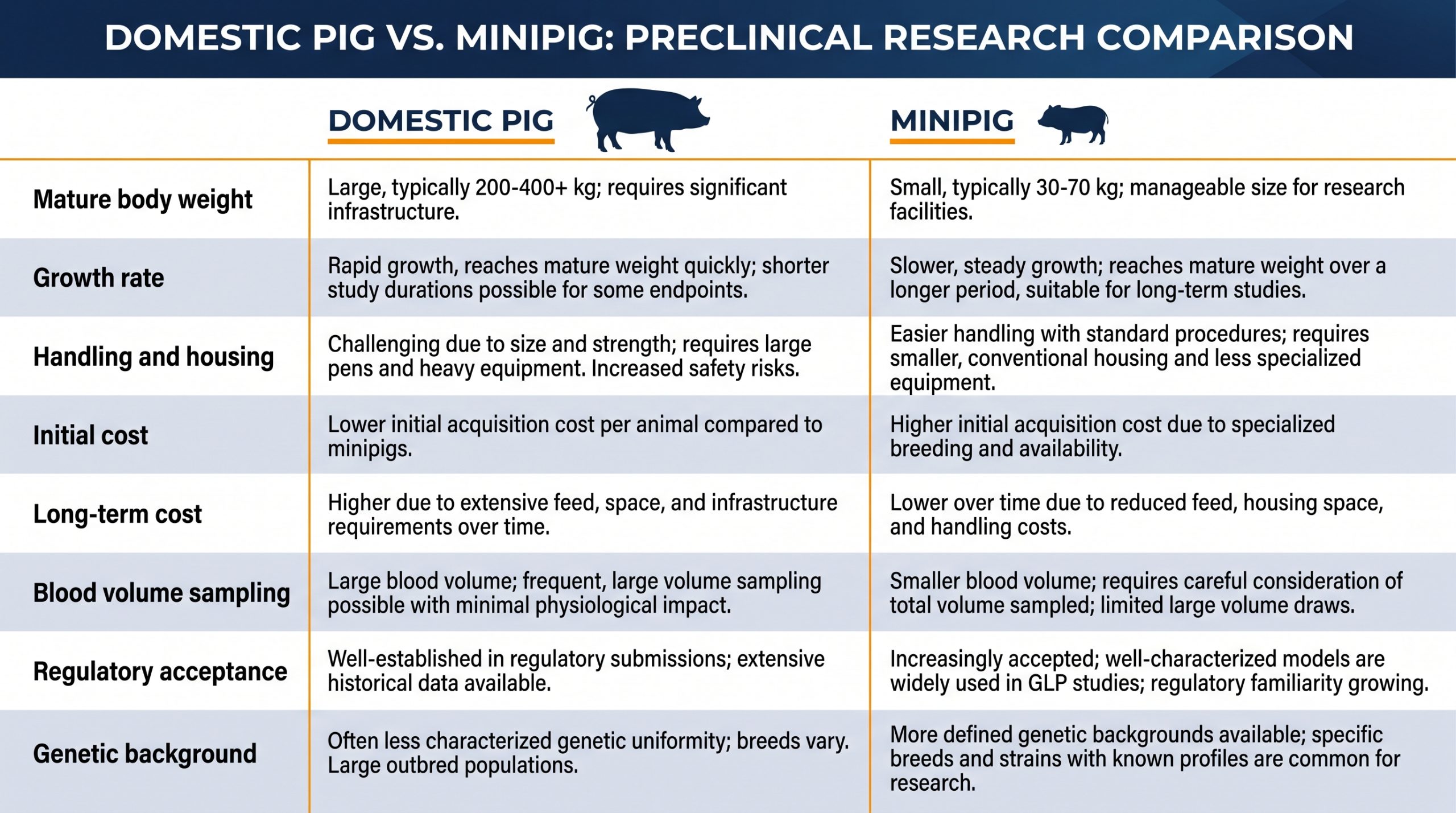
| Attribute | Domestic Pig | Minipig |
|---|---|---|
| Mature body weight | 150–250+ kg | 30–80 kg |
| Growth rate | Fast; challenging for long studies | Slower; better for chronic work |
| Handling & housing | Requires larger pens; heavier lifting | Easier to handle; smaller footprint |
| Initial cost | Lower | Higher |
| Long-term cost | Higher (feed, space) | Lower over time |
| Blood volume sampling | Very generous | Adequate for most PK/PD needs |
| Regulatory acceptance | Common in device studies | Strong for toxicology (FDA, EMA) |
| Genetic background | More variable | More uniform, standardized |
What Research Areas Benefit Most from Porcine Models?
Porcine models shine wherever human-like organ scale and function are essential. In cardiovascular research, porcine heart size, coronary artery distribution, and electrophysiology support studies of myocardial infarction, heart failure, atherosclerosis, and testing of stents, valves, and pacemakers. Cardiac regeneration research and transcatheter device evaluation both rely heavily on swine platforms.
In dermatology, porcine skin closely resembles human skin in thickness, hair follicle density, epidermal turnover, and collagen content — making it a highly relevant model for transdermal drug testing and wound healing studies. Additional strong-fit areas include gastrointestinal absorption research, metabolic disease modeling (obesity, type 2 diabetes), surgical training, medical device validation, and infectious disease research where the porcine immune system offers relevant parallels to humans.
Cardiovascular Research
Stent evaluation, valve testing, pacemaker validation, myocardial infarction models, heart failure, atherosclerosis, transcatheter devices.
Dermatology & Wound Healing
Transdermal drug delivery, wound healing, burn models, topical formulation testing — due to high skin-structure similarity with humans.
GI & Metabolic Disease
Gastrointestinal absorption, drug bioavailability, obesity modeling, type 2 diabetes, metabolic syndrome research.
Scenario: A Medical Device Team Choosing a Cardiovascular Model
Next-Generation Coronary Stent Validation
Consider a team developing a next-generation coronary stent. They need vessel diameters similar to human coronaries, physiologically comparable blood flow, and the ability to perform fluoroscopy-guided catheterization. A rodent model cannot support the catheter sizes involved, and rabbit anatomy is too small for the target device platform.
A domestic pig at approximately 40–60 kg offers coronary dimensions and hemodynamics that closely match adult humans, allowing the team to validate deliverability, deployment accuracy, and short-term biological response. Follow-up chronic studies may switch to minipigs to control body weight over 6–12 months, preventing outgrowth of the implant.
✅ Key Takeaway: This staged approach — domestic pig for acute validation, minipig for chronic follow-up — illustrates why breed selection is rarely a one-size-fits-all decision. Expert scientific escort is essential to match the model to each phase.
How Do Genetically Engineered Pig Models Advance Biomedical Research?
Genetically engineered (GE) pigs carry targeted modifications — knock-out, knock-in, overexpression, or conditional constructs — that recapitulate human genetic diseases or produce therapeutic proteins. Modern gene-editing tools such as CRISPR-Cas9, TALENs, and ZFNs enable precise modifications, while somatic cell nuclear transfer supports the creation of stable GE lines.
Applications span disease modeling (cystic fibrosis, Alzheimer’s, Huntington’s, oncology), xenotransplantation with humanized organs, and biopharmaceutical “pharming” for therapeutic protein production. According to translational pig model reviews, integrating GE swine platforms earlier in drug development can improve clinical trial success rates by exposing efficacy and safety signals that rodent models miss.
???? GE Pig Application Areas
- Cystic Fibrosis: CFTR knock-out pigs producing lung and pancreatic phenotypes matching human disease
- Cardiovascular Disease: Atherosclerosis and familial hypercholesterolemia models
- Xenotransplantation: Humanized organ platforms for transplant medicine research
- Biopharmaceutical Pharming: Therapeutic protein production in milk or blood
- Neurodegeneration: Alzheimer’s and Huntington’s phenotype studies
Swine Models in Drug Development: PK/PD and Drug Metabolism
Cytochrome P450 (CYP) enzymes drive most drug metabolism, and porcine — particularly minipig — CYP3A, CYP2A, and CYP2C enzymes share meaningful functional similarity with their human counterparts. This overlap makes swine highly relevant for predicting bioavailability, half-life, excretion routes, and potential drug-drug interactions.
PK/PD studies in swine also benefit from the ability to collect serial blood samples, place indwelling catheters, and administer drugs via routes that mirror clinical use — oral, intravenous, subcutaneous, transdermal, inhaled, and intra-arterial. This flexibility, combined with human-like body weight for dose scaling, supports more predictive first-in-human dose selection than smaller species allow.
“When you run PK/PD in a minipig and the hepatic CYP enzyme profile closely mirrors human, you are not estimating first-in-human dose — you are measuring it under highly translatable conditions. That is the difference between preclinical data that informs decisions and preclinical data that merely checks a regulatory box.”
— Adir Koreh, CEO, Biotech Farm Ltd.
Are Swine Models Accepted for Preclinical Toxicology and Safety Assessment?

Minipigs are increasingly recognized by FDA, EMA, and ICH as a suitable non-rodent species for preclinical toxicology, often complementing or replacing dog and non-human primate studies. Their acceptance stems from human-comparable metabolism, similar organ responses to toxic insults, and compatibility with multiple administration routes.
Advantages for toxicology include better dose extrapolation thanks to human-like body weight, robust pathology endpoints, and the ability to run repeat-dose and chronic studies with manageable animal numbers. Breed-specific background findings should be characterized in advance to avoid misinterpreting incidental lesions as treatment-related effects — a nuance that experienced facilities routinely address during study design.
✅ Regulatory Frameworks Governing Swine Toxicology Studies
- ICH M3(R2): Nonclinical safety studies supporting clinical trials
- ICH S5(R3): Reproductive toxicology guidance
- FDA & EMA Guidance: Species selection criteria for non-rodent toxicology
- GLP Compliance: Standard requirement for pivotal regulatory-submission studies
Designing a Swine Preclinical Study: Breed, Sex, and Age
Breed selection revisits the domestic-versus-minipig question with study-specific weighting: chronic device work often favors minipigs for stable body weight; acute surgical validation may favor domestic pigs for anatomical scale. Certain minipig lines carry documented predispositions that should be reviewed before enrollment.
Sex differences influence drug metabolism, hormonal profiles, and disease progression. Many programs balance sexes across groups or, when scientifically justified, use a single sex to control variability. Age matters for developmental studies and for endpoints where organ maturity or age-related pathology is central. A consistent supplier, controlled genetic background, and standardized husbandry practices further reduce variability and improve reproducibility.
Why SPF Status Matters in Swine Preclinical Studies
Specific Pathogen-Free (SPF) pigs are raised in controlled environments and certified free of designated pathogens. Their use eliminates confounding variables from subclinical infections, improves data reliability by ensuring observed effects reflect the experimental intervention, and protects herd health across the research facility.
SPF sourcing also supports animal welfare by reducing disease burden and improving quality of life during the study. Facilities that maintain rigorous entry protocols, quarantine practices, and health monitoring provide a stable foundation for regulatory-grade data. This is particularly critical for long-term toxicology, chronic device implantation, and studies where immune competence is an endpoint.
Common Endpoints Measured in Swine Studies
Endpoint design should match the study question and regulatory context. The table below summarizes typical categories and representative measurements used across porcine preclinical studies.
| Endpoint Category | Representative Measurements | Typical Use |
|---|---|---|
| Clinical observation | Body weight, food/water intake, clinical signs | General health, tolerability |
| Pharmacokinetics | Plasma, tissue, urine drug concentrations | ADME characterization |
| Pharmacodynamics | Biomarkers, enzyme activity, gene expression | Target engagement, efficacy |
| Imaging | CT, MRI, ultrasound, angiography, fluoroscopy | Anatomy, device performance |
| Histopathology | Organ-level microscopy, immunohistochemistry | Toxicity, disease progression |
| Clinical pathology | Hematology, chemistry, inflammatory markers | Systemic safety monitoring |
| Surgical outcomes | Graft patency, wound healing scores, device function | Device and procedure validation |
Ethical Considerations and Animal Welfare in Swine Research
Responsible swine research is anchored in the 3Rs: Replacement with non-animal alternatives whenever possible, Reduction of animal numbers through careful statistical design, and Refinement of procedures to minimize distress and enhance welfare. These principles guide every stage of study planning and execution.
Institutional Animal Care and Use Committees and equivalent ethical review bodies enforce compliance with national and international guidelines. Practical welfare measures include appropriate anesthesia and analgesia, skilled postoperative care, spacious and clean housing, environmental enrichment, and social grouping. Facilities that combine transparent documentation with attentive, tender care of animals produce both better welfare outcomes and higher-quality scientific data.
Replacement
Use non-animal alternatives — in vitro, in silico, organoids — whenever scientifically and regulatorily appropriate before escalating to in vivo studies.
Reduction
Apply power analysis and statistical rigor to use the minimum number of animals necessary to achieve robust, reproducible scientific conclusions.
Refinement
Optimize anesthesia, analgesia, housing enrichment, and postoperative care protocols to minimize pain, distress, and adverse experiences throughout the study.
How the Right Facility Supports Complex Swine Studies
Executing a swine preclinical study demands more than surgical skill — it requires integrated project management, imaging infrastructure, veterinary expertise, and regulatory awareness. The table below maps common research needs to how a well-equipped facility supports them in practice.
| Research Need | How a Well-Equipped Facility Delivers |
|---|---|
| Cardiovascular device testing | Fluoroscopy, C-Arm imaging, echocardiography, catheterization suites |
| Complex surgical procedures | State-of-the-art operating rooms, 4K laparoscopic towers, senior surgeons |
| Chronic toxicology and PK | Long-term housing, SPF sourcing, structured sampling schedules |
| Study design and regulatory readiness | Scientific escort, GLP-aligned documentation, tailored protocols |
| Animal welfare integration | Enrichment, attentive husbandry, 3Rs-driven refinements |
This mapping illustrates how infrastructure, expertise, and welfare culture jointly determine study quality. Researchers benefit most when a facility combines these elements under a single, transparent framework.
Frequently Asked Questions
Ready to Plan Your Next Swine Preclinical Study?
Choosing the right swine model, designing endpoints that satisfy regulators, and executing complex procedures with welfare-first standards all require deep experience across surgery, imaging, pharmacology, and project management. Contact Biotech Farm to discuss your project with our expert team.

© Biotech Farm Ltd. | All content is for informational purposes and reflects the professional experience of the authoring team. Always consult qualified preclinical research professionals for study-specific guidance.