Reviewed by Adir Koreh, CEO of BIOTECH FARM Ltd. — more than 20 years of hands-on experience establishing large animal models for medical device preclinical validation, with a veterinary team working together for over a decade.
An engineering team in Tel Aviv spent fourteen months cycling a novel endovascular delivery catheter through silicone vascular models. Their bench simulations showed zero structural failures across three hundred simulated deployments. When their technical file reached a notified body auditor in Frankfurt, review stopped immediately. The auditor issued a major deficiency because the submission lacked in vivo tissue response data under physiological arterial pulsation.
European Medical Device Regulation 2017/745 eliminated legacy assumptions about biological safety. Regulators no longer accept bench simulations alone when blood contact or tissue remodeling presents unquantified physiological friction. Medical device manufacturers must establish clear evidence showing whether living tissue tolerates, clears, or integrates their product before clinical trials begin.
Failing to map preclinical animal testing early adds eighteen months of remediation and substantial capital costs in repeat evaluations. This guide clarifies regulatory expectations for in vivo evidence under current European rules. It sets a direct framework for what notified bodies demand, how to avoid redundant animal models, and how to build defensible documentation.
Regulatory compliance begins with scientific relevance. — Adir Koreh, CEO, BIOTECH FARM Ltd.
Notified bodies do not reject animal studies — they reject unrepresentative ones. The single most common cause of major deficiencies across more than twenty years of large animal model work is not missing data but data generated on prototype devices that no longer match the final commercial design in material, finish, or sterilization.
What are the CE mark preclinical animal testing requirements for medical devices?
The European Union Medical Device Regulation does not mandate an identical checklist of animal tests for every commercial product. Preclinical animal testing requirements follow a risk-based evaluation framework. Device classification, the type and duration of anatomical contact, and remaining safety uncertainties determine whether in vivo studies are necessary.
Under Annex II of Regulation (EU) 2017/745, manufacturers must present technical documentation containing complete verification and validation test results. This documentation includes laboratory bench testing, chemical characterization, and simulated use models. In vivo animal investigations are required whenever those non-animal methods leave unanswered questions about biological interaction or mechanical functionality inside living tissue.
Manufacturers must scientifically justify every decision to conduct or exclude animal trials. Notified bodies verify whether the chosen study designs directly address identified physiological risks.
Are animal studies mandatory for CE marking medical devices?
Animal studies are not mandatory for every medical device seeking a CE mark. Class I non-invasive instruments, minor accessories, and well-characterized devices rarely justify in vivo animal exposure. Manufacturers can establish biological safety using physical characterization, chemical extractable testing, and cell-based in vitro assays.
When existing scientific literature and bench testing prove conformity with safety requirements, animal testing is unnecessary. An overarching preclinical strategy balances chemical analysis with established mechanical testing. For an overview of this progression, review the Biotech Farm guide on the medical device Preclinical Regulatory Pathway to compare European expectations with global submission routes such as 510k and PMA.
In vivo studies become compulsory only when a safety gap remains open. If cell cultures and synthetic flow loops cannot simulate biological responses, animal models provide the required empirical proof.
When might a Notified Body require MDR preclinical data that includes in vivo testing?
Notified bodies mandate in vivo preclinical data when mechanical bench models cannot simulate complex physiological responses. Long-term implantable devices and structural heart implants always face intense regulatory scrutiny, as do resorbable orthopedic anchors and vascular grafts. Reviewers expect living animal data whenever local tissue remodeling, systemic toxicity, or dynamic thrombogenicity could create catastrophic clinical hazards.
Novel materials trigger immediate demands for living biological validation. When a polymer or surface coating lacks decades of clinical history, bench testing cannot predict fibrous encapsulation or chronic inflammation. Auditors also demand animal models when delivery mechanics involve delicate surgical maneuvers, such as transcatheter valve seating or microscopic neural lead placement.
Performance claims that depend on active biological healing require living tissue confirmation. If a bone void filler claims accelerated osseointegration, bench chemistry cannot validate that claim.
Which sections of the EU MDR specifically address preclinical testing and animal models?

Preclinical evaluation under the MDR centers on Annexes II and I. Annex II Section 6 outlines product verification and validation requirements. It specifies that technical files must present results and critical analyses of engineering tests, simulated use, and animal studies whenever relevant to device performance.
Annex I defines the General Safety and Performance Requirements that every device must satisfy. Items within Chapter II of Annex I require manufacturers to address chemical, physical, and biological properties. These sections demand assessment of tissue compatibility and foreign body reactions as well as degradation mechanics and delivery risks.
Clinical evaluation requirements in Annex XIV also reference non-clinical data. Regulators cross-examine preclinical animal results against proposed clinical trial protocols to ensure patient safety during first-in-human studies.
Preclinical data versus clinical data in the CE mark evaluation path
Preclinical data encompasses all safety and performance evidence collected before human contact. It incorporates bench engineering and computational modeling, chemical profiling, and both in vitro cytotoxicity and in vivo animal testing. This evidence demonstrates that the device operates predictably under simulated and physiological extremes.
Clinical data reflects information derived directly from human use. It includes formal clinical investigation reports, published literature on equivalent devices, and post-market clinical follow-up registries. Guidance in MDCG 2020-5 on clinical equivalence emphasizes that preclinical data must establish baseline technical and biological comparability before claiming equivalence to another device.
Preclinical validation establishes the safety baseline that makes human trials ethical. Human clinical trials confirm therapeutic efficacy in patient populations.
Evidence must precede human exposure. — Preclinical Regulatory Principle, EU MDR Framework
What must be included in the technical documentation regarding preclinical testing?
The technical documentation submitted to a notified body must contain full study protocols, defined statistical endpoints, and complete raw data. Notified bodies reject summarized marketing brochures or high-level slide decks immediately during initial completeness checks. Regulators inspect every variable, from animal weights and anesthesia records to histological slice staining techniques.
Reports must explain all protocol deviations and animal dropouts without exception. When an animal dies prematurely during a surgical study, the submission must provide necropsy findings and explain device involvement transparently. Technical files must also trace test findings directly to the device risk management documentation.
Traceability from ISO 14971 risk files to in vivo bench data
Every in vivo study protocol must originate from an identified failure mode in the ISO 14971 risk management file. If vascular perforation is a known hazard, the preclinical protocol must define explicit radiological or histological endpoints to measure vessel wall disruption. The technical documentation must contain a traceability matrix connecting identified biological risks to specific preclinical study results.
Structuring test summaries for notified body technical reviews
Notified body technical experts review dozens of submissions monthly and prioritize clearly formatted data. High-performing dossiers summarize preclinical studies in structured overview tables followed by signed study director reports. Tabular summaries must detail sample sizes and follow-up intervals, evaluated tissues and objective endpoints, and explicit pass criteria.
How to justify avoiding animal testing while remaining MDR compliant
Avoiding animal testing under the MDR requires a defensible scientific rationale rather than an administrative excuse. Manufacturers must demonstrate that existing physical, chemical, and historical data fully answer every biological safety question. The biological evaluation process begins by characterizing materials through chemical spectrometry and extractable testing.
When chemical characterization proves that released substances fall well below toxicological thresholds, manufacturers can justify omitting systemic toxicity animal models. Validated in vitro assays can evaluate cytotoxicity, skin irritation, and cellular genetic mutations without living tissue. For an examination of non-animal biological safety methods, explore the Biotech Farm overview on Preclinical Testing and safety evaluation of medical devices to refine testing scopes.
Literature equivalence provides another path to omit animal work. Animal testing creates redundant harm when a device uses an established material with identical processing, surface treatment, and clinical contact.
Preclinical testing modalities across medical device contact categories
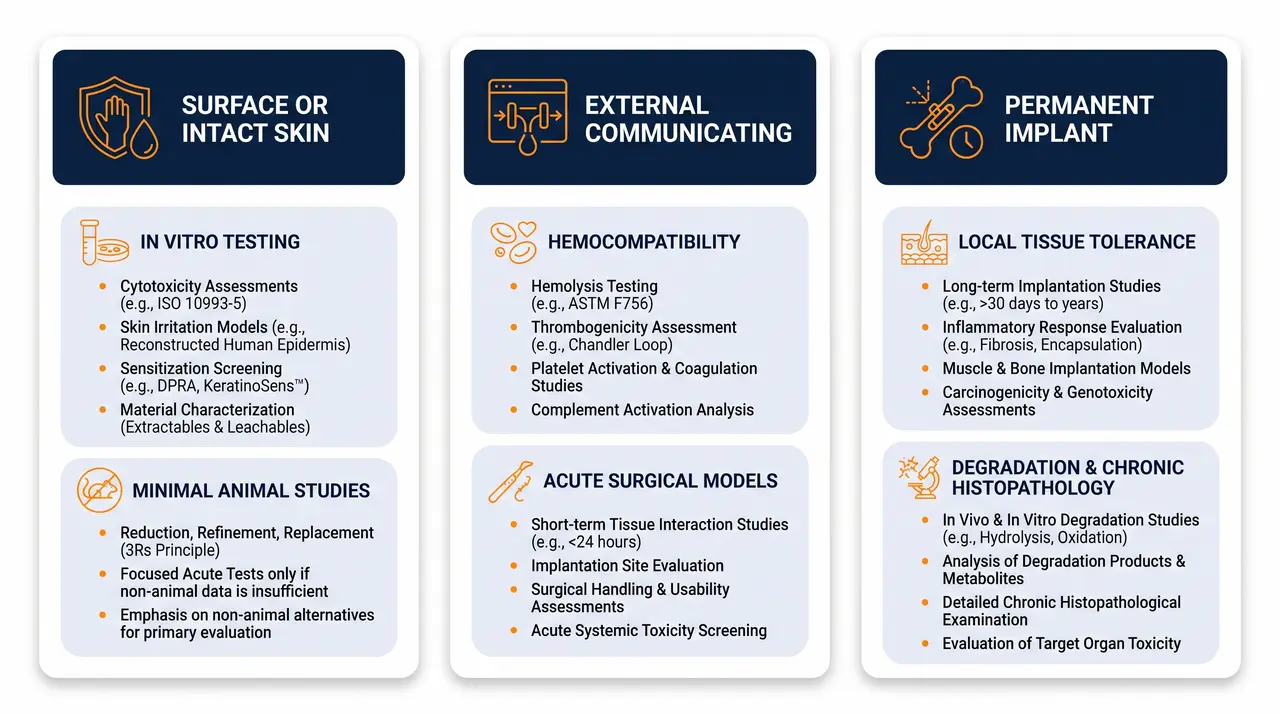
Medical devices require distinct preclinical validation packages based on patient contact nature and duration. The following comparison illustrates typical data expectations across device categories.
Matching the preclinical approach to device classification prevents costly audit delays. Over-testing wastes resources, while under-testing halts regulatory clearance.
Animal study models for local tolerance and functional performance
Preclinical in vivo investigations divide into two operational categories: biocompatibility tolerance studies and functional performance models. Biocompatibility studies evaluate how host tissue responds biologically to materials. Functional studies evaluate whether the device performs its intended mechanical or therapeutic mission inside living anatomy.
Both categories require rigorous planning. Selecting appropriate animal species ensures that physiological structures, healing rates, and mechanical stresses accurately reflect human clinical use.
Implantation studies and local tissue tolerance
Local tolerance studies observe cellular reactions around implanted devices over predefined durations. Pathologists examine microscopic tissue sections for polymorphonuclear cells and lymphocytes, macrophages and multinucleated giant cells, and fibrous capsules. Implantation studies confirm whether local tissue heals naturally around the foreign body or enters destructive chronic inflammation.
Functional surgical performance models beyond biocompatibility
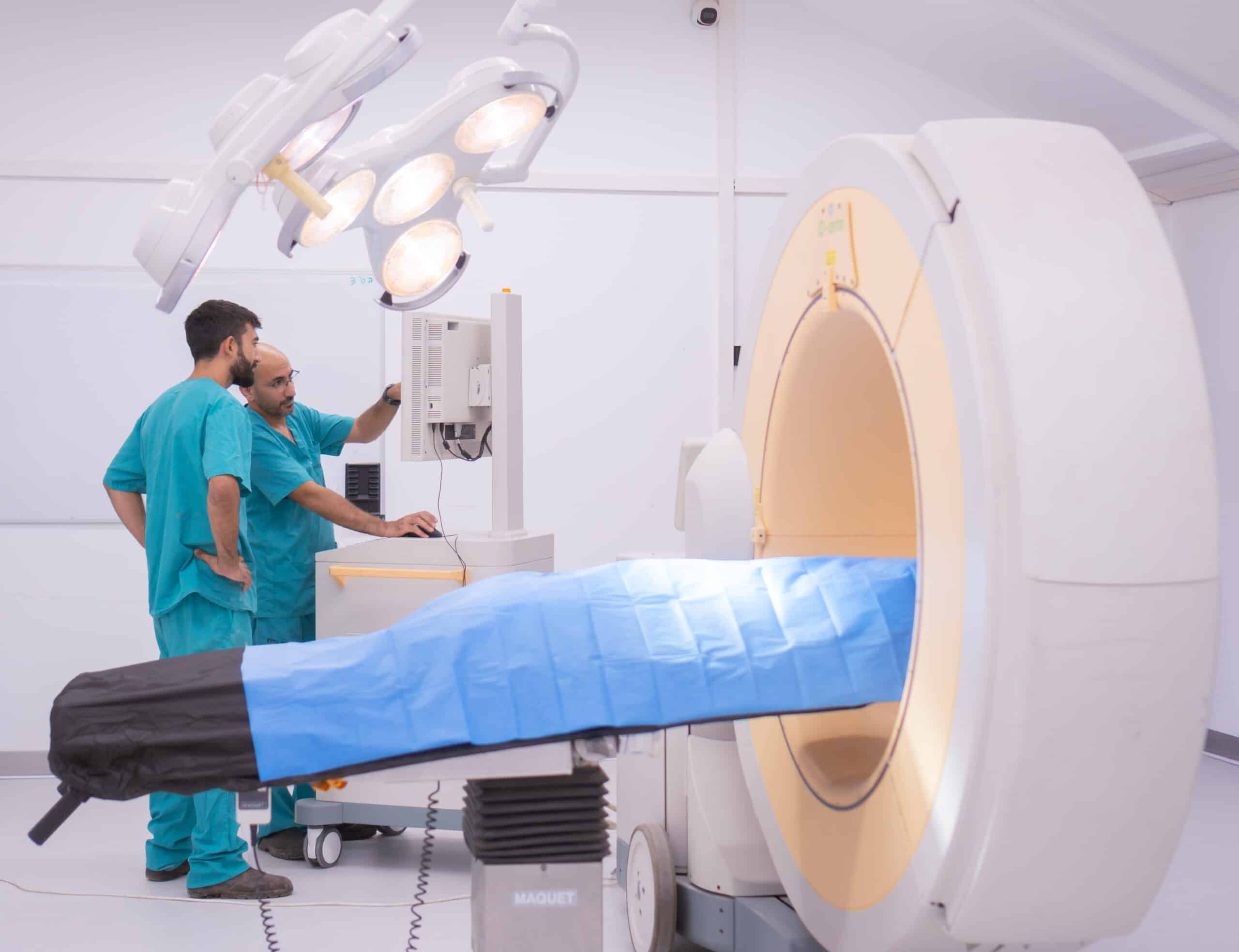
Functional animal models validate clinical handling and device deployment under authentic surgical conditions. For complex cardiovascular devices, surgeons deploy systems in porcine models under real-time fluoroscopic C-arm guidance. These trials evaluate trackability through tortuous anatomy and deployment accuracy as well as immediate hemodynamic response and procedural safety.
What is ISO 10993 and how does it affect animal testing?
ISO 10993 serves as the harmonized global standard for medical device biological evaluation. The standard rejects routine animal testing in favor of a structured risk assessment philosophy. ISO 10993-1 instructs manufacturers to evaluate existing chemical, physical, and toxicological data before considering in vivo procedures.
When animal studies are justified, specific sub-parts dictate experimental protocols. ISO 10993-2 enforces animal welfare requirements and mandates replacement, reduction, and refinement across all experimental designs. Other parts such as ISO 10993-10 and ISO 10993-11 define specific animal protocols for systemic toxicity, pyrogenicity, and irritation.
Adhering to ISO 10993 guarantees regulatory consistency across jurisdictions. Notified bodies verify that test designs match exact standard parameters.
Compliance depends entirely on methodological rigor. — ISO 10993 Biological Evaluation Framework
Specific animal model considerations under ISO 10993-6
Standard ISO 10993-6 defines tests for local effects after implantation. The standard requires choosing an animal species whose anatomical dimensions and physiological reactions correlate with human clinical applications. Porcine models are standard for vascular and dermal devices, while ovine and rabbit models serve orthopedic and subcutaneous implants.
Implantation periods must represent both acute biological stabilization and long-term equilibrium. Study protocols typically establish sequential termination intervals such as two, twelve, and twenty-six weeks. These intervals reveal whether initial foreign body reactions resolve into healthy fibrous encapsulation or worsen into tissue necrosis.
For external sensors and attached diagnostics, contact mechanics introduce unique biological stresses. Review the specialized Biotech Farm resource on wearable medical device preclinical validation and testing for methods evaluating dermal tissue interfaces.
Biological Evaluation Report requirements for notified body audits

The Biological Evaluation Report synthesizes every element of biological safety into a definitive regulatory document. Qualified toxicologists compile the report, which interprets all chemical profiling and bench tests together with published literature and animal study outcomes. It provides an expert opinion confirming that all biological hazards have been mitigated.
Notified body auditors scrutinize this report during technical documentation reviews. The document must analyze study results critically rather than merely cataloging completed procedures. The toxicologist must address any histological variations, tissue inflammation, or animal anomalies observed during in vivo evaluations.
A well-reasoned Biological Evaluation Report bridges the gap between raw laboratory data and regulatory approval. It validates the safety profile of the finished medical device.
Is GLP required for preclinical animal studies for CE marking?
The European Medical Device Regulation does not contain a blanket statutory clause stating every animal study must be GLP-certified. However, notified bodies consistently expect adherence to the OECD Principles of Good Laboratory Practice for key preclinical safety studies. Critical animal studies providing definitive evidence of systemic safety, hemocompatibility, or local tissue integration must meet rigorous quality controls.
Key safety data derived from non-GLP exploratory trials frequently triggers major audit non-conformities. Notified bodies challenge data integrity if a testing facility lacks independent quality assurance oversight, calibrated analytical equipment, and secure specimen archives. Exploratory prototype testing does not require GLP compliance, but definitive validation studies must withstand audit scrutiny.
Sponsors must ensure that testing facilities operate formal quality systems matching international research standards.
Animal welfare standards and institutional ethics committee approvals
Every animal investigation supporting a CE mark submission must comply with international and national animal welfare legislation. European authorities reject data originating from unmonitored or unapproved animal operations. Studies must follow the established 3Rs framework by proving that replacement, reduction, and refinement were evaluated systematically.
Testing facilities must obtain formal protocol approval from an Institutional Animal Care and Use Committee or equivalent national supervisory council before initiating studies. In Israel, preclinical operations must comply with Ministry of Health regulations under the Council for Animal Experimentation. Research facilities operate under strict government licensing to protect experimental animal welfare.
Veterinary oversight ensures humane care, pain management, and appropriate postoperative monitoring throughout long-term studies. Ethical documentation forms an essential appendix within the submitted technical file.
Common mistakes sponsors make in MDR preclinical study design
Medical device startups often make critical errors when designing preclinical testing programs. The most damaging mistake is initiating animal studies using prototype devices that differ in material, finish, or sterilization from the final commercial design. If the manufacturing method changes later, regulators will reject the animal data as non-representative.
Sponsors also struggle with underpowered study designs and arbitrary follow-up timelines. Enrolling too few animals leaves statistical gaps that prevent pathologists from drawing definitive conclusions. Similarly, terminating an implantation study before tissue reaches biological equilibrium invalidates long-term safety claims.
Failing to establish objective, quantitative endpoints creates audit complications. Qualitative observations like “the tissue healed well” hold no value during a rigorous technical file review.
Animal studies performed on prototypes that differ from the final commercial device in material, finish, or sterilization are rejected as non-representative — forcing complete study repetition at full cost.
Too few animals leave statistical gaps that prevent pathologists from drawing definitive conclusions, and premature study termination before tissue reaches biological equilibrium invalidates long-term safety claims.
Observations such as “the tissue healed well” hold no value during technical file review. Every endpoint must be objective, quantitative, and predefined in the approved protocol.
Unjustified shortcuts cause regulatory rejection. — Adir Koreh, CEO, BIOTECH FARM Ltd.
Technical depth required in final preclinical study reports
Final preclinical study reports must provide exhaustive scientific detail to satisfy notified body assessors. Every report must contain a signed compliance statement from the study director, detailed animal identification logs, and complete surgical procedural notes. Anesthetic depths, intraoperative drug delivery, and postoperative analgesia regimens must be documented fully.
Pathology documentation requires high-resolution histological imaging accompanied by semi-quantitative scoring tables. Pathologists must evaluate inflammation and capsule thickness, necrosis and cellular infiltration, and material degradation against matched control groups. Individual animal scoring sheets must accompany the summary conclusions.
The technical report must explain every experimental deviation without ambiguity. Complete transparency builds regulatory confidence and shortens audit rounds.
Managing project timelines when in vivo studies become necessary
Conducting in vivo preclinical trials significantly alters medical device commercialization schedules. A chronic twenty-six-week implantation study requires several months of preparation before the first surgical procedure. Ethics committee reviews and facility scheduling consume considerable lead time, as do specialized animal procurement and protocol finalization.
Following surgical execution, tissue processing and histological slide preparation demand eight to twelve additional weeks. Board-certified veterinary pathologists require time to score samples, interpret tissue reactions, and author the audited study report. Sponsors must account for these biological timelines within their overall regulatory project planning.
Engaging an experienced preclinical research organization early prevents unnecessary operational bottlenecks. Proactive scheduling ensures studies conclude before target submission windows close — a 12-week implantation study typically requires six to eight months from protocol drafting to final pathology reporting.
Preclinical validation strategies for novel materials and bioresorbables
Devices manufactured from bioresorbable polymers or novel synthetic alloys present complex biological challenges. Resorbable devices change their physical, chemical, and mechanical profile throughout the degradation process. Notified bodies demand animal trials that track the entire absorption profile from initial implantation to complete cellular clearance.
Preclinical studies for resorbable devices must measure degradation kinetics, local mechanical strength retention, and downstream organ clearance. Histological evaluations must confirm that degraded particulate matter does not cause micro-embolisms or systemic organ toxicity. Testing schedules must extend well past total mass loss to verify complete tissue recovery.
Novel materials also require thorough wear-debris evaluation in articulated joint models. Quantifying macrophage responses to shed nanoparticles proves long-term biocompatibility under dynamic mechanical loads.
Practical alignment between manufacturer risk profiles and facility capabilities
Translating preclinical study designs into compliant regulatory evidence requires specialized facilities, advanced surgical equipment, and seasoned veterinary researchers. The table below illustrates how specific device challenges match dedicated preclinical operational workflows.
Access to dedicated surgical suites and imaging equipment accelerates preclinical timelines. Close collaboration between surgical teams and regulatory toxicologists prevents protocol rework.
Frequently asked questions about CE mark animal testing
Device teams frequently ask specific questions when assembling preclinical evidence packages for European regulatory review.
Designing an audit-ready preclinical program for European market entry
How will your team address the biological safety questions waiting in your next notified body review? Successful market authorization depends on aligning device engineering files with compliant in vivo study protocols. Biotech Farm provides advanced surgical suites, modern fluoroscopic imaging tools, and extensive veterinary expertise to execute your study under rigorous standards.