
With over 20 years of hands-on expertise in large animal model development and preclinical study execution, our team has witnessed firsthand how regulatory gaps between the FDA and EMA can derail even the most promising drug development programs. A development team standing two months before locking the safety package for a novel molecule often discovers that the toxicology data collected for the FDA does not meet the EMA’s stringent risk-management requirements for first-in-human trials.
The core gap between the two agencies is not about the overall scientific quality governed by ICH principles — it concerns risk analysis methodology and the timing of laboratory animal testing. Understanding the differences between the American and European approaches determines whether your project advances as planned or stalls in prolonged waiting periods.
This article analyzes the practical differences in required data packages, living model selection, and quality standard compliance to help you build a unified, efficient submission pathway for both markets.
Key Insight: The most common reason for cross-Atlantic regulatory failure is not inadequate science — it is presenting the same data without adapting the narrative framework to each agency’s review culture. The FDA evaluates empirically through numerical safety margins and raw documentation quality, while EMA reviewers examine the biological logic connecting pharmacology to clinical risk, devoting particular attention to theoretical edge-case scenarios.
What Are the FDA Preclinical Requirements Before IND?
Anyone submitting an IND application in the United States must prove to the regulator that the drug is reasonably safe for initial exposure to trial subjects. The FDA reviews the data within thirty days of receiving the dossier, and during this window, the agency’s team examines whether an unjustified risk to patients exists.
The American agency publishes clear expectations regarding the scope of nonclinical information within its official IND submission guidelines. The primary emphasis is placed on identifying target organs for toxicity, establishing numerical safety margins, and understanding the reversibility of biological damage after treatment cessation.
Even when dealing with an innovative molecule with a unique mechanism, the agency expects to receive continuous physiological monitoring data covering central organ systems.
Which Types of Studies Are Considered IND-Enabling?
A package of experiments enabling an American file opening consists of a defined series of safety and pharmacokinetic tests. The program includes repeated-dose toxicology studies, safety pharmacology assessment for vital systems, and genetic toxicity data collection for small molecules.
However, the package scope is not identical for every development, because requirements derive directly from the characteristics of the intended clinical treatment. The duration of the animal study must cover the planned length of clinical trial treatment, with two to four weeks of continuous exposure constituting a common basis for single administration in humans.
Development teams are required to perform comprehensive systemic exposure assessment at every dose level tested. A mismatch between the preclinical administration route and the intended injection method in the clinic can invalidate all findings.
How Does the EMA Treat Nonclinical Data Before CTA or IMPD Submission?
In Europe, clinical trial applications are submitted through an IMPD dossier filed via the EU’s centralized CTIS system. EMA requirements focus on in-depth scientific analysis combining nonclinical findings with the product’s cellular mechanisms of action.
The European regulator demands detailed presentation of risk mitigation strategies, as defined by the EMA risk management guidelines for first-in-human and early clinical trials. The European dossier is not satisfied with a collection of raw reports — it requires critical analysis of the biological relevance of each experimental model.
So when specific toxicity is discovered in living tissue, the researcher must explain whether the mechanism is related to the pharmacological target or to off-target activity. This biological explanation often determines the fate of the approval.
Critical Distinction: While the FDA asks “What are the numbers?”, the EMA asks “Why does this biological mechanism matter?” Both questions must be answered comprehensively in your submission package.
Differences Between FDA and EMA in Preclinical Safety Assessment
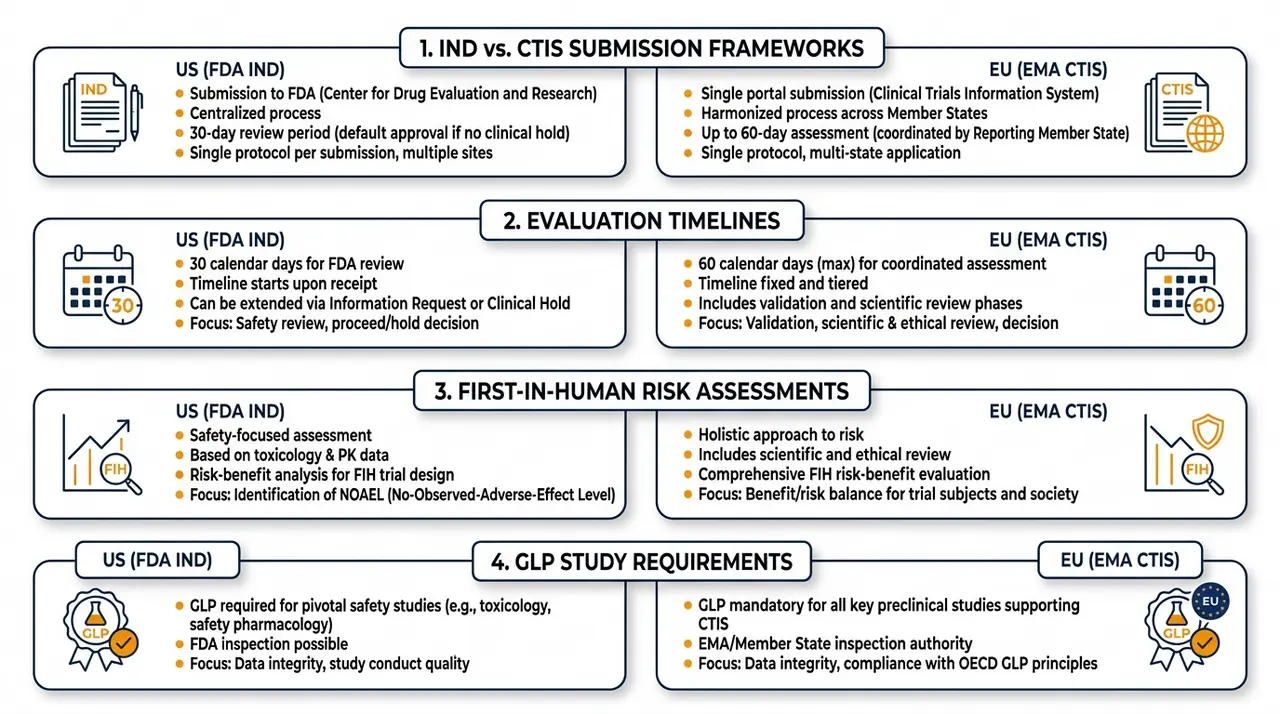
The basic scientific standard on both sides of the ocean is based on international agreements, primarily the ICH M3(R2) guidance document that defines the scope of experiments supporting human trials. The practical gap lies not in the laboratory protocol itself, but in the expectations of dossier reviewers at each agency.
The FDA tends to examine data from an empirical perspective, with rigorous checking of numerical safety margins and raw documentation quality. In contrast, EMA reviewers examine the biological logic connecting pharmacology to clinical risk, devoting particular attention to theoretical edge-case scenarios.
Companies developing advanced biological products frequently encounter more stringent European requirements regarding receptor binding characterization in human tissues before approving the initial dose.
“The gap between FDA and EMA is not about the quality of science — it is about how each agency tells the story of risk. Master both narratives, and your program moves forward on both continents simultaneously.”
— Adir Koreh, CEO, Biotech Farm Ltd.
Regulatory Comparison Table: United States vs Europe
Understanding the structural differences between the agencies helps build a modular research plan that does not require unnecessary repetition of expensive experiments.
This comparison illustrates that while toxicological tests are essentially similar in nature, their presentation in registration documents requires direct adaptation to each region’s regulatory culture.
What Is the Difference Between an IND Dossier and an IMPD Dossier?
An IND dossier constitutes an exemption request allowing the transport of an unapproved drug across state borders in the United States for clinical trial purposes. The document includes a pharmacological overview, proposed clinical protocol, investigator information, and manufacturing and quality assurance data.
In contrast, an IMPD in Europe presents a concise, structured summary of the scientific information about the product under investigation. The document is an integral part of the CTA application and serves national authorities and ethics committees in each member state for assessing the safety of the planned trial.
The formal structure also differs, with the IMPD requiring detailed specification of the active substance and finished product properties alongside laboratory animal test results.
What Goes Into the Nonclinical Summary in Each Region?
Within the registration dossier, the nonclinical section consolidates all findings collected during early development. The document presents detailed summary tables alongside narrative text analyzing the significance of measured exposure levels.
The regulator expects to receive a clear definition of the NOAEL level, details of target organs affected at high doses, and a quantitative assessment of safety margins relative to the planned human dose. The document also includes scientific justification for experimental model selection and an explanation of the findings’ implications for humans.
Sloppy writing triggers immediate delays.
Which Toxicology Studies Are Required for Phase 1?

Safety assessment before first human exposure requires repeated-dose toxicity studies in two mammalian species — one rodent and one non-rodent — unless a different biological rationale exists. The duration of the experiments derives directly from the planned length of clinical treatment.
For short-duration clinical trials, a dosing period of two to four weeks in animals is generally considered sufficient. The experiments include daily clinical examinations, animal weighing, clinical pathology testing of blood and urine, and rigorous monitoring of behavioral changes.
At the end of the dosing period, pathologists perform full histopathological examination of dozens of tissues and organs to identify subtle microscopic changes.
Study Duration Requirements
2-4 weeks of animal dosing supports single-dose human trials. Longer clinical protocols require proportionally extended animal studies per ICH M3(R2) guidelines.
Species Selection
One rodent (rat) and one non-rodent (dog or pig) constitute the standard package. Biological products may justify a single relevant species.
Histopathology Scope
Full microscopic examination of dozens of tissues identifies target organ toxicity and supports NOAEL determination with high confidence.
How Many Animal Species Are Needed in Preclinical Research?
The traditional approach in small molecule drug development requires safety evaluation in two different species, usually rat and dog or pig. The reason lies in differences in metabolic pathways and enzyme profiles between different mammals, a situation that can lead to unexpected toxicity.
However, in developing target-focused biological products such as monoclonal antibodies, the drug often acts exclusively against the specific human epitope. When the molecule does not bind to the corresponding protein in rodents, a mouse study provides no valuable biological information.
In these cases, regulators in both regions allow the use of a single biological species, provided it is proven to be the only pharmacologically relevant species.
How to Build a Scientific Justification for Single Species Selection
Building a justification dossier for single species selection requires solid comparative data collected in ex-vivo test systems. Researchers present receptor affinity measurements, biological activity profiles in isolated tissues, and protein expression data across multiple species.
If it becomes clear that monkey or pig exhibit distinct similarity to human tissue while rodents do not respond to the product, the data is submitted as the basis for determining the exclusive species. It is mandatory to demonstrate that the rodent’s lack of response stems from absent molecular binding rather than rapid clearance of the substance from the bloodstream.
This justification prevents unnecessary experiments in animals that yield no scientific benefit, in accordance with the international 3Rs principle (Replacement, Reduction, Refinement).
3Rs Principle in Action: Both FDA and EMA actively support the Replacement, Reduction, and Refinement framework. A well-justified single-species approach can save hundreds of animal lives and hundreds of thousands of dollars in development costs.
Is GLP Compliance an Absolute Requirement in Every Safety Study?
Compliance with Good Laboratory Practice standards constitutes a foundational principle in safety studies, as detailed by OECD principles in the international GLP standards guide. Pivotal toxicology studies supporting first-in-human dose determination must be conducted in a facility with valid GLP accreditation.
However, early discovery studies, mechanism-of-action tests, and pharmacological feasibility experiments are not obligated to meet this standard. These studies operate under rigorous scientific quality control, but without the formal quality assurance framework required for official registration experiments.
Biotech Farm’s research facility enables complex feasibility and validation studies in large animal models, with strict adherence to controlled work procedures and rigorous data documentation. Disciplined work at the preliminary stage prevents surprises during official registration phases.
What Is the Difference Between Safety Pharmacology and General Toxicology Testing?
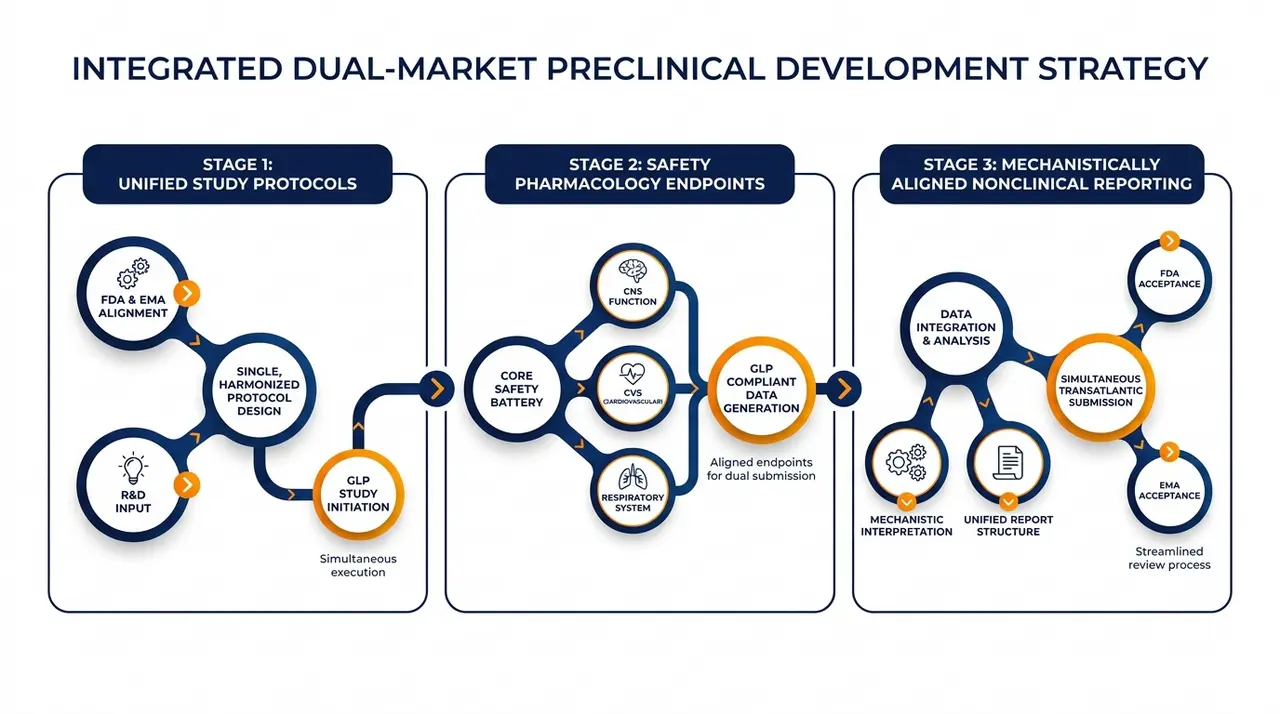
Safety pharmacology tests examine immediate functional effects of the drug on vital physiological systems. The focus is directed primarily at the cardiovascular system, the central nervous system, and the respiratory system. Sudden damage to these systems can place human lives in immediate danger.
In contrast, general toxicology studies examine the cumulative effect of the product on body tissues over time. These tests examine structural changes alongside cellular degeneration and internal organ damage after prolonged exposure to escalating doses.
While toxicology focuses on tissues, safety pharmacology deals with real-time physiological function.
Safety Pharmacology Focus
- Cardiovascular function (hERG, ECG)
- Central nervous system effects
- Respiratory system monitoring
General Toxicology Focus
- Target organ identification
- Histopathological tissue changes
- NOAEL determination
What PK and TK Requirements Determine the FIH Dose in Humans?
Determining the starting dose for a first-in-human trial relies on a precise combination of pharmacokinetic data and toxicokinetic findings collected in animal experiments. Researchers calculate the total systemic exposure of the drug by measuring the area under the curve and peak plasma concentration.
This data enables translation of the NOAEL value found in the most sensitive species into an equivalent human dose, using appropriate safety factors of at least tenfold. Kinetic models reveal whether the drug tends to accumulate in fatty tissues or clear rapidly through the kidneys.
Clearance rate also influences the design of time intervals between doses administered to volunteers in the first clinical trial.
Common Errors in Exposure Margin Calculations for First-in-Human Trials
A common flaw in initial dose planning stems from blind reliance on body weight instead of body surface area or free blood exposure values. Many drugs display different plasma protein binding between animals and humans, a situation that distorts the active concentration calculation.
Another frequent error involves using analytical measurement methods that have not undergone full validation at low concentrations. When the calibration curve is unreliable, clearance calculations become erroneous and place the entire safety margin in doubt.
Warning: Errors in exposure margin calculations can stop development entirely. Always verify that your analytical methods are fully validated across the entire expected concentration range before finalizing FIH dose calculations.
When Is a Full Genotoxicity Package Required Before Entering the Clinic?
For synthetic small molecules, performing a basic genetic toxicity test battery constitutes a threshold condition for entering Phase 1 trials. The accepted battery includes a bacterial mutagenicity assay and an in-vitro cytogenetic test for assessing chromosomal damage in mammalian cells.
However, for therapeutic proteins and monoclonal antibodies, regulators generally do not require routine genotoxicity testing. Large biological molecules do not penetrate the cell nucleus and do not directly interact with DNA molecules, making the risk of mutation formation extremely low.
This exemption applies provided the product does not contain active chemical linkers or synthetic toxins as found in antibody-drug conjugates.
Drug Delivery System Development in Large Animal Models
When a company develops a sophisticated injection platform or sustained-release system, testing in small rodents does not reflect the anatomy of the target tissue in humans. In assessing the penetration rate of a subcutaneous implant or a drug-eluting stent in blood vessels, organ size and blood flow rate determine substance distribution.
Complex studies such as Drug Delivery Systems Preclinical Testing require physiological models such as pigs or sheep to precisely mimic clinical conditions. Biotech Farm’s research facility is equipped with advanced surgical suites including C-Arm imaging systems, high-resolution ultrasound devices, and 4K laparoscopy towers.
This equipment enables operating surgeons to perform implant insertion procedures with maximum precision, while continuously monitoring the system’s behavior in living tissue over weeks.
Biotech Farm Facility Capabilities for Large Animal Studies
- Advanced surgical suites with C-Arm fluoroscopy systems
- High-resolution ultrasound imaging for real-time monitoring
- 4K laparoscopy towers for minimally invasive procedures
- Continuous hemodynamic monitoring in pig and sheep models
- Expert veterinary team with over a decade of collaborative experience
How to Design a Single Work Plan That Satisfies Both Regulators Simultaneously
Companies targeting global launch build a single nonclinical information package planned in advance to meet the most stringent requirements of both agencies. This planning saves significant financial resources and prevents the need to repeat complex animal experiments at a later stage.
To achieve this goal, it is recommended to adopt the longer study durations required, include safety pharmacology endpoints within toxicology studies, and prepare an in-depth mechanistic analysis that meets European expectations.
Early engagement in scientific advisory meetings with both the FDA and EMA clarifies points of disagreement before investing massive budgets in actual experiments.
Common Mistakes in Preclinical Submissions That Lead to Trial Halts
The most critical mistake leading to clinical trial suspension is defining an incorrect safety margin between the concentration that caused toxicity in animals and the planned human dose. Agency reviewers immediately halt applications when they identify an unexplained gap in exposure levels.
Another common failure is using a drug batch manufactured in a process different from the one intended for the clinic. Changes in impurity profiles or structural excipients between the animal testing phase and clinical manufacturing can invalidate all collected data.
Inconsistency in documenting deviations during laboratory study execution raises suspicion among inspectors and undermines the credibility of the entire dossier.
Critical Warning: A batch change between preclinical testing and clinical manufacturing is one of the most common — and most preventable — causes of complete data invalidation. Lock your manufacturing process before beginning pivotal toxicology studies.
How to Conduct Bridging Studies Between American and European Reference Products
Companies developing biosimilar products must compare their product to an originator already approved in the target region. The EMA requires using a reference product sourced from the European Union, while the FDA requires comparison to a reference product purchased in the United States.
To avoid running duplicate expensive trials, many companies conduct a three-way bridging study including physicochemical comparison and three-directional pharmacokinetic comparison. The trial compares the biosimilar to the American product, the biosimilar to the European product, and the two reference products themselves.
When full equivalence is demonstrated across all three axes, regulators allow extrapolation of efficacy and safety data from a clinical trial conducted against one reference product to the other market.
Timing Gaps in Pediatric Development Plan Requirements for Nonclinical Research
The issue of pediatric treatment receives substantially different regulatory emphasis between the two regions. In Europe, the EMA requires submission of a pediatric investigation plan (PIP) at a very early stage, often immediately upon completion of initial pharmacokinetic studies in adults.
In contrast, the FDA allows deferring the PSP (Pediatric Study Plan) submission to more advanced stages of clinical development, toward the end of Phase 2. This timing difference directly impacts the need for conducting toxicology studies in juvenile animals.
When the European plan is approved early, the sponsor may be required to perform safety studies in juvenile models before entering advanced trial stages in the United States.
Adapting Large Animal Models for Biotech Industry Needs
Selecting the right physiological model constitutes a foundational element in the success of regulatory submissions for drugs and integrated medical devices.
Biotech Farm’s facility provides close scientific support throughout all stages of the experiment, from protocol definition to final data analysis. Precise alignment between research needs and the experimental environment enables creation of a data package that withstands the most rigorous inspections by health authorities worldwide.
Practical Working Recommendations for Pharma Companies and Early-Stage Biotech Ventures
Early-stage ventures must define their registration strategy before beginning laboratory work. Advance planning prevents duplicate expenses and ensures that every dollar invested in research serves the final submission.
Lock the manufacturing protocol of the active substance before starting official toxicology studies, and verify that analytical measurement methods are fully validated. Close collaboration between development scientists, regulatory experts, and the executing veterinary team ensures a complete response to all safety requirements.
Rigorous documentation is the key.
Frequently Asked Questions About Global Preclinical Regulation
We have compiled answers to key questions concerning development managers and scientists ahead of regulatory submissions in the United States and Europe.
Ready to Plan Your Next Experimental Array?
Success in cross-continental regulatory submission begins with precise planning of the preclinical experimental array and correct selection of the biological model and executing facility. Has your safety package been built to pass without delays in both Washington and Amsterdam?
Biotech Farm’s expert team is at your service to plan and execute complex preclinical studies in large animal models, with personalized scientific support and adherence to the most stringent international standards. Contact us today via the Biotech Farm contact page to examine your project’s unique needs and receive a professional, personalized response.