With more than 30 years of combined hands-on expertise in large animal preclinical research — and a veterinary team that has worked together for over a decade — we have seen exactly what happens when studies are run in the wrong framework. Every preclinical program eventually runs into the same question: does this study need to be GLP, or is non-GLP enough? The confusion is understandable, because the terms describe two different things. Scientific quality is about whether a study is well designed and its conclusions sound. GLP, on the other hand, is a regulatory framework that governs how a study is planned, executed, documented, and archived. A non-GLP study can be excellent science, and a GLP study can still use a poorly chosen model. This guide separates the two concepts, gives you a practical comparison table, decision rules for each development stage, and the mistakes that cost sponsors the most time and money.
Key Insight: GLP does not make science better — it makes studies reconstructable. A regulator should be able to take the final report, pull the raw data, the study plan, the deviation records, and the archive, and rebuild exactly what happened, when, and by whom. Choosing the right model, endpoint, and study design remains a scientific judgment — one that experienced facilities bring to the table long before the first animal is dosed.
What Exactly Is GLP in Preclinical Research?
Good Laboratory Practice is a regulatory quality system that applies to nonclinical safety studies intended to support regulatory submissions or critical safety decisions. It originated with FDA regulations issued in 1978 and was later harmonized globally through the OECD Principles of GLP. The core idea is not that GLP makes science better; it is that GLP makes studies reconstructable. A regulator should be able to take the final report, pull the raw data, the study plan, the deviation records, and the archive, and rebuild exactly what happened, when, and by whom.
That reconstructability is achieved through defined roles and controls. Every GLP study has a single point of accountability, the Study Director, and an independent Quality Assurance Unit that audits the work. Deviations are formally documented, investigated, and assessed for impact. Samples and data move through a documented chain of custody. Protocols are version-controlled, and all study materials are archived for long periods under regulated conditions.
It is equally important to understand what GLP is not. GLP does not guarantee that the animal model was scientifically appropriate or that the endpoints answered the right question. It guarantees controlled execution and traceable documentation. Choosing the right model, endpoint, and study design remains a scientific judgment, one that experienced facilities bring to the table long before the first animal is dosed. Programs working with large animal models benefit from a partner who understands both the science and the regulatory framework, so the study is right the first time.
A Familiar Scenario: Six Months of Data a Reviewer Cannot Use
Warning: Imagine a sponsor that runs an exploratory toxicology package in a non-GLP setting, saves considerable money, and then submits the data to support a first-in-human application. The reviewer asks a simple question: can you demonstrate traceability from the reported findings back to the raw records? Without a GLP framework, the answer is often no. There is no independent QA audit trail, no formal deviation log, and no regulated archive. The data may be scientifically reasonable, but it cannot carry the weight of a safety claim, and the study has to be repeated.
Now reverse the scenario. A sponsor runs a small feasibility pilot as non-GLP, learns that the dose range is wrong and the delivery procedure needs refinement, then runs a single well-designed GLP study. Total cost is lower, the timeline is shorter, and the submission is clean. The lesson is not that one mode is better than the other. The lesson is that the choice must match the purpose of the study, and that the purpose should be decided before the protocol is written, not after the data is collected.
What Does “non-GLP” Actually Mean?
A non-GLP study is simply a study conducted outside the full GLP regulatory system. It is not a study without quality. Feasibility work, proof-of-concept studies, mechanism exploration, dose range finding, method development, and candidate screening all typically fall in this category. In many programs, the majority of studies conducted are non-GLP, and that is by design.
The advantage of non-GLP work is speed and adaptability. A team can run a pilot, see an unexpected result on day three, adjust the protocol, and continue learning within the same effort. Formal quality assurance does not have to inspect the study in real time, concentration analysis of dosing solutions may not be required, and data summaries can replace full formal reports. This flexibility is exactly what discovery and early development need, where the goal is to answer questions quickly rather than to defend every step to a regulator.
But flexibility has a boundary. Even a non-GLP study should be well documented, with raw data retained and methods recorded clearly enough that a colleague could reproduce the work. Facilities that operate exploratory studies with GLP-like discipline in their documentation give their sponsors an insurance policy: if the data later matters, there is something to stand on.
Side by Side: How GLP and non-GLP Studies Compare
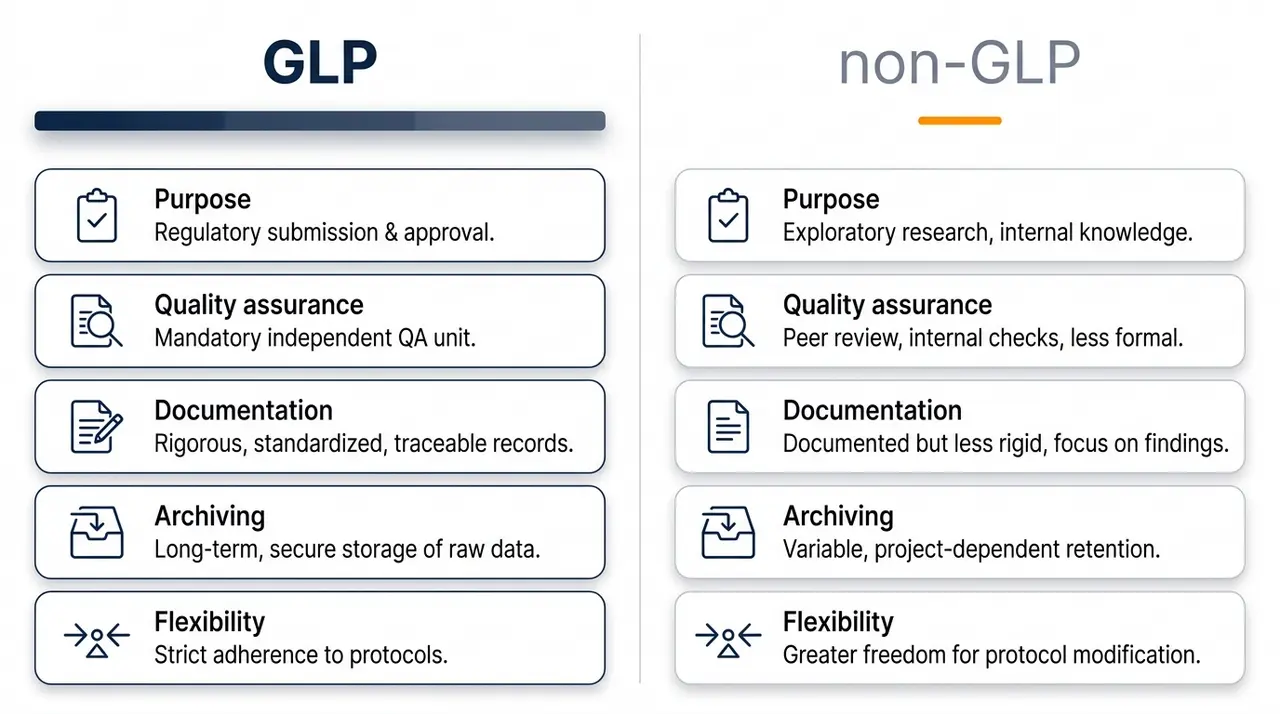
The table below summarizes the practical differences between the two frameworks across the dimensions that matter for planning and budgeting.
| Dimension | GLP Study | non-GLP Study |
|---|---|---|
| Purpose | Regulatory submission, pivotal safety decision | Exploration, screening, internal decision-making |
| Regulatory framework | FDA 21 CFR Part 58, OECD GLP Principles | Internal quality standards |
| Quality assurance | Independent QA unit with in-study audits | Internal checks only, if any |
| Documentation | Formal SOPs, raw data, full reports, deviation logs | Flexible, context-dependent |
| Archiving | Long-term regulated archiving of all materials | Project-specific retention |
| Deviations | Formal documentation, investigation, impact assessment | Informal handling |
| Submission acceptability | Directly accepted by regulators | Requires justification or replacement studies |
| Time and cost | Higher | Lower |
| Flexibility | Low, protocol is locked | High, mid-study learning allowed |
| Reproducibility | High, enforced by controls | Variable, depends on internal practice |
One row deserves emphasis: submission acceptability. GLP data is accepted by regulators across OECD member countries under the Mutual Acceptance of Data framework, which means a study run once can support submissions in multiple jurisdictions. Non-GLP data has no such default acceptance, and that difference alone justifies GLP for pivotal safety studies.
When Does a Regulator Expect GLP?
The general rule is straightforward: when the goal is a safety package supporting a regulatory submission or a critical safety decision, GLP is expected. The European Medicines Agency coordinates GLP inspections precisely to verify that nonclinical safety studies supporting marketing applications were conducted under GLP conditions. In the United States, FDA regulations under 21 CFR Part 58 apply to nonclinical laboratory studies intended to support applications, and the agency has clarified through formal guidance which studies fall inside and outside the scope of the regulations.
Conversely, exploratory and feasibility work is usually outside GLP. FDA has explicitly distinguished between studies intended for submission and exploratory, screening, or range-finding work, which sponsors may conduct without GLP. The practical takeaway for any program: classify every planned study by its eventual use. If the answer to “will a reviewer rely on this data to judge human safety?” is yes, plan for GLP from day one.
Can non-GLP Data Ever Support a Regulatory Submission?
Sometimes, yes, but the burden shifts to the sponsor. When non-GLP data is included in a submission, regulators expect full transparency, strong documentation, and a scientific justification explaining why the absence of GLP does not compromise the conclusions. What reviewers look for is traceability, reliability, auditability, and a clear account of any deviations and their impact.
A well-built justification typically includes a list of deviations from GLP principles, an assessment of each deviation’s impact on data quality, the controls that were in place, confirmation that raw data is available, and a description of archiving practices. An often-cited example comes from the ICH M3(R2) guideline on nonclinical safety studies, which allows acute toxicity data to be collected in a non-GLP setting when appropriate repeated-dose GLP studies support the overall safety package. The pattern is consistent: non-GLP data can fill supporting roles, but pivotal safety claims rest on GLP evidence.
Good News: Facilities that operate exploratory studies with GLP-like discipline in their documentation give sponsors an insurance policy — if the data later matters in a submission, there is something to stand on. This dual-discipline approach is exactly how experienced large animal facilities bridge the gap between flexibility and regulatory defensibility.
Behind the Scenes: How the Quality Assurance Unit Works
The Quality Assurance Unit, or QAU, is the institutional backbone of GLP. It is an independent control mechanism, separate from the people running the study, whose job is to confirm that the work adheres to the approved study plan and the facility’s procedures. FDA’s own Questions and Answers on the GLP regulations devote extensive attention to the QAU’s responsibilities, precisely because independent oversight is what regulators trust.
The key detail is timing. QA audits happen during the study, not only at the end. Inspectors may observe critical phases such as dosing or necropsy, review records as they are generated, and verify that the study plan was approved before work began. When a deviation occurs, QA documents it, ensures an investigation takes place, and confirms the impact on data integrity is assessed. This continuous, independent verification is what turns a laboratory report into evidence a regulator can rely on without re-running the experiment.
“The lesson is not that one mode is better than the other. The lesson is that the choice must match the purpose of the study, and that the purpose should be decided before the protocol is written, not after the data is collected.” — Biotech Farm Preclinical Research Team
Exploratory Studies: Two Studies, Two Purposes
An exploratory study and a GLP study may look identical on the bench, but they serve opposite purposes. Exploratory studies generate hypotheses, find dose ranges, develop models, and identify endpoints worth measuring. They thrive on iteration: parameters can change mid-study, endpoints can be soft and observational, and sample sizes can be small. The value is in learning speed.
A GLP study is built to produce pivotal data. The protocol is locked before the first procedure, acceptance criteria are defined in advance, documentation is complete, and deviations are managed formally. Nothing changes mid-study without a documented amendment, and even then, changes must not compromise the study’s integrity. Both study types belong in a program; the error is forcing one to do the other’s job.
Exploratory Study
- Generates hypotheses and identifies dose ranges
- Thrives on iteration and mid-study learning
- Soft endpoints, small sample sizes acceptable
- Value is in learning speed
GLP Study
- Built to produce pivotal, submission-ready data
- Protocol locked before the first procedure
- Acceptance criteria defined in advance
- Deviations managed formally with amendments

What Is a non-GLP Feasibility Study Good For?
A non-GLP feasibility study is a pilot whose entire purpose is to de-risk the GLP study that follows. Instead of discovering problems during an expensive pivotal study, the sponsor surfaces them early, when they are cheap to fix. In large animal research this is particularly valuable, because procedural complexity and per-animal costs are high, and a failed pivotal study is a serious setback.
A well-designed feasibility pilot might test whether the chosen animal model suits the device or compound, whether the delivery or implantation procedure is technically viable, what dose range is likely to be tolerated, what toxicity profile is expected, and whether the intended biomarkers are actually measurable in that species. The outcomes are concrete: a go or no-go decision, a refined protocol, and an optimized dose range carried into the pivotal study. Facilities that run both feasibility and GLP work under one roof, with surgical and imaging infrastructure suited to large animals, can shorten this loop considerably, since the pilot and the pivotal study share the same environment, team, and equipment.
Do Efficacy Studies Need GLP?
In most cases, no. Preclinical efficacy studies are usually exploratory in nature: they help select the best candidate, confirm a mechanism, or build the biological rationale for a program. GLP is generally not required for them, because they are not the evidence regulators rely on to judge human safety. Applying GLP to typical efficacy work adds cost and rigidity without adding regulatory value.
The caveat is rigor. A non-GLP efficacy study still needs robust methodology, appropriate controls, and honest documentation, otherwise the candidate selection it informs is built on sand. And there is a boundary case: when an efficacy finding becomes a pivotal regulatory or clinical claim, for example in some cell and gene therapy or orphan device contexts, the level of rigor should rise accordingly, even if full GLP is not technically mandated. The question to ask is whether the data will support a claim, and if so, to act as though reviewers will scrutinize it.
Which Safety Studies Almost Always Require GLP?
The natural candidates are the submission-enabling safety studies, the ones that form the primary evidence for human safety in an IND, NDA, or medical device submission. Repeat-dose toxicology is the classic example, along with safety pharmacology studies that are part of the safety package. The European Commission’s framework on Good Laboratory Practice reflects the same principle across the EU, requiring member states to ensure conformity with OECD GLP principles for nonclinical safety testing.
A simple test identifies a submission-enabling study: if the study is a primary piece of evidence in the regulatory submission for safety, it needs GLP. Any study intended to demonstrate that a product is sufficiently safe for human use must be reliable and reproducible to a standard that survives independent regulatory inspection. When in doubt, consult the regulatory strategy early; retrofitting GLP onto a finished study is impossible, and repeating it is expensive.
What GLP Does to Your Budget and Timeline
GLP increases both direct cost and duration. Quality assurance involvement, formal documentation, dosing solution concentration analysis, controlled archiving, and facility requirements all add overhead. A GLP study routinely costs a multiple of its non-GLP equivalent and takes longer from planning to final report.
The counterbalance is risk. GLP significantly reduces the chance of late-stage failure caused by inadmissible or irreproducible data, which is the most expensive failure mode in preclinical development. Total cost of ownership matters more than invoice price: an early investment in GLP for pivotal studies prevents the far larger cost of repeating an entire program. For a deeper treatment of how GLP supports data reliability in animal studies, see our companion article on GLP animal studies and their importance for medical device development.

Building the Strategy: When to Move from non-GLP to GLP
A smart preclinical strategy escalates rigor as the program matures. The table below maps the typical progression.
| Development Stage | Typical Studies | Appropriate Framework |
|---|---|---|
| Discovery / target identification | Screening, early biology | Pure non-GLP, maximum flexibility |
| Lead optimization / proof of concept | Feasibility pilots, method development, dose finding | Non-GLP with increasing internal rigor |
| Candidate selection | Pivotal safety assessments | Transition to GLP or GLP-ready designs |
| Regulatory submission (IND / NDA / IDE) | Core safety package | Full GLP |
Each transition point is a strategic decision, not an automatic milestone. The right moment to move to GLP depends on the regulatory pathway, the product class, and the risk tolerance of the sponsor. What should never happen is reaching the submission stage and discovering that the studies supporting it were run in the wrong framework. Planning the transition early, ideally with a facility that can host both the exploratory and the pivotal phases, keeps the program coherent. More broadly, our guide to regulatory compliance in preclinical research and GLP standards covers the wider compliance landscape that surrounds these decisions.
Five Mistakes That Cost Sponsors Time and Money
- Mistake 1 — Treating non-GLP as a synonym for no quality. Exploratory studies still require scientific rigor, honest documentation, and retained raw data; without them, even internal decisions are built on unreliable foundations.
- Mistake 2 — Delaying GLP considerations until the study is already planned. GLP requirements shape facility selection, protocol design, and budget. Sponsors who engage GLP planning early avoid redesign work and last-minute facility changes.
- Mistake 3 — Over-applying GLP to studies that do not need it. Running a screening study or a feasibility pilot under full GLP burns budget and strips away exactly the flexibility that makes exploratory work valuable. Rigor should match purpose, not exceed it.
- Mistake 4 — Insufficient archiving and raw data retention for non-GLP studies. If exploratory data later needs justification in a submission, or if a reviewer questions the rationale for a dose selection, accessible raw records are the only defense.
- Mistake 5 — Underestimating the feasibility phase entirely. Jumping from in vitro or small animal work straight into a pivotal large animal study without a pilot is a recipe for expensive failure. A structured non-GLP feasibility study in a well-equipped large animal facility, with an experienced surgical and scientific team, is one of the highest-return investments in the entire preclinical chain.
Frequently Asked Questions About GLP and non-GLP Studies
So Which Framework Does Your Next Study Need?
The choice between GLP and non-GLP comes down to three questions: what is the purpose of the study, will a regulator rely on it, and what is the cost of being wrong? A balanced preclinical strategy uses the flexibility of non-GLP work to learn quickly and cheaply, then reserves the rigor and cost of GLP for the pivotal studies that must survive regulatory scrutiny. Programs that get this balance right move faster and spend less overall than programs that treat every study identically.
Do you have a study on the horizon and are unsure which framework it requires, or would you like an experienced team to review your preclinical plan end to end? Biotech Farm Ltd. offers a state-of-the-art large animal facility, GLP validation study support, and more than 30 years of experience leading preclinical research for medical devices and pharmaceuticals, with a tailored, scientifically supportive approach for every program.