Preclinical Study Timeline Planning: Navigating Drug Development from Lab to IND Submission
Behind every first-in-human trial lies a meticulously orchestrated preclinical phase where science, logistics, and regulatory strategy must move in concert. At Biotech Farm, we view preclinical study timeline planning not as a scheduling exercise but as a strategic discipline that shapes the entire drug development timeline preclinical trajectory. The preclinical phase duration influences investor confidence, funding rounds, and the window in which a candidate can reach patients.
Establishing safety and preliminary efficacy of a new molecule requires alignment between pharmacology, toxicology, CMC, and regulatory workstreams — with each dependency mapped and each risk anticipated. Whether the program involves a novel biologic, a small molecule, or a combination product, the earliest planning decisions have outsized effects on cost and speed. For programs involving formulated products, integrated Drug Delivery Systems Preclinical Testing can be scoped early to align exploratory pharmacokinetics with downstream toxicology needs.
Expert Insight
The distinction between a “schedule” and a “plan” is critical in preclinical development. A schedule lists dates; a plan incorporates risk management, contingency buffers, alternative suppliers, and defined escalation paths. Programs that plan the IND-enabling package as an integrated deliverable — rather than a collection of independent studies — consistently reach submission faster and with fewer costly mid-course corrections.
How Long Do Preclinical Studies Really Take? Understanding the Full Scope
The common industry answer to “how long preclinical studies take” is 2–5 years, but the reality is more nuanced. According to the NIH Clinical Center’s life cycle overview, nonclinical research typically spans this range as part of the overall drug development lifecycle, yet the actual preclinical phase duration depends heavily on drug modality, indication, regulatory pathway, and material availability.
A focused exploratory program may complete initial in vitro and pharmacokinetic characterization within three to six months, whereas a comprehensive IND-enabling package with GLP toxicology can extend well beyond a year. The drug development timeline preclinical scope is much broader than “animal studies” alone — it encompasses planning, method development, test article production, pathology, quality assurance, and final report generation, each contributing weeks or months to the overall duration.
Exploratory Phase
Initial in vitro characterization and pharmacokinetic profiling can be completed in 3–6 months for focused programs.
IND-Enabling Package
Comprehensive GLP toxicology with full reporting can extend well beyond a year, depending on complexity and modality.
Full Development Lifecycle
NIH data indicates nonclinical research spans 2–5 years as part of the broader drug development lifecycle.
What is Preclinical Study Timeline Planning, and Why Does it Matter?
Preclinical study timeline planning is the disciplined integration of every workstream that touches the drug candidate before human exposure. This includes pharmacology, ADME/PK, toxicology, bioanalysis, CMC (Chemistry, Manufacturing, and Controls), regulatory affairs, and CRO management. The goal is straightforward: ensure the critical path advances without bottlenecks while parallel activities feed into it on time.
The distinction between a “schedule” and a “plan” is meaningful. A schedule lists dates; a plan incorporates risk management, contingency buffers, alternative suppliers, and defined escalation paths. For Israel-based sponsors, Biotech Farm supports this integration locally, coordinating in-life work with regulatory milestones so the drug development timeline preclinical remains realistic and defensible.
Key Workstreams in Preclinical Planning: Pharmacology · ADME/PK · Toxicology · Bioanalysis · CMC · Regulatory Affairs · CRO Management · Ethics & Compliance
Discovery vs. IND-Enabling: A Different Kind of Preclinical Work
The preclinical study timeline is best understood as two connected but distinct chapters. Discovery focuses on identifying, screening, and optimizing a drug candidate — characterizing potency, selectivity, and initial safety signals. IND-enabling studies pursue a different objective: demonstrating that the candidate is reasonably safe for first-in-human (FIH) trials and generating the regulatory evidence required to support that conclusion.
Specific IND-enabling activities include GLP toxicology, safety pharmacology (typically cardiovascular, respiratory, and CNS per ICH S7A), and genotoxicity testing per ICH S2(R1). Understanding the transition point matters because the required rigor and documentation change dramatically. Sponsors preparing to file should also review IND vs NDA Preclinical Differences to appreciate how nonclinical requirements evolve later in development.
???? Discovery Phase
- Candidate identification & screening
- Potency & selectivity characterization
- Initial in vitro safety profiling
- Lead optimization
???? IND-Enabling Phase
- GLP toxicology studies
- Safety pharmacology (ICH S7A)
- Genotoxicity testing (ICH S2(R1))
- Regulatory documentation & QA
Key Workstreams Driving the Preclinical Critical Path
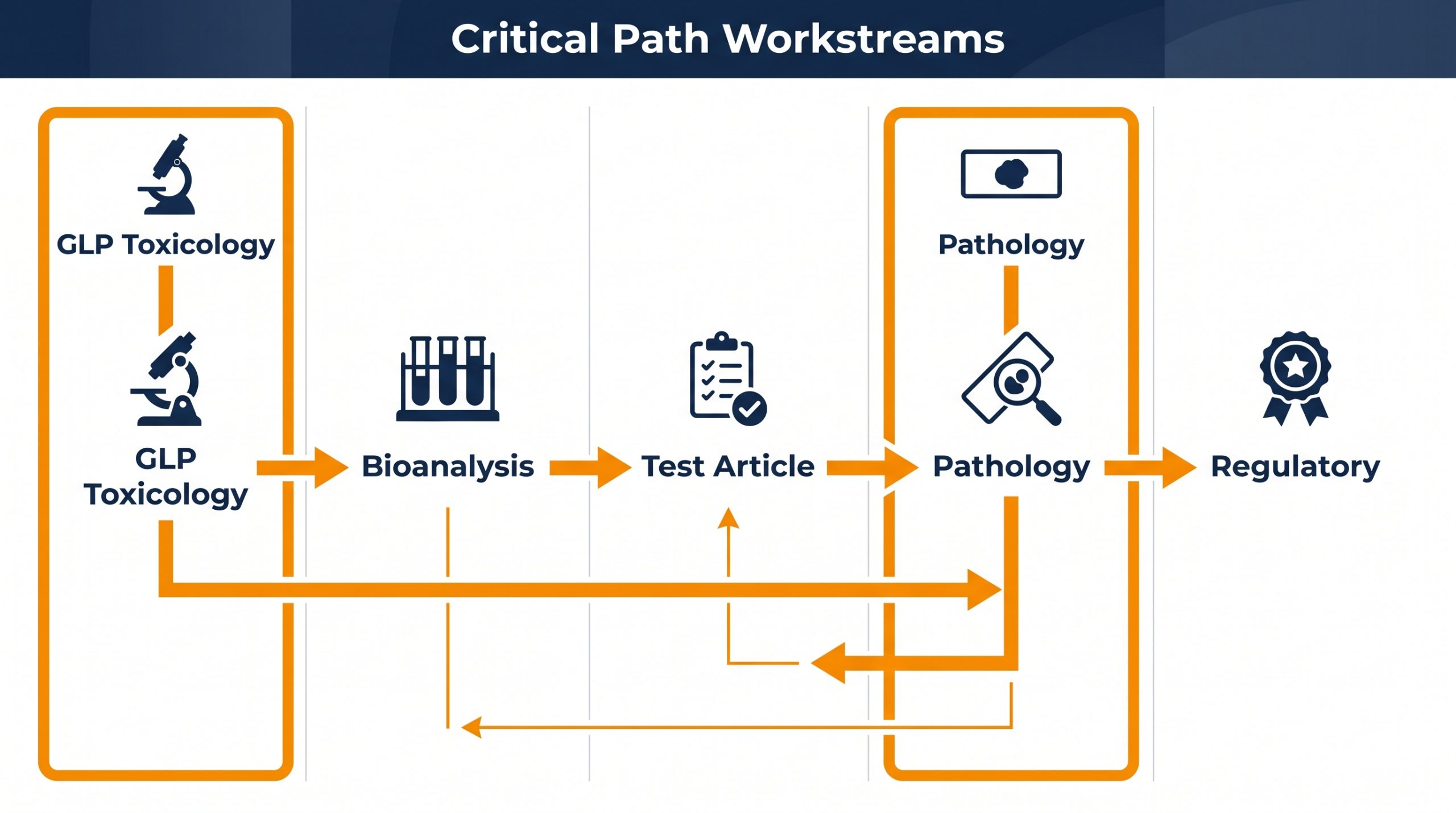
The preclinical phase duration is rarely dictated by a single activity. Instead, several parallel workstreams converge, with GLP toxicology studies — including pathology and final report generation — typically defining the critical path. Test article readiness, formulation stability, and validated analytical methods often gate the start of pivotal studies.
Common bottlenecks in CRO study timeline execution include animal availability (especially for large animal models), facility scheduling, pathology capacity, and regulatory response windows. Anticipating these constraints during planning is more effective than reacting to them mid-study.
Typical Critical Path Milestones
A representative critical path sequence begins with protocol development and institutional ethics approval (in Israel, through the Council for Animal Experiments), followed by the in-life study phase, pathology and data analysis, QA review, draft report generation, and final report issuance.
The ICH M3(R2) guideline links nonclinical safety study durations to intended clinical exposure, meaning the toxicology plan must be built backward from the clinical protocol. Institutional and ethical approvals — mandated under Israeli regulation — are non-negotiable prerequisites that should be initiated as early as protocol drafts allow.
✅ Critical Path Sequence: Protocol Development → Ethics Approval → In-Life Study → Pathology & Analysis → QA Review → Draft Report → Final Report → IND-Ready Package
How Long Does GLP Toxicology Take (Including Reports)?
The GLP tox study timeline is often underestimated because the “in-life” portion is only one segment of a much longer process. Dosing and observation phases may span weeks to months, but the full study — from protocol finalization through pathology, QA audit, and report issuance — commonly runs six to nine months, sometimes longer.
The gap between last dose and final signed report frequently surprises sponsors, and it is here that programs lose ground when planning was optimistic. Study duration itself follows the “equal or exceed” principle: the toxicology exposure duration should match or exceed the planned clinical dosing period. According to OECD principles, GLP adds documentation, quality control, traceability, and reporting layers that extend timelines but substantially reduce regulatory risk.
“A GLP study that runs longer than a research study but produces a defensible, reproducible dataset is almost always the better investment. Only GLP-compliant pivotal data will be accepted for IND-enabling purposes.”
— Adir Koreh, CEO, Biotech Farm Ltd.
The Role of ADME/PK and Bioanalysis in Preclinical Timelines
ADME/PK and bioanalytical studies can run in parallel with other preclinical activities, but they are on the critical path in a subtler way — they generate the exposure data required to interpret toxicology findings. A common source of delay in the preclinical study timeline is bioanalytical method development: matrix effects, sample stability issues, and re-analysis of study samples can each add weeks.
The pragmatic strategy is to establish “fit-for-purpose” analytical methods early, then invest in full GLP validation only when the study design is locked. Poor coordination between bioanalysis and in-life sampling plans is a frequent contributor to expanded drug development timeline preclinical estimates.
- Matrix effects during method development
- Sample stability issues identified late
- Re-analysis of incurred study samples
- Misalignment between bioanalysis and in-life sampling plans
Scenario: What Sponsors Must Prepare Before Engaging a CRO
Consider a sponsor ready to initiate GLP toxicology with a CRO. Success or delay is largely determined before the first animal is dosed. Prerequisites include an approved protocol, a well-characterized test article with certificate of analysis, a validated or fit-for-purpose bioanalytical method, defined acceptance criteria, a sampling plan, and a coordinated QA/regulatory strategy.
Insufficient preparation results in costly rework once CRO engagement begins. Frequent time sinks include repeated protocol revisions, unresolved QA questions, and misalignment on deliverables such as report format or data transfer specifications. A short pre-initiation review — sometimes called a study readiness gate — can save weeks downstream.
???? CRO Engagement Prerequisites Checklist
- Approved protocol with defined endpoints
- Well-characterized test article + certificate of analysis
- Validated or fit-for-purpose bioanalytical method
- Defined acceptance criteria and sampling plan
- Coordinated QA/regulatory strategy
- Agreed report format and data transfer specifications
Breakdown of Preclinical Study Phases: Before, During, and After In-Life
Effective preclinical study timeline planning divides work into three temporal phases. The pre-study phase covers planning, protocol approval, ethics/IACUC review, test article characterization, and method development. The in-life phase encompasses dosing, observations, sampling, and terminal procedures. The post-study phase — often longer than in-life — includes necropsy, pathology, data analysis, QA audit, and report writing.
Sponsors regularly underestimate post-study duration. Defining report templates, data flow, and acceptance criteria upfront meaningfully shortens the interval between last dose and final report.
| Phase | Typical Activities | Approximate Duration |
|---|---|---|
| Pre-study | Protocol, ethics approval, test article characterization, method development | 2–4 months |
| In-life | Acclimation, dosing, observations, sampling, necropsy | 2 weeks–6+ months |
| Post-study | Pathology, bioanalysis, QA audit, draft and final report | 3–6 months |
Common Pitfalls: Factors That Extend Preclinical Timelines
Understanding how long preclinical studies take requires understanding what tends to make them longer. The recurring culprits behind extended preclinical phase duration include protocol amendments after study initiation, issues with drug material supply or formulation stability, failed analytical method transfers, CRO resource conflicts, and unexpected toxicological findings that trigger repeat or expanded studies.
“Scope creep” — adding endpoints after protocol finalization — is a subtle but expensive contributor. A mismatch between study objectives and selected endpoints often surfaces late, when correction is costly. Pathology and histology bottlenecks, particularly for programs requiring specialized staining or electron microscopy, also delay report finalization.
Material & Formulation
Drug material supply issues, formulation instability, and failed analytical method transfers commonly gate study initiation.
Protocol Amendments
Amendments after study initiation and endpoint scope creep are among the most expensive and avoidable timeline extensions.
Unexpected Findings
Unexpected toxicological findings may trigger repeat or expanded studies, requiring additional animal cohorts and extended pathology timelines.
Strategies for Accelerating Preclinical Timelines Without Compromising Quality
Smart parallelism is the most effective lever for compressing the drug development timeline preclinical without cutting corners. Bioanalytical method development can advance alongside pilot in vivo studies. Stability studies can run in parallel with pharmacology characterization. Regulatory preparations — briefing documents, pre-IND meeting requests — can begin before the pivotal GLP tox study concludes.
CMC activities such as process development and scale-up should be sequenced to deliver GLP-grade material on time, not just eventually. Clear “exit criteria” define what must be finalized before GLP work begins and what can remain provisional. Contingency planning for PK data that misses expected exposure targets is prudent — a dose-range-finding study result often reshapes the pivotal design.
- Bioanalytical method development alongside pilot in vivo studies
- Stability studies concurrent with pharmacology characterization
- Regulatory briefing documents prepared during GLP execution
- CMC scale-up sequenced to deliver GLP-grade material on schedule
Building a Preclinical Gantt Chart: Milestones and Dependencies
A useful Gantt chart for preclinical study timeline planning is organized by workstream, with dependencies mapped as inputs and outputs and buffer times built into high-risk activities. Regulatory milestones — pre-IND meeting, IND submission target — anchor the right side of the chart.
Critical milestones include final protocol approval, first dose, last dose, necropsy completion, pathology lock, draft report, final report, and IND-ready package assembly. Dependencies worth explicitly marking include test article availability, validated analytical methods, facility scheduling windows, ethics committee cycles, and QA sign-off timing.
How Biotech Farm Supports Your Program
| Business Need | How Biotech Farm Supports It in Practice |
|---|---|
| Local execution in Israel | Integrated facility with in-house surgical, imaging, and animal care infrastructure |
| Large animal models | Access to pig, sheep, goat, and rabbit models with humanoid organ relevance |
| Scientific escort through planning | Senior team engagement from protocol design through report review |
| Ethics and regulatory readiness | Familiarity with Israeli Council for Animal Experiments processes and documentation |
| Flexible study scoping | Exploratory-through-IND-enabling programs matched to sponsor stage and budget |
Managing CRO Study Timelines to Prevent Surprises
Effective CRO study timeline management begins with clear Service Level Agreements and defined deliverables. Weekly control points, a structured change management process, and documented backup plans for critical resources reduce the frequency of surprises. Response times for draft reviews, approval workflows, and the definition of a “change request” should be agreed upon before study start.
Transparency about the availability of critical personnel — Study Director, Pathologist, QA — matters because their bandwidth often defines report completion dates. The FDA’s IND application framework expects Pharmacology & Toxicology data sufficient to establish that a candidate is reasonably safe for human exposure, meaning CRO deliverables must satisfy both scientific and documentation standards.
“Transparency about the availability of critical personnel — Study Director, Pathologist, QA — matters because their bandwidth often defines report completion dates, not the in-life phase itself.”
— Biotech Farm Preclinical Strategy Team
What is an IND-Enabling Study Package?
An IND-enabling study package is the comprehensive nonclinical dataset that regulatory authorities require to support the initiation of human clinical trials. It typically comprises GLP toxicology studies (acute and repeat-dose subchronic), safety pharmacology (cardiovascular, respiratory, CNS per ICH S7A), genotoxicity testing per ICH S2(R1), ADME/PK data including dose proportionality and exposure margins, and detailed reports and summaries.
The FDA’s guidance on the Pharmacology & Toxicology section of an IND — and the accompanying content and format guidance for Phase 1 studies — describes the expected structure and depth. Programs that plan the IND-enabling package as an integrated deliverable, rather than a collection of independent studies, tend to reach submission faster.
???? Toxicology
GLP acute and repeat-dose subchronic toxicology studies with full pathology and histopathology reporting.
❤️ Safety Pharmacology
Cardiovascular, respiratory, and CNS assessments per ICH S7A guidelines.
???? Genotoxicity
Standard genotoxicity battery per ICH S2(R1) including Ames test and in vitro/in vivo clastogenicity assays.
Why GLP Standards Impact Preclinical Study Duration
Good Laboratory Practice is the quality system governing planning, execution, monitoring, recording, archiving, and reporting of nonclinical safety studies. Per OECD principles, GLP adds rigorous layers of documentation, quality assurance, and traceability that extend the GLP tox study timeline compared to non-GLP work.
These layers exist for a reason: they underpin data integrity and regulatory acceptance across jurisdictions. A GLP study that runs longer than a research study but produces a defensible, reproducible dataset is almost always the better investment. Sponsors weighing “faster non-GLP” versus “compliant GLP” should recognize that only GLP-compliant pivotal data will be accepted for IND-enabling purposes.
Comparison Table: Non-GLP vs. GLP Preclinical Studies
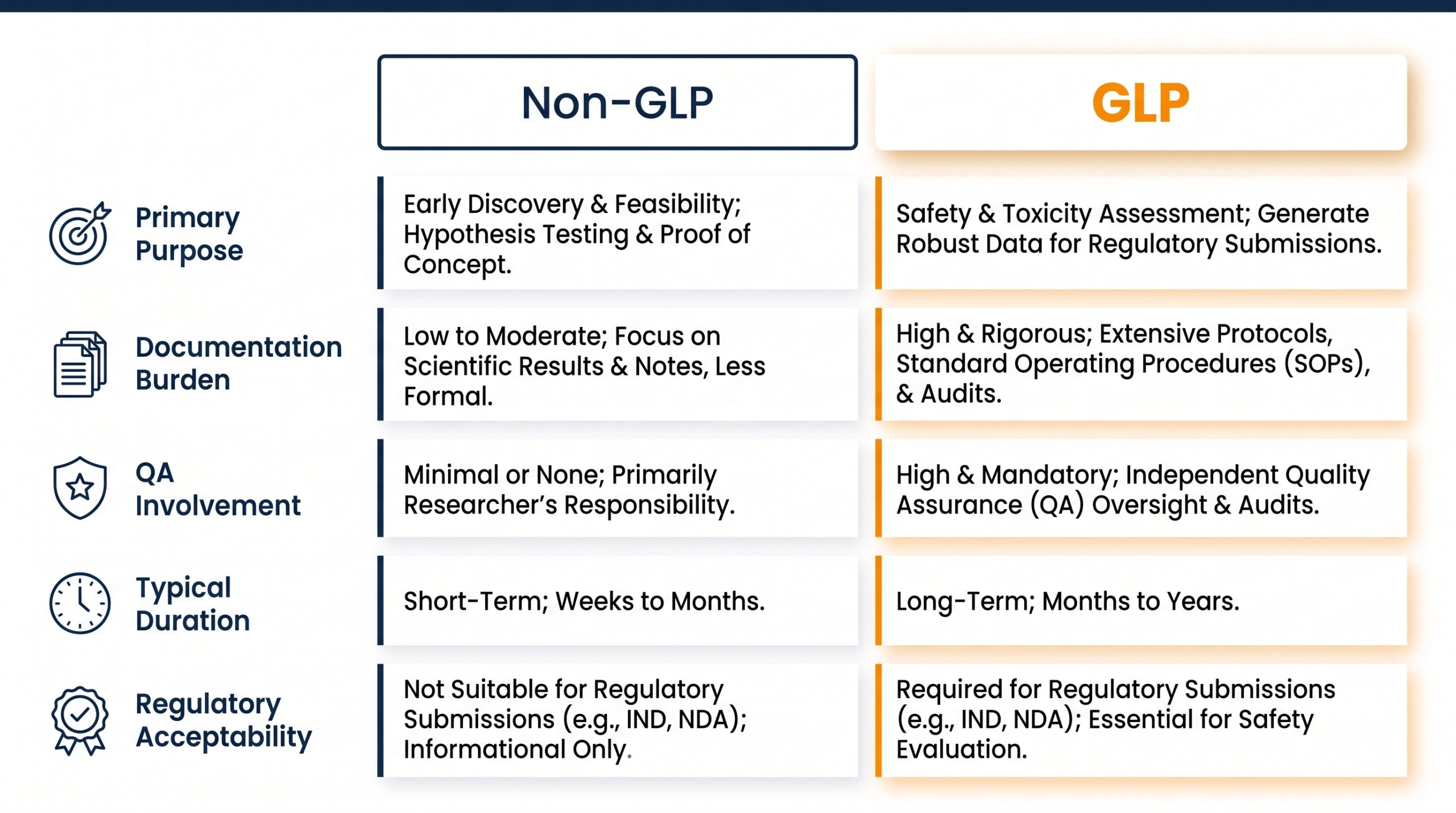
| Attribute | Non-GLP (Exploratory) | GLP (IND-Enabling) |
|---|---|---|
| Primary purpose | Screening, dose-range finding, mechanism | Regulatory submission, safety justification |
| Documentation burden | Moderate | Extensive, audit-ready |
| QA involvement | Limited or none | Independent QA audit and sign-off |
| Typical duration | Weeks to a few months | Several months to a year+ |
| Regulatory acceptability | Supportive only | Pivotal for IND/CTA |
Frequently Asked Questions
Ready to Map Your Preclinical Path?
What would it mean for your program if your preclinical timeline were built around dependencies rather than optimism? If you are planning your next IND-enabling package, exploring large animal models, or reassessing an existing preclinical schedule, our team is available to review your plan and identify where time can realistically be gained.