Preclinical GI Research | Large Animal Models | Translational Surgical Data
Pig Model Gastrointestinal Procedures: Building Translational GI Data in a Large Animal Facility
Preclinical gastrointestinal research demands anatomy, tissue behavior and working space that closely resemble the operating room — and that is precisely where the porcine platform earns its place. With more than three decades of experience in leading, managing and scientifically escorting large animal studies, our team designs GI protocols that translate laboratory concepts into surgical and endoscopic evidence.
Device developers, surgical innovators and pharma groups rarely need “an animal” — they need a controlled biological environment in which a stapler, a stent, a suturing platform or a hemostatic agent behaves as it would in a patient. This article walks through the practical anatomy of that decision: procedure types, study design, preparation, endpoints, complications, model selection and the documentation that regulators and investors expect.
Exclusive Insight: Why the Pig Colon Rarely Behaves Like a Textbook Diagram
Most sponsors arrive expecting the porcine colon to mirror the human colon segment-for-segment. In practice, the proximal colon is organized as a spiral (ansa spiralis), which changes mobilization strategy, tension calculations and specimen orientation. Teams that ignore this anatomical detail routinely misinterpret burst-pressure data. Building the segment choice into the protocol — not discovering it intraoperatively — is one of the highest-leverage decisions in any pig colon surgery model.
Unlocking Preclinical Research: An Overview of Pig Model Gastrointestinal Procedures
Pig model gastrointestinal procedures use domestic pigs or minipigs to reproduce human GI conditions for the evaluation of devices, surgical techniques and therapeutic candidates. The porcine GI model supports work along the entire tract — stomach, duodenum, jejunum, ileum, colon and rectosigmoid — using open, laparoscopic or endoscopic access.
The value lies in the data package generated: intraoperative feasibility observations, imaging, functional measurements, gross pathology and histology from defined tissue segments. A swine intestinal model can answer questions that bench testing and rodent work simply cannot, such as whether a stapling device seats correctly on a wall of clinically realistic thickness.
Study design splits into two families. Non-survival (acute, terminal) work answers immediate technical and safety questions, while survival studies follow healing, remodeling and complications over days to weeks. Choosing between them shapes budget, ethics documentation, facility requirements and the entire analytical plan.
Why Choose a Porcine GI Model Over Small Animal Models?
The question comes up in almost every kickoff meeting: why not stay with rodents? The answer is dimensional and mechanical. The pig digestive system offers lumen diameters, wall thickness, mesenteric vasculature and abdominal volume that accommodate human-sized instrumentation. Trocars, 4K laparoscopic towers, standard endoscopes, circular staplers and clip appliers can be used as they are, without miniaturized prototypes that no longer represent the final product.
Pig digestive system surgery therefore mirrors the clinical workflow: insufflation, port placement, dissection planes, anastomotic construction and closure. That realism matters for design verification, human factors evaluation, surgeon training and regulatory submissions. The physiological proximity of swine models for biomedical research — cardiovascular, renal, integumentary and digestive — is what allows a single animal to yield systemic safety context alongside local GI performance data.
Bridging the Gap: Human–Porcine GI Similarities and the Differences You Must Design Around
Pigs are monogastric omnivores, and post-gastric physiology, transit dynamics and mucosal architecture parallel human biology closely enough for translational inference. Reviews of porcine intestinal models emphasize that the large gastrointestinal tract provides increased surgical access, manipulation and experimental tissue volume, as described in the Frontiers in Veterinary Science review of porcine intestinal microbiota models.
Differences are equally important. The porcine proximal colon is organized as a spiral (ansa spiralis), which changes mobilization strategy, tension calculations and specimen orientation. Despite that, comparative transcriptomics has shown highly conserved regional programs in the porcine and human colonic enteric nervous system. Broader translational reviews of porcine models of digestive disease map both the parallels and the anatomical variations that must be acknowledged in the protocol rather than discovered mid-study.
Diverse Applications: Gastrointestinal Procedures Performed in a Pig Model
Procedure selection follows the scientific question. Feasibility studies favor short acute sessions; performance and durability questions demand defect creation, resection and reconstruction; healing questions require survival follow-up with structured tissue harvesting. Defect models, partial and segmental resections, hand-sewn and stapled anastomoses, ostomy creation, leak models and perfusion assessments all sit within the standard repertoire of pig large animal models for R&D.
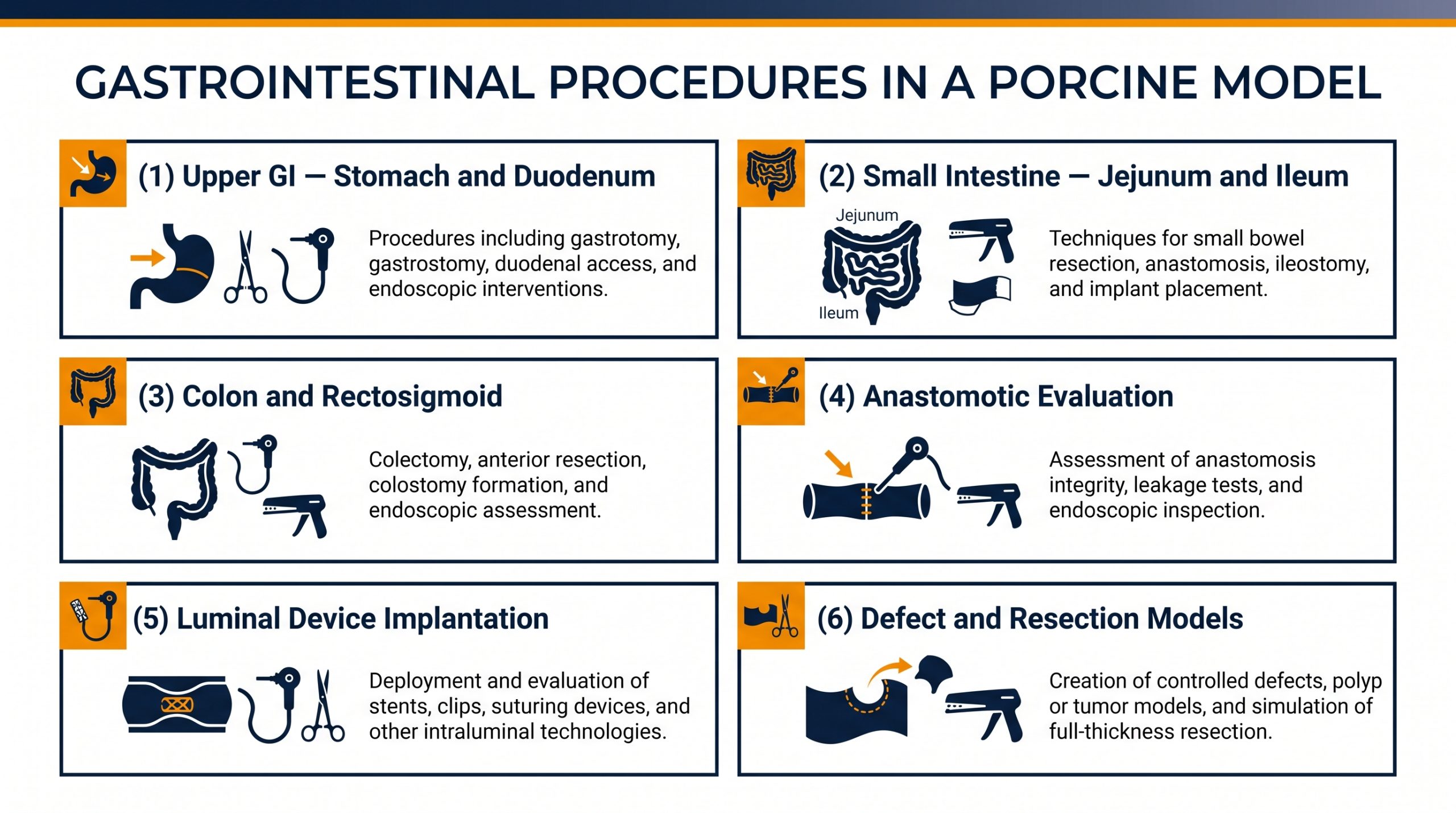
Upper GI: Stomach & Duodenum
Gastrostomy, ulcer induction, sleeve-type resections, transgastric endoscopic gastrojejunostomy and endoscopic suturing, including reproducible bleeding models for hemostatic device testing.
Small Intestine: Jejunum & Ileum
The swine intestinal model workhorse for anastomotic evaluation, luminal implants, bypass configurations, obstruction models and absorption studies with multi-site testing per animal.
Colon & Rectosigmoid
Low anterior resection analogues, circular stapling, transanal approaches, endoscopic full-thickness resection, defect closure and diverting stoma creation.
Mastering Pig Colon Surgery Models: From Technique Validation to Hard Endpoints
A pig colon surgery model is often the decisive study for colorectal devices. It tests whether a resection technique, closure method or anastomotic device produces a durable, well-perfused, leak-resistant junction. Acute studies measure immediate technical success and burst pressure; survival studies add clinical leak rates, abscess formation, stricture and adhesion burden.
Mechanical characterization matters because tissue thickness, layer composition and compression behavior drive staple line integrity; published mechanobiological analyses of colorectal stapling emphasize that porcine colonic length and spiral organization must be accounted for when extrapolating device performance. Typical endpoint sets combine clinical observation, imaging or contrast studies, ex vivo burst or tensile testing, and blinded histopathology scoring of inflammation, collagen deposition and mucosal continuity. In a swine intestinal model, the same endpoint architecture applies with segment-specific reference values.
“A deviation that is recorded, explained and time-stamped strengthens a submission — an undocumented one can invalidate an entire cohort.” — Biotech Farm Surgical & Research Team
Understanding the Swine Intestinal Model: When and Why It Is Needed
The swine intestinal model refers to research conducted primarily in the jejunum and ileum, where lumen diameter and wall thickness approximate human dimensions. It becomes the model of choice whenever the study requires human-scale instruments, realistic mesenteric handling or physiologically relevant transit and absorption.
Typical scenarios include anastomotic device qualification, luminal implant retention, enteral access systems, adhesion-prevention materials and nutrient absorption pharmacology. The porcine GI model is also applied to complex chronic conditions — for example, short bowel syndrome studies that examine perioperative nutritional management, intestinal adaptation and long-term outcomes after extensive resection.
Long-term healing questions demand survival design, structured analgesia, nutritional support and defined humane endpoints. When a sponsor needs both acute technical proof and chronic durability, a staged program — acute cohort first, survival cohort second — usually reduces total cost and protects the timeline.
Study Design Essentials: Non-Survival Versus Survival Pig Models
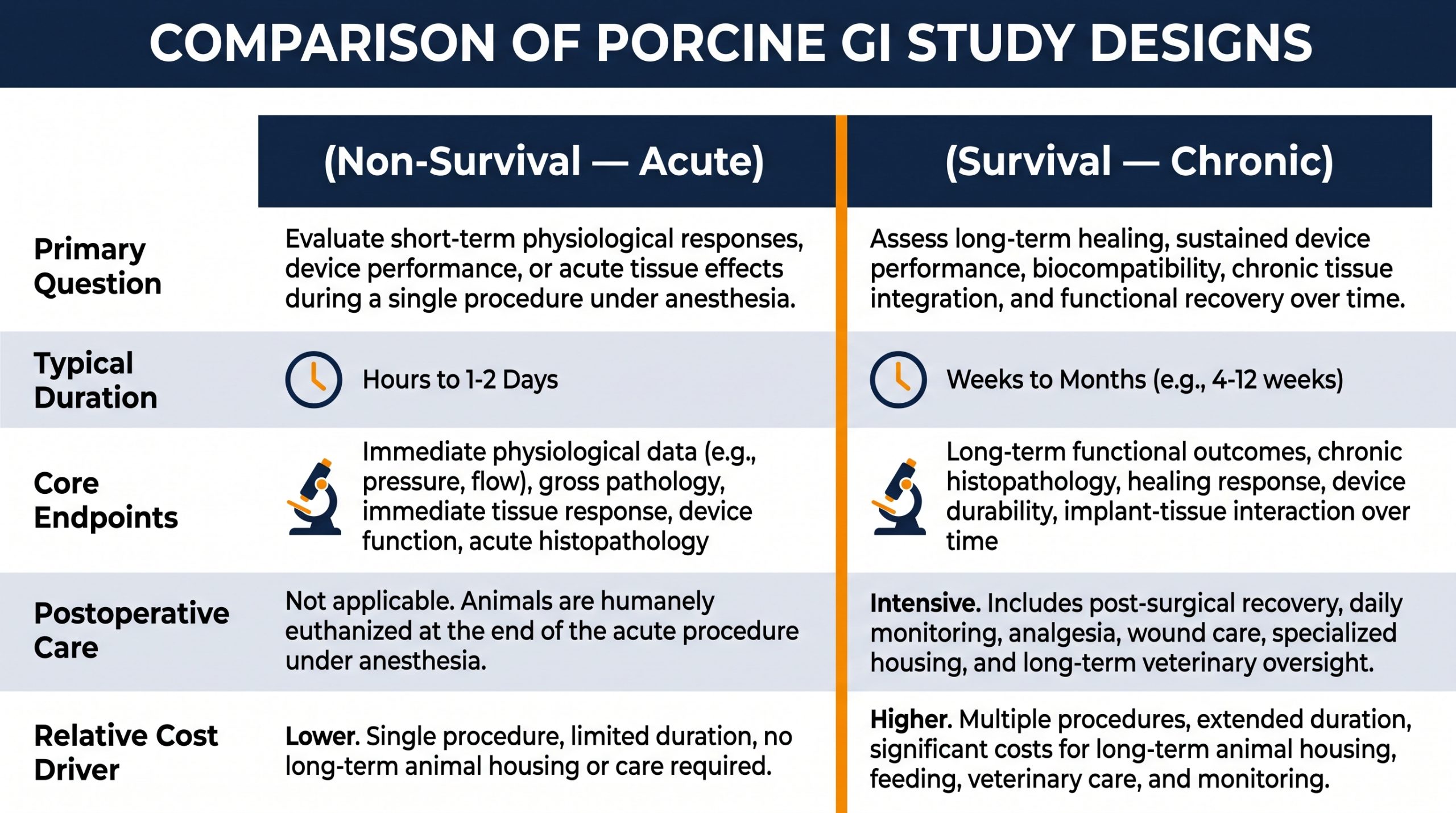
The design decision drives everything downstream: anesthesia duration, sterility requirements, staffing, husbandry, ethics documentation and analytical scope. Non-survival studies concentrate resources into a single session; survival studies extend the commitment across weeks of monitoring and care.
Selecting a Non-Survival Design
Choose acute work for proof of concept, ergonomics and human-factors assessment, acute hemostasis testing, immediate burst-pressure measurement, imaging validation and physician training. It yields fast answers, avoids postoperative variables and is well suited to early iterative prototyping where the device may still change between sessions.
Selecting a Survival Design
Survival models are mandatory when the claim involves healing, integration, degradation, chronic patency or late complications. They require perioperative antibiotics, multimodal analgesia, clinical scoring, weight and feed intake tracking, imaging follow-up and predefined stop criteria — with veterinary oversight throughout.
| Design parameter | Non-survival (acute) | Survival (chronic) |
|---|---|---|
| Primary question | Feasibility, acute safety, technique | Healing, durability, late complications |
| Typical duration | Single session, hours | 3 days to 12 weeks or longer |
| Core endpoints | Technical success, burst pressure, imaging | Leak, stricture, adhesions, histology |
| Postoperative care | Not applicable | Analgesia, antibiotics, nutrition, scoring |
| Relative cost driver | OR time and consumables | Housing, monitoring, pathology |
Preparing for Success: Pre-operative Management in Pig GI Surgery Studies
Preparation determines whether the surgical field is workable and whether results are comparable across animals. Inadequate fasting produces a distended, contaminated field, obscures the anastomotic site and increases aspiration risk during induction; excessive restriction stresses the animal and alters mucosal and metabolic parameters.
Fasting, Diet and Bowel Preparation Principles
Published feeding-management reviews for gastrointestinal studies in pigs describe food withdrawal windows commonly in the range of 12–24 hours with water available until shortly before induction, sometimes preceded by a low-residue or liquid diet. Reviews of preoperative food and water restriction in laboratory pigs stress standardization and documentation of the exact interval, since protocol drift is a frequent, avoidable source of variability.
Adjusting for Upper Versus Lower GI Targets
Upper GI and endoscopic work prioritizes gastric emptying; colonic and rectosigmoid procedures may add enemas or extended low-residue feeding. Anesthesia, ventilation and monitoring protocols are matched to the segment, the duration and the expected physiological load.
Measuring Success: Key Endpoints in Porcine Intestinal Surgery Models
Endpoints must be defined before the first animal enters the operating room. Clinical outcomes include mortality, leak, peritonitis, wound infection, ileus, feed intake and body weight trajectory. Functional outcomes cover transit, patency, perfusion assessment and, where relevant, absorption markers. Mechanical outcomes typically involve burst pressure, tensile strength and anastomotic index measurements.
- Inflammatory infiltrate and granulation tissue scoring
- Neovascularization and collagen maturation
- Mucosal continuity and foreign-body response
Histopathology closes the loop, scored blindly against a predefined scale. In any swine intestinal model, a written tissue collection map — segment identity, orientation, fixation and staining plan — protects the dataset from ambiguity months later. Separating one primary endpoint from supporting secondary endpoints keeps the statistical plan honest and makes the resulting report far easier for a notified body or reviewer to read.
Common Mistakes That Undermine Porcine GI Studies
The most frequent failures are not surgical; they are procedural. Undefined success criteria, inconsistent fasting, unblinded scoring, mixed pig weights within a cohort, and improvised deviations from protocol all erode interpretability. A second cluster involves logistics: histology sent without orientation markers, missing device lot numbers, or imaging saved without standardized settings. Clinical complications — hemorrhage, anastomotic leak, infection, ileus, stricture and adhesions — are mitigated through meticulous planning, experienced surgical hands, gentle tissue handling, controlled tension, verified perfusion and disciplined asepsis.
Optimal Selection: Matching Pig Size and Age to the Procedure
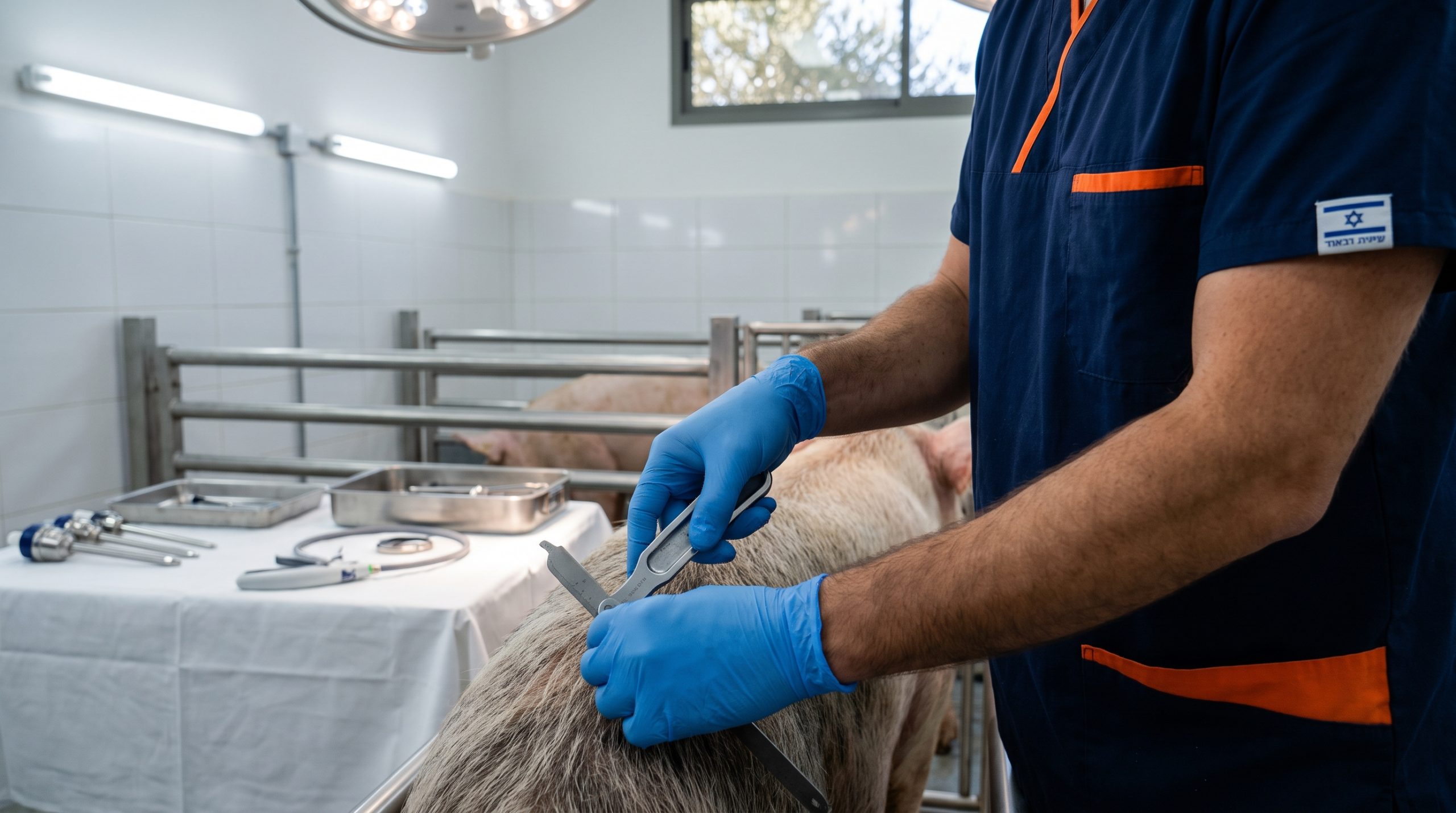
Animal selection is a technical decision, not a logistical convenience. Weight determines abdominal working space, port geometry, bowel diameter and wall thickness — all of which affect whether human instrumentation performs as intended in pig model gastrointestinal procedures.
Matching Size to Instruments and Surgical Approach
Laparoscopic procedures generally require sufficient abdominal volume for insufflation and triangulation, while endoscopic work depends on esophageal and gastric dimensions matching the scope platform. Circular staplers, in particular, must be matched to realistic luminal diameters, or the study will validate a size that does not exist clinically.
Age Considerations in Survival and Healing Studies
Younger animals grow rapidly, which can confound long-term implant fit and healing interpretation; older or minipig cohorts stabilize that variable. The same size-and-age logic guides other platforms in our facility, from orthopedics to ophthalmology research in pigs, where organ dimensions define instrument compatibility.
Mini-Pig or Domestic Pig? A Practical Comparison for Your GI Study
Minipigs bring predictable adult weight, manageable handling and stable anatomy over long follow-up, which is why they are favored for chronic implant and pharmacology work. Domestic pigs offer excellent availability, robust anatomy, larger tissue volume and lower cost, making them highly effective for acute feasibility, surgical training and short survival windows in a porcine GI model.
| Consideration | Minipig | Domestic pig |
|---|---|---|
| Growth over study period | Slow and predictable | Rapid; relevant beyond a few weeks |
| Best fit | Long-term survival, chronic implants | Acute studies, training, short survival |
| Handling and housing | Easier at chronic timepoints | Straightforward at typical study weights |
| Tissue volume | Adequate, smaller scale | Generous for multi-sample harvesting |
| Decision driver | Study duration and endpoint timing | Cost, availability, anatomical scale |
Transparency and Trust: Documentation and Deliverables You Should Expect
A commercial study is only as valuable as its paper trail. Reporting frameworks such as the ARRIVE 2.0 guidelines explanation and elaboration define what complete animal research reporting entails, and they translate directly into practical deliverables for sponsors.
Operative Reports and Raw Data
Each procedure should generate a report covering surgical steps, timing, device identifiers and lot numbers, intraoperative findings, anesthesia and monitoring records, and any deviation with its rationale. Raw measurement files, imaging exports and clinical scoring sheets are supplied in organized, traceable form rather than as summary statements.
Sample Chain-of-Custody
Tissue samples require labeled orientation, fixation timing, transfer records and histology requisitions. At Biotech Farm, well-documented procedures, scientific escort throughout the project and an interactive conference room for real-time protocol discussion are part of how sponsors keep control of their own dataset.
Ensuring Consistency: Our Reproducibility Methodology
Reproducibility in pig model gastrointestinal procedures is engineered, not hoped for. It begins with written SOPs for fasting, induction, positioning, port placement, anastomotic technique, closure and sampling, and continues with the same trained surgical team performing the same steps in the same sequence across every animal.
Statistical planning — group size, randomization, allocation and blinding of assessors — is agreed before execution. Measurement protocols specify instrument settings, timepoints and acceptable tolerances, so that a burst pressure recorded in week one is comparable to one recorded in week six.
Defining explicit success criteria for each critical step allows the team to identify, in real time, when a procedure has departed from plan. Every deviation is logged with time, cause and corrective action, producing a dataset that withstands external scrutiny.
What a Sponsor Actually Needs — and How the Facility Delivers It
Preclinical programs rarely fail for lack of ideas; they stall on scheduling, missing documentation or a model that does not match the device. The table below maps common research needs to the practical capabilities that support them.
| Research need | How the facility supports it in practice |
|---|---|
| Realistic surgical environment | Large operating rooms with C-Arm fluoroscopy, HD and cardiac ultrasound, 4K laparoscopic towers and surgical microscopy |
| Protocol design and refinement | Scientific escort from feasibility to final report, with senior surgeons and 30+ years of research management experience |
| Regulatory-grade documentation | Well-documented procedures, GLP-oriented validation practice, structured operative reports and traceable raw data |
| Animal welfare compliance | Spacious animal housing, dedicated veterinary care, refinement-driven husbandry and defined humane endpoints |
| Iterative device development | Flexible scheduling of acute and survival cohorts, matching needs and services rather than fixed packages |
Timeline and Logistics: Planning a Porcine GI Surgical Study
A realistic program runs in three phases. Planning takes days to several weeks and includes protocol writing, ethics submission, animal sourcing, device logistics and a pilot discussion. Execution is measured in procedure days, determined by cohort size, anesthesia duration and the complexity of each construct. Follow-up applies only to survival designs and extends to the defined endpoint.
Analytical turnaround adds time: gross pathology is immediate, but histology processing, sectioning, staining and blinded scoring typically add weeks. Sponsors who plan histology capacity in advance avoid the most common schedule slip. Because Biotech Farm coordinates surgery, imaging, husbandry and sample handling under one roof, transitions between phases are shorter and fewer external dependencies enter the critical path — an advantage that matters most for teams working toward a submission or investor milestone.
Compliance and Ethics: Regulatory Adherence in Pig GI Research
Animal experimentation in Israel operates under the Animal Welfare (Animal Experiments) Law, 1994, which establishes the national council, institutional committees, permit requirements and supervisory duties. Studies require ethics committee approval demonstrating that no valid alternative exists, that the minimum number of animals is used, and that suffering is minimized throughout.
The 3Rs — Replacement, Reduction, Refinement — are not a slogan but an operating framework: replacing animal work where bench or ex vivo models suffice, reducing group sizes through efficient multi-site designs within a single animal, and refining anesthesia, analgesia and husbandry continuously. Veterinary oversight accompanies every stage, from acclimatization through recovery. Animals housed with genuine, attentive care are calmer, healthier and produce cleaner physiological data — welfare and scientific quality are inseparable in practice.
Frequently Asked Questions About Porcine GI Studies
Ready to Define Your Porcine GI Protocol?
Which question is your program trying to answer first — acute feasibility, device durability, or long-term healing? Bring your device, your endpoints and your timeline, and our scientific and surgical team will help translate them into a workable, ethically approved and fully documented porcine GI protocol.