Pilot Study vs. Pivotal Study in Preclinical Research: A Comprehensive Guide for Biotech Companies
The path from a promising molecule to a first-in-human clinical trial is paved with carefully sequenced preclinical decisions. Two study categories anchor this path: the pilot study, designed to reduce uncertainty and refine methods, and the pivotal preclinical study, engineered to generate the definitive, regulator-ready evidence that supports human exposure. Confusing the two — or skipping the first in favor of the second — is a common and costly mistake. This guide unpacks the practical, scientific, and regulatory distinctions between the two study types so biotech teams can allocate resources wisely and move forward with confidence.
20+ Years Large-Animal Expertise
GLP-Aligned Pivotal Programs
IND-Enabling Study Support
The single most impactful decision in preclinical development is often the simplest: knowing when you are still learning versus when you are ready to prove. A well-designed pilot can save six months and hundreds of thousands of dollars by preventing a GLP pivotal study from failing due to avoidable design flaws. Treat the pilot as an investment, not a shortcut.
What Exactly Separates a Pilot Study from a Pivotal Preclinical Study?
A pilot study in preclinical research is a small, targeted experiment intended to test feasibility, characterize variability, and refine protocols before larger investments are made. It is exploratory in nature and typically runs under non-GLP conditions. The pivotal preclinical study, by contrast, is the study that generates primary evidence for a major development or regulatory decision — most often an IND or CTA submission.
Its objective is not to learn, but to confirm. Pivotal studies typically follow GLP, use pre-specified statistical plans, and carry the documentation burden required for regulatory scrutiny.
Pilot Study (Non-GLP)
A fast, small-scale experiment aimed at answering practical questions: Is the animal model appropriate? Can the administration route be executed reliably? What is the variability of the primary endpoint? What is a reasonable starting dose? Delivers variability estimates, protocol modifications, and a clearer design blueprint for downstream work.
Pivotal Study (GLP)
Explicitly built to support decision-making — most commonly, whether a compound can safely enter human trials. These studies adhere to Good Laboratory Practice (GLP), with full data traceability, Quality Assurance oversight, protocol lock, and archived records. They are the studies that regulators read when deciding to grant IND clearance.
Is a Feasibility Study the Same as a Pilot Study?
The terms are frequently used interchangeably, but they answer different questions. A feasibility study asks “Can this be done?” — evaluating whether a model is suitable, an endpoint measurable, or a procedure executable. A pilot study asks “How should we do it?” — running a miniature version of the intended experiment to expose weaknesses in dose selection, timing, sampling, or analytical methods before a definitive study is designed.
In practice, feasibility and pilot elements are often combined, especially in large-animal work where model, device, and procedural variables interact. The scientifically supportive escort provided at Biotech Farm helps clients scope these early studies precisely so that no effort is wasted duplicating what a single, well-designed exploratory phase can deliver.
- Feasibility: “Can we do this?” — model suitability, endpoint measurability, procedure viability
- Pilot: “How should we do this?” — dose refinement, timing, sampling, analytical method stress-testing
- In large-animal work: Both are frequently combined into a single exploratory phase
Comparison Table: Pilot vs. Pivotal Preclinical Studies at a Glance
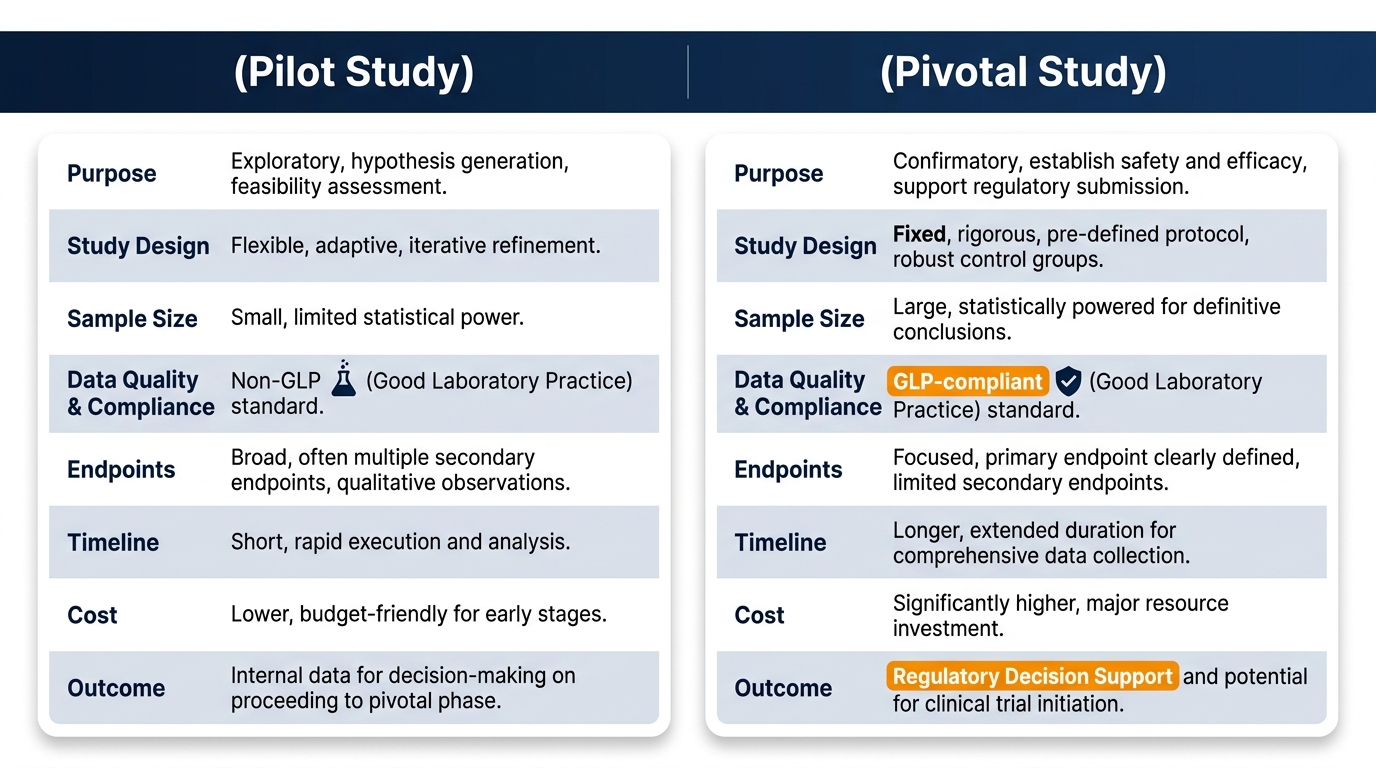
| Attribute | Pilot Study (Non-GLP) | Pivotal Study (GLP) |
|---|---|---|
| Primary Purpose | Learn, refine, de-risk | Confirm, support regulatory decision |
| Sample Size | Small, exploratory | Powered per pre-specified plan |
| Regulatory Standard | Non-GLP (scientifically robust) | GLP-compliant |
| Protocol Flexibility | Adaptable during execution | Locked; deviations formally documented |
| QA Oversight | Optional / limited | Mandatory throughout |
| Data Archiving | Working records | Full traceability, long-term archive |
| Typical Output | Dose ranges, refined SOPs, variability estimates | Submission-ready final report |
| Regulatory Use | Internal decision-making | IND / CTA submissions |
The Regulatory Landscape: When GLP Becomes Non-Negotiable
Whether a study must be conducted under GLP depends on its intended use. Non-GLP work is scientifically valid and often preferable during early exploration, when learning speed matters more than formal documentation. GLP becomes mandatory once the study is intended to support human exposure — particularly for safety pharmacology and toxicology studies submitted to regulators.
The OECD Principles on Good Laboratory Practice define the quality system underpinning these submission-grade studies, covering QA, SOPs, archiving, and data traceability.
✅ When Non-GLP Pilot Is Sufficient
- Proof-of-concept work and model evaluation
- Technique refinement and dose range-finding
- Early MTD assessments for hypothesis generation
- Internal optimization without regulatory intent
⚠️ When GLP Becomes Mandatory
- Studies intended to support human exposure
- Safety pharmacology and pivotal toxicology
- Any data included in IND or CTA submissions
- Studies subject to ICH M3(R2) or ICH S6(R1) requirements
The scientific quality of a non-GLP study can be very high, but its formal quality architecture is lighter. GLP mandates: Study Director designation, QA unit involvement, change control, archived raw data, and formal reporting. Non-GLP studies operate without these formal requirements — which allows faster iteration but excludes results from use as primary regulatory evidence.
Exploratory vs. Confirmatory: Two Different Scientific Mindsets
Beyond the GLP/non-GLP axis lies an equally important distinction: exploratory vs. confirmatory preclinical research. Exploratory studies generate hypotheses and probe mechanisms with flexibility and breadth. Confirmatory studies test a single, pre-specified hypothesis under strict controls with a locked analysis plan.
The scientific literature — including the widely cited discussion in PMC on distinguishing exploratory from confirmatory preclinical research — emphasizes that failure to separate these mindsets is a major driver of translational failure.
“Failure to separate exploratory and confirmatory thinking is one of the most pervasive and underappreciated contributors to translational failure in biomedical research.”
— PMC / National Library of Medicine, Preclinical Research Standards
Is a Pilot Study Exploratory or Confirmatory?
Most pilots are exploratory or feasibility-focused: they gather preliminary data, refine methods, and stress-test assumptions. Occasionally a pilot carries a confirmatory element — for example, verifying that a critical assay produces stable readings before the pivotal study is initiated. But the overall intent remains preparatory rather than definitive.
Scenario: A Biotech Facing the Pilot-or-Pivotal Decision
Consider a company developing a novel implantable cardiovascular device. The team has strong bench data and a validated large-animal model, but the delivery catheter is a new iteration. Should they go straight to GLP pivotal safety?
A short non-GLP pilot to verify catheter handling, procedural reproducibility, and imaging endpoints will save months of rework — almost certainly the right call before committing to a full GLP pivotal program.
A company with a well-characterized small molecule that has already completed DRF studies elsewhere may legitimately proceed directly to a GLP pivotal toxicology program. This decision-making process is central to navigating regulatory compliance in preclinical research.
Quick Screening Questions to Guide the Choice
Three practical questions typically resolve the pilot-vs-pivotal debate:
Common Mistakes Teams Make When Designing Pilot Studies
The most frequent error is asking a pilot study to do too much. A small, exploratory experiment cannot deliver conclusive efficacy claims, nor can its data be submitted to regulators as primary safety evidence.
- Over-scoping the pilot: Small exploratory experiments cannot deliver conclusive efficacy claims or serve as primary regulatory safety evidence.
- Under-documenting findings: Lessons cannot transfer cleanly into the pivotal design if documentation is insufficient.
- Running without pre-defined objectives: Treating the pilot as a “rehearsal” without explicit goals leaves the team with data but no decisions.
Well-scoped pilots have narrow, explicit objectives: estimate variability, establish a dose range, validate a measurement method, or train personnel. Anything broader dilutes the value of the exercise.
What Should a Pilot Study Actually Deliver?
A well-executed non-GLP pilot produces “decision-ready” outputs — not raw data, but a design blueprint that materially reduces the risk of the pivotal study failing. These typically include:
What Should a Pivotal Preclinical Study Deliver?
A pivotal study must produce a comprehensive, submission-ready final report. This includes fully traceable raw data, pre-defined statistical analyses, QA statements, detailed deviation logs, and clear justifications for any protocol amendments.
Required elements are strict, because the report will be read by regulators against the ICH M3(R2) and, for biologics, ICH S6(R1) frameworks. These deliverables are essential for IND-enabling toxicology submissions and must withstand line-by-line regulatory scrutiny.
- Fully traceable raw data with long-term archiving
- Pre-defined statistical analysis plan (executed without post-hoc modification)
- Quality Assurance unit statements and audit trail
- Detailed deviation log with impact assessments
- Compliance with ICH M3(R2) and/or ICH S6(R1) as applicable
How Pilot Data Sharpens the Pivotal Design
The most tangible value of a pilot is its contribution to sample size calculation for the pivotal study. Pilot data provides variance estimates — standard deviation or coefficient of variation — that anchor realistic power calculations.
Effect sizes observed in pilots can be inflated (a phenomenon sometimes called the “winner’s curse”), so most statisticians recommend leaning more heavily on variability estimates than on preliminary effect estimates when powering the pivotal.
Dose Range-Finding and MTD Studies vs. Pivotal Toxicology
DRF and MTD studies are canonical pilot formats. They select the dose levels and identify early toxicity signals that will define the pivotal design. Pivotal toxicology studies, in contrast, are comprehensive GLP investigations that characterize the full safety profile at selected doses over defined durations. This detailed safety assessment, often starting with a single dose toxicity study, is foundational for regulatory approval.
Metrics and Checks: How to Judge a Pilot’s Success
| Metric | What It Tells You | How It Informs the Pivotal Study |
|---|---|---|
| Endpoint variability (SD/CV) | Reliability of the measurement | Drives sample size calculation |
| Dose tolerability | Upper bound of exposure | Defines high-dose selection |
| Procedural success rate | Operator and protocol robustness | Refines SOPs and training requirements |
| Assay performance | Analytical readiness | Confirms method suitability for GLP |
| Model relevance | Translational validity | Locks the model choice for pivotal |
Biotech Farm’s Approach Across the Pilot-to-Pivotal Continuum

Biotech Farm operates as a large-animal preclinical facility with more than thirty years of research management experience. The infrastructure is designed to accommodate both rapid non-GLP pilot work and the more structured demands of pivotal safety studies. Scientific escort is embedded throughout — study design, model selection, endpoint definition, and reporting — so that the transition from exploratory learning to confirmatory evidence generation happens without procedural gaps.
| Business Need | How Biotech Farm Supports It |
|---|---|
| Rapid protocol iteration in early development | Non-GLP pilot environment with experienced surgical and imaging teams for large-animal models |
| Complex device or procedural feasibility | Fully equipped surgery rooms with C-Arm fluoroscopy, high-definition ultrasound, and 4K laparoscopic towers |
| IND-ready safety evidence | Pivotal, GLP-aligned toxicology programs with full documentation and traceability |
| Multi-phase preclinical planning | Scientific escort connecting feasibility, pilot, and pivotal phases into one coherent program |
| Ethical and welfare compliance | Adherence to the 3Rs — Replacement, Reduction, Refinement — with well-documented procedures |
Ensuring Compliance and Quality Along the Way
Regulatory compliance in preclinical research demands adherence to international guidelines and a commitment to documented quality. We adhere to relevant guidelines, including ICH M3(R2) and ICH S6(R1) for general nonclinical safety and biotechnology-derived pharmaceuticals. Processes are designed to support seamless transitions from feasibility and non-GLP pilot studies into GLP pivotal preclinical safety studies, giving clients a clear path toward IND submissions.
“Understanding whether a given study should be exploratory or confirmatory is often the pivot point of an entire program. We help partners weigh model maturity, endpoint stability, and regulatory timing before committing to a study category — a decision that shapes cost, timeline, and downstream regulatory acceptance.”
— Adir Koreh, CEO, Biotech Farm Ltd.
Frequently Asked Questions
Ready to Design Your Next Preclinical Study?
Whether you are scoping an early non-GLP pilot to reduce methodological uncertainty or preparing a GLP pivotal program to support an IND submission, does your current study plan clearly separate what needs to be learned from what needs to be proven?

This article is provided for educational and informational purposes. Always consult with qualified regulatory and scientific advisors for guidance specific to your development program. References to regulatory frameworks (ICH M3(R2), ICH S6(R1), OECD GLP Principles) reflect publicly available guidelines and do not constitute legal or regulatory advice.