Preclinical Project Management CRO: The Operational Backbone Behind Successful Studies
Behind every preclinical program that reaches its data lock on time and within budget, there is a disciplined layer of coordination that most sponsors underestimate. A preclinical project management CRO function is not administrative overhead — it is the mechanism that translates a scientific protocol into a controlled sequence of decisions, materials, samples, and deliverables. This article explores how strong CRO project management shapes preclinical outcomes, where projects tend to fail, and how to evaluate a partner not only on its science but on its ability to execute predictably.
Expert Operational Insight
Most preclinical projects do not fail because the science was wrong — they fail because coordination broke down. Assumptions were never stated, milestones were interpreted differently by each party, and document versions multiplied without control. A disciplined PM layer is the single most effective risk-reduction investment a sponsor can make before a study initiates.
What Is Preclinical Project Management in a CRO?
Preclinical project management inside a Contract Research Organization is the end-to-end orchestration of outsourced non-clinical activities: planning, coordination, monitoring of timelines, budgets, and quality, and continuous risk management until data and final reports are delivered. In practical terms, CRO project management means setting clear scope expectations, defining milestones, coordinating regulated documents, tracking test articles and samples, controlling scope changes, and closing the project properly.
When a sponsor chooses to outsource preclinical project work, the PM becomes the single point of accountability that keeps scientific intent aligned with operational reality — from kickoff through archival.
Distinguishing “Scientific Management” from “Operational Management”
Scientific management is the responsibility of the Study Director, who owns GLP compliance, interpretation of data, and the scientific integrity of the report. Operational management belongs to the Project Manager, who orchestrates logistics, communication, and dependencies. According to OECD guidance on the Study Director role, scientific accountability cannot be delegated — but without a PM shielding the Study Director from operational noise, even the best science stalls.
Study Director
GLP-accountable, owns scientific integrity, interprets data, signs the final report.
Project Manager
Operationally accountable, orchestrates logistics, communication, milestones, and budget control.
Sponsor
Approves scope, provides test article, owns strategic decisions, and responds to exceptions in a timely manner.
Why Do Preclinical Projects Fail Without Strong Project Management?
Most preclinical projects do not fail because the science was wrong. They fail because coordination broke down: assumptions were never stated, materials arrived late, milestones were interpreted differently by each party, and document versions multiplied without control.
- Scope creep from informal verbal agreements
- Shipping delays on test articles and reagents
- Protocol inconsistencies discovered mid-study
- Discrepancies between raw data and final reports
- Painful, repeated revision cycles on deliverables
Effective preclinical study management counters this with transparency, timely decision-making, and structured exception handling. As ISRAC explains regarding GLP implementation, the entire purpose of quality principles is to ensure data reliability — which requires management discipline as much as scientific rigor.
Day-to-Day: What a CRO Project Manager Actually Does
A CRO project manager is the connective tissue between sponsor, laboratory, animal facility, bioanalytical teams, and QA. On any given day the PM runs status meetings, updates action item trackers, escalates risks, coordinates QA reviews, plans resources, monitors budget against burn, controls document versions, and confirms that data will be delivered in the agreed format.
In preclinical project management CRO engagements, the discipline is not glamorous — it is the daily practice of turning ambiguous requests into documented decisions with owners and dates.
Reports and Tools a PM Should Provide
Sponsors should expect the following minimum reporting artifacts from a mature preclinical project management CRO:
Weekly Status Report
RAG-flagged milestone overview, open decisions, and top risks with owners.
RAID Log
Risks, Assumptions, Issues, Dependencies — tracked and owned.
Gantt Chart
Critical path with dependencies visible and updated in real time.
Deliverables Tracker
Format, owner, planned date, and actual date for every output.
Decision Log
Every decision documented with rationale, date, and approver.
Coordinating Multiple CROs Under One Preclinical Program
When a sponsor runs a program across several vendors — say, an in-life CRO, a bioanalytical lab, and a pathology reader — the risk is not the science of each vendor, but the seams between them. Strong preclinical study management introduces a single integration layer: a master plan, shared milestones, and a decision mechanism that prevents contradictory instructions.
Owners are named per deliverable, communication SLAs are agreed, and dependencies are explicitly mapped (bioanalysis depends on sampling timing; toxicology conclusions depend on test article QC).
A Simple RACI Model for Preclinical Studies
| Activity | Sponsor | CRO PM | Study Director | QA | Bioanalytical |
|---|---|---|---|---|---|
| Protocol approval | A | R | R | C | I |
| Sampling schedule | C | R | A | I | C |
| Data lock | A | R | R | C | C |
| Final report | A | C | R | C | I |
R = Responsible | A = Accountable | C = Consulted | I = Informed
When Is It Right to Outsource Preclinical Projects — and When Is It Not?
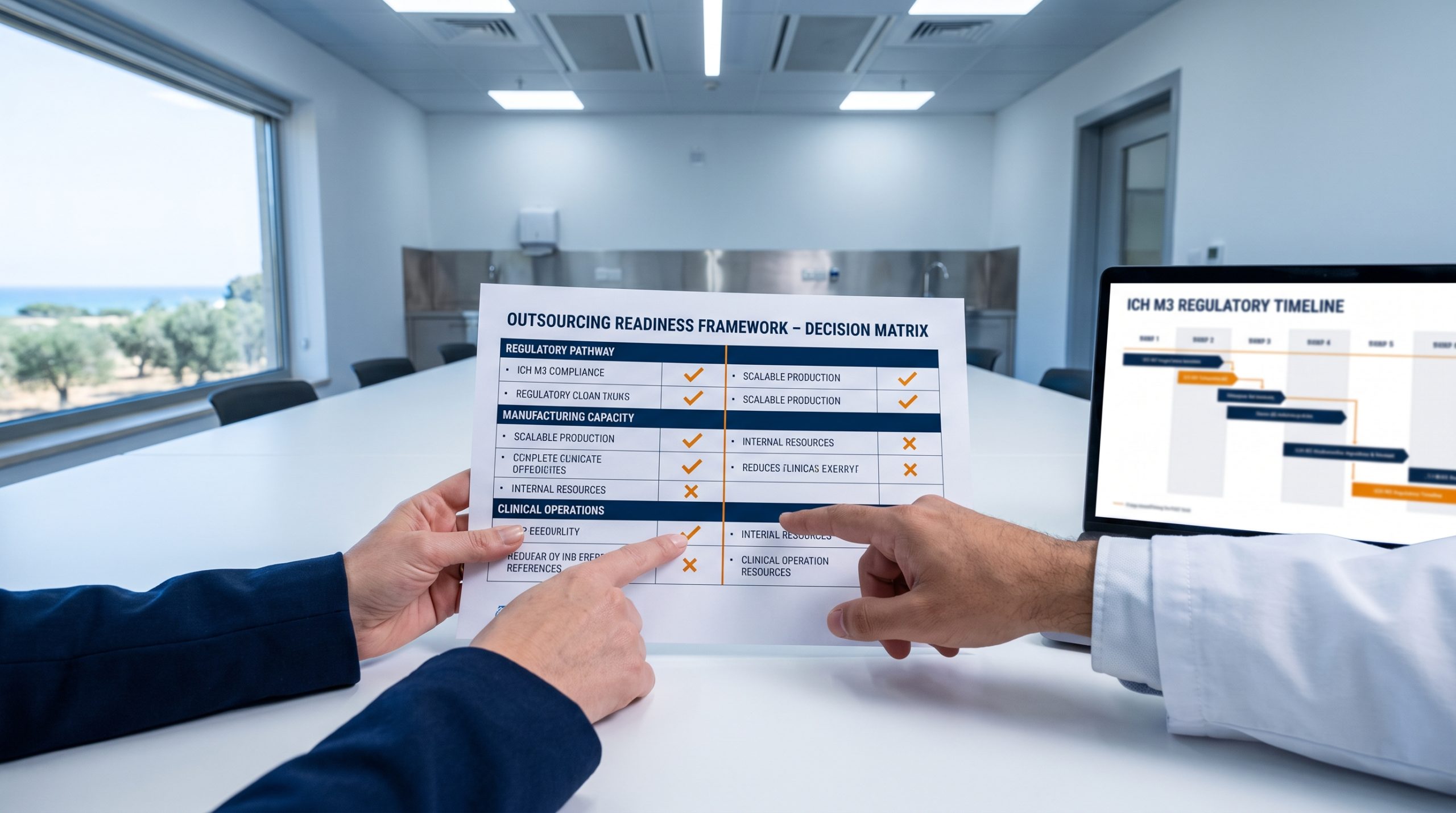
Outsourcing is the right choice when internal infrastructure, capacity, or specialized expertise is lacking, or when the program requires timelines that cannot be met in-house. It is the wrong choice when the sponsor cannot own critical decisions internally, or when requirements are still ambiguous.
- Lacking specialized facility or equipment
- Parallel execution required at speed
- Defined objectives and success criteria in place
- Test article prepared and released
- Sponsor cannot own critical decisions
- Requirements and endpoints still ambiguous
- No internal champion to manage the relationship
- Test article not yet manufactured or qualified
Regulatory context matters as well; ICH M3(R2) shapes the timing and scope of non-clinical safety studies, and therefore the realistic timelines a CRO can commit to. Sponsors evaluating partners often review Biotech Farm’s unique approach to understand how a specialized CRO structures collaboration around such decisions.
Choosing a CRO Based on Project Management — Not Just Science
Two CROs may be scientifically comparable and still deliver very different experiences. The differentiator is management maturity. Evaluate transparency of milestones, the change control process, QA independence, regulatory reporting experience, and the ability to deliver data consistently in the required format.
“In preclinical project management CRO selection, the essential questions are simple: Who is the actual PM — name and availability? What does a weekly status report look like? How are deviations handled?”
— Biotech Farm, Preclinical PM Framework
Due Diligence Questions Checklist for the First Meeting
| Area | Question to Ask | Strong Answer Looks Like |
|---|---|---|
| PM Assignment | Who is my PM and what is their load? | Named PM, defined capacity |
| Status Cadence | What does weekly reporting include? | RAID + milestones + budget |
| Change Control | How is scope change priced and approved? | Written Change Order process |
| Data Delivery | In what format and when? | Defined structure, dictionary, dates |
| Deviations | How are they logged and reported? | QA-reviewed deviation log |
Study Director vs. Principal Investigator vs. Project Manager
Confusing these three roles is one of the most common causes of governance gaps. The Study Director is scientifically and GLP-accountable for the entire study. A Principal Investigator may lead a defined scientific or operational segment, often at a test site distinct from the main facility. The Project Manager is operationally accountable — planning, coordinating, controlling — ensuring that everything happens on time and at the required quality.
This separation, described in the OECD Principles of Good Laboratory Practice, prevents scientific progress from outrunning documentation, and prevents documentation from stalling scientific progress.
- Study Director: GLP-accountable, owns scientific integrity, signs the final report — cannot delegate this accountability.
- Principal Investigator: Leads a defined segment at a specific site; reports to the Study Director.
- Project Manager: Operationally accountable for planning, control, and communication across all parties.
Deliverables That Must Be Defined Upfront in a Preclinical Project
Deliverables should never be discovered late. Everything required for decision-making and regulatory submission must be listed at kickoff: approved protocol, raw data, statistical analysis, final report, Certificates of Analysis, supply chain documentation, and deviation records. Format matters as much as content: Excel or CSV structure, file naming conventions, draft and final dates, and the number of review cycles.
When sponsors outsource preclinical project work, ambiguity in deliverables is the most expensive form of ambiguity.
“Hidden” Deliverables Often Missed
Three deliverables are frequently underestimated and cause the most friction at study close:
Data Dictionary
What each column means and its units — the difference between data and interpretable data.
Sample Inventory
Chain of custody and retention records — essential for any future reanalysis or audit.
Audit Trail
Who did what and when — ALCOA+ compliance and the gateway to submissible data.
Building a Realistic Preclinical Timeline
Realistic timelines are constructed from dependencies, not from optimism. The critical inputs are model or animal availability, test article manufacture and release, QA review windows, sampling schedules, analytical turnaround, and report writing time. Classic delay factors include protocol changes after initiation, test articles that do not meet specification on arrival, poor shipping planning, and lack of resource availability at the CRO during peak periods.
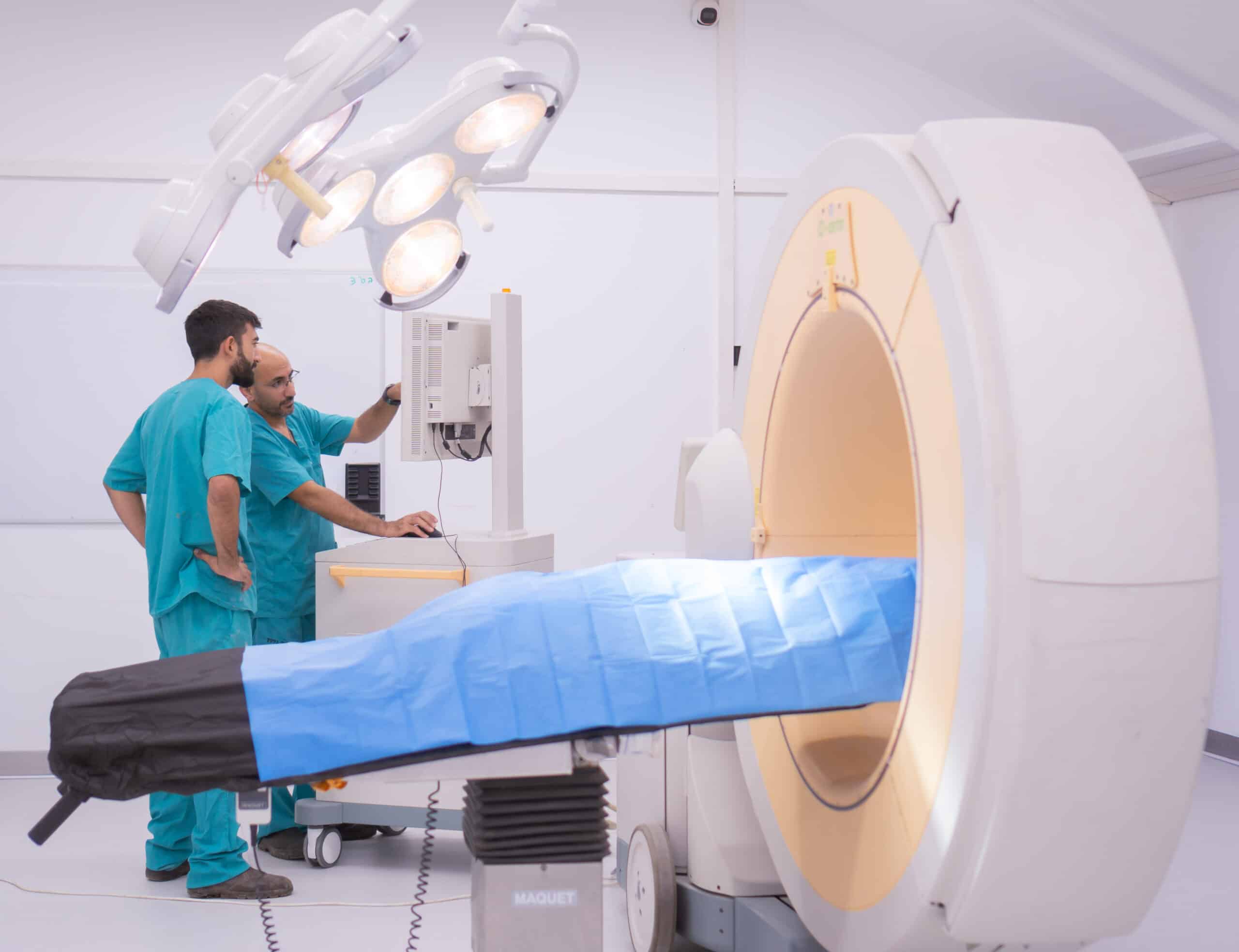
Certain activities carry unusually specific timeline considerations — for example, preclinical imaging services often depend on equipment scheduling, contrast agent availability, and reader turnaround, all of which the PM must sequence with the in-life schedule.
Recommended Milestones for a Defensible Plan
| # | Milestone | What It Locks |
|---|---|---|
| 1 | Kickoff | Roles, cadence, scope baseline |
| 2 | Protocol Final | Scientific design, endpoints |
| 3 | In-Life Start | Animals, materials, readiness |
| 4 | Last Sample | End of in-life phase |
| 5 | Data Lock | No further data changes |
| 6 | Draft Report | Sponsor review window |
| 7 | Final Report | Archival, closure |
Preventing Scope Creep and Budget Overruns
Scope creep in CRO project management rarely arrives as a single event. It accumulates through informal requests, verbal agreements, and “small” additions that only surface at invoicing. The antidote is a sharp Statement of Work, a formal Change Order mechanism, and transparent pricing for deviations.
Every change should carry a description, its impact on timeline and cost, written approval, and a corresponding update to the work plan. In effective contract research project management, the PM centralizes this discipline so that both sides see the same picture in real time — eliminating “invoice surprises” at the end of the project.
???? Scope Change Control — Required Elements
- Written description of the change and its scientific rationale
- Impact assessment: timeline, cost, resources
- Written approval from named sponsor representative
- Updated work plan, budget, and milestone tracker
- Entry in the decision log with version reference
KPIs to Measure in Preclinical Project Management
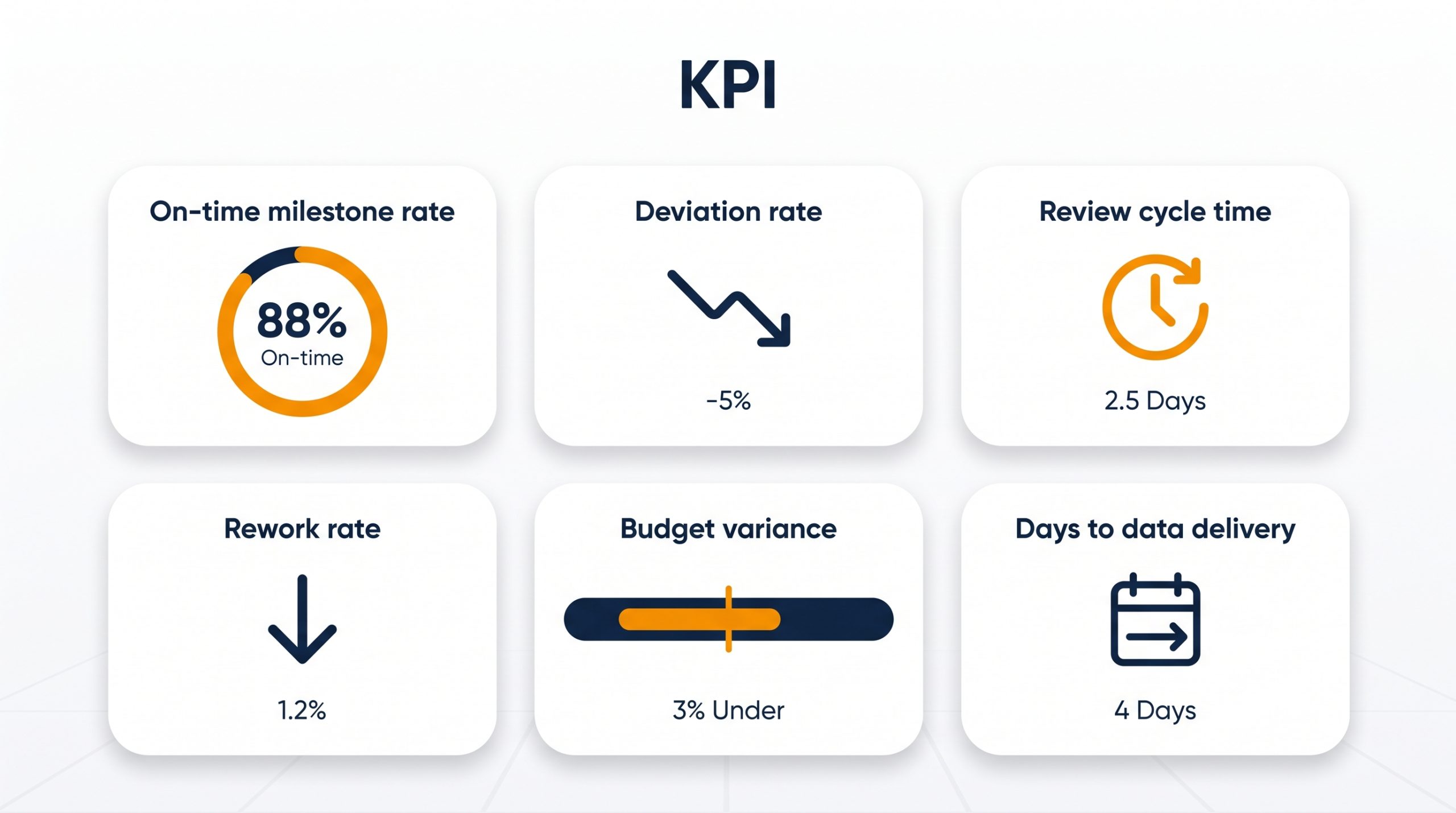
Without measurement, “the project is going well” is an opinion. KPIs turn it into a fact. Useful indicators cover time, quality, and transparency.
| KPI | What It Measures | Healthy Signal |
|---|---|---|
| On-time milestone rate | Schedule adherence | > 85% |
| Deviation rate | Process control | Low, well-documented |
| Review cycle time | Sponsor + CRO responsiveness | Defined and stable |
| Rework rate | Quality of first pass | Trending down |
| Budget variance | Financial discipline | Within agreed band |
| Days to data delivery | Speed after data lock | Predictable, contracted |
Minimal PM Dashboard a Sponsor Should See Weekly
At minimum: milestone status with a red/amber/green flag, top three risks with mitigation owners, open decisions awaiting sponsor input, deviations since last update, and budget-to-date against plan. Anything longer tends to be ignored; anything shorter hides problems.
What a Proper Kickoff Looks Like
A good kickoff closes gaps before the study begins. It confirms objectives, roles, communication protocols, data formats, known risks, and the agreed timeline. It also establishes a contact list, meeting cadence, response SLAs, and an organized document repository with version control and templates.
In contract research project management, kickoff is not a ceremony — it is the working session where ambiguity becomes documented commitment. Sponsors engaging comprehensive preclinical research and development services often use kickoff to align across surgical, imaging, and pathology workstreams simultaneously.
- Study objectives and primary/secondary endpoints
- Named roles: PM, Study Director, sponsor contact, QA lead
- Communication cadence and response SLAs
- Data format, file naming conventions, and delivery dates
- Known risks and pre-identified mitigation owners
- Document repository location and version control protocol
- Agreed milestone plan with signed baseline
Managing Communication and Documentation to Prevent Knowledge Loss
Knowledge loss between teams is usually caused by fragmented storage and unclear ownership. A Single Source of Truth is essential: a decision tracker with dates, version control on every controlled document, and meeting summaries with named action owners.
Define upfront where documents live, how files are named, and who approves what — so no one ever has to choose between “two correct versions.” This directly reflects ALCOA+ principles referenced across accreditation frameworks and is a core reliability requirement of any serious preclinical project management CRO engagement.
“Every decision must be documented with a date and a named owner. If it was not written down, it did not happen — and in regulated research, that distinction can invalidate an entire study.”
— Adir Koreh, CEO, Biotech Farm Ltd.
Contract Research Project Management vs. In-House Project Management
Internal project management focuses on people, priorities, and internal politics. Contract research project management shifts the emphasis to contracts, deliverables, and vendor relationships. The PM must manage legal aspects of the agreement, external quality systems, communication protocols with a separate legal entity, and the interfaces between the sponsor’s decision-making and the vendor’s execution.
It is a different discipline, and treating it as identical to in-house PM is one of the most common mistakes sponsors make. Readers exploring the breadth of outsourced engagements can review Biotech Farm’s latest articles for practical perspectives.
- Focused on internal people and priorities
- Shared organizational culture and systems
- Informal escalation paths available
- No contractual interface complexity
- Focused on contracts, deliverables, vendor SLAs
- External quality systems and audit rights
- Formal change control and decision documentation
- Separate legal entity interface management
How Biotech Farm Supports Preclinical Project Management
Biotech Farm’s approach to preclinical study management is built around a few relative advantages that sponsors consistently value. First, a dedicated project manager acts as a single accountable point of contact, which reduces coordination overhead when sponsors outsource preclinical project activities across surgical, imaging, and analytical workstreams. Second, communication is structured around documented decisions and scheduled reporting, so risks surface early rather than during final review. Third, the facility integrates in-life work, imaging, and reporting under a unified operational plan, which shortens the seam between activities.
| Sponsor Need | How It Is Supported in Practice |
|---|---|
| Predictable timelines | Milestone plan built on dependencies, updated weekly |
| Regulatory-ready documentation | Protocols, deviations, and reports aligned with GLP expectations |
| Fewer coordination gaps | Named PM and consolidated integration across workstreams |
| Transparent scope control | Formal Change Order process with written approvals |
| Reliable data delivery | Defined formats, data dictionary, and audit trail |
Sponsors can learn more about our facility and how its infrastructure supports robust preclinical studies with consistent operational execution.
Frequently Asked Questions
Ready to Plan Your Next Preclinical Program with Predictable Execution?
If your team is preparing to launch a study and wants operational execution that matches the quality of your science — how would a dedicated project management layer change the way you plan your next timeline? To discuss your program in detail, contact Biotech Farm and start a conversation with a team that treats project management as a scientific enabler, not an afterthought.